















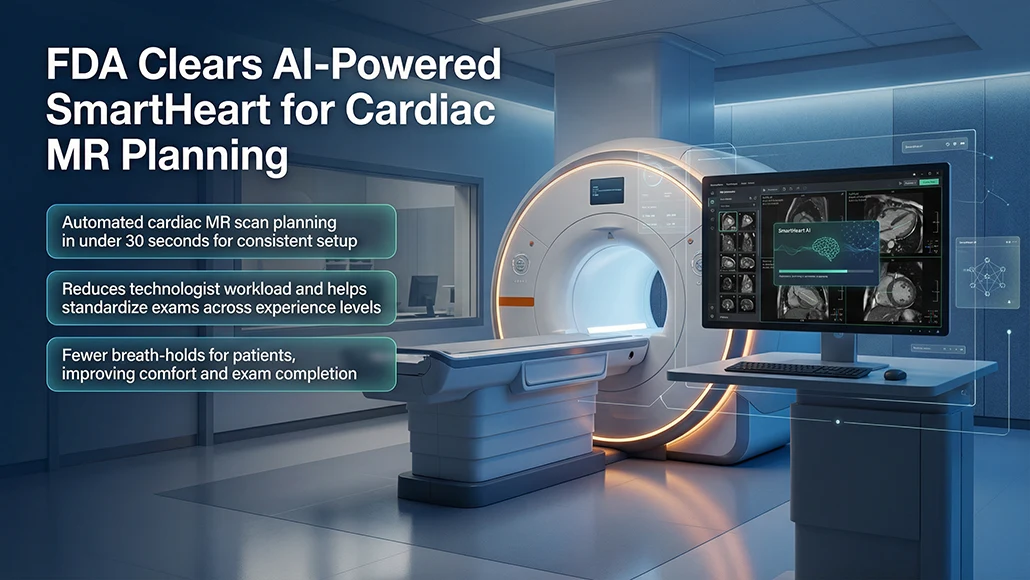

Philips announced that it has received FDA 510(k) clearance for its SmartHeart planning solution, an AI-powered cardiac magnetic resonance (MR) planning solution designed to simplify one of the most demanding MRI exams. The system automates scan planning in under 30 seconds, helping make cardiac MR exams more consistent and easier to perform across clinical environments.
Cardiac MR imaging has traditionally required highly experienced operators due to the complexity of the procedure. Technologists must manage intricate scan planning, coordinate breath holds and adapt to patient-specific anatomical variations. By integrating AI directly into the planning workflow, SmartHeart automates these steps with a single click. This approach enables more stable workflows, reduces operator workload and supports consistent image quality during cardiac MR examinations. The system automatically plans 14 standard and advanced cardiac views in less than 30 seconds. According to Philips, the technology was trained using 1,200 cardiac MR datasets, enabling the AI to perform reliably across a wide range of patient anatomies.
Philips, headquartered in Amsterdam, said the solution can help healthcare systems manage ongoing staffing shortages while demand for advanced imaging continues to grow. By reducing operator variability and improving workflow consistency, the company said SmartHeart helps expand access to cardiac MR imaging for technologists with varying levels of experience. The platform is also designed to improve the patient experience, with Philips noting that SmartHeart can reduce the number of breath holds for basic views by up to 75%. This can improve comfort for patients, including those with dyspnea, arrhythmias, pediatric patients, or anxiety.
SmartHeart is part of Philips’ expanding portfolio of AI-enabled cardiac MR innovations. Following the FDA clearance, the platform can now deliver additional technologies including CINE FreeBreathing, Cardiac Motion Correction (MoCo) and CardiacQuant Perfusion. CINE FreeBreathing enables diagnostic-quality imaging without requiring breath holds, supporting patients who cannot hold their breath or who experience irregular heart rhythms. Cardiac MoCo corrects for both cardiac and respiratory motion to provide robust insights that support a more definitive diagnosis. Philips developed CardiacQuant Perfusion to deliver non-invasive, non-ionizing quantitative assessment of myocardial perfusion, enabling clinicians to evaluate subtle perfusion deficits more objectively.
Ioannis Panagiotelis, business leader, MR at Philips, said: “Cardiac MR is one of the most powerful tools available to assess the heart, yet its complexity and exam length have historically constrained its broader clinical impact. With SmartHeart embedded directly into the planning workflow, Philips is fundamentally redefining how CMR is performed – transforming it from a highly specialized, time-intensive procedure into a streamlined, intelligent, and scalable solution. This empowers clinicians to deliver consistent, precision cardiac care to significantly more patients.”