













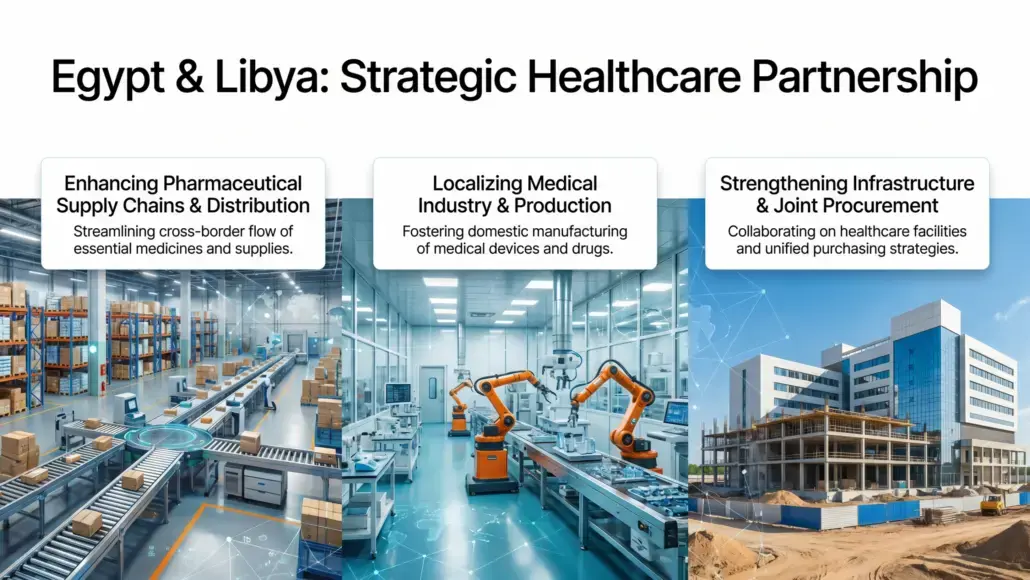

Officials from Egypt and Libya have convened to explore expanding collaboration within the healthcare sector, concentrating on pharmaceutical distribution, the development of domestic medical manufacturing capabilities, professional training initiatives, and medical facility improvements. During discussions held between high-ranking representatives of both nations, attention centered on reinforcing existing ties and fostering knowledge exchange in healthcare advancement.
The Chairperson of Egypt’s Unified Procurement Authority, Hisham Stait, hosted Libya’s Minister of Health Mohamed Al-Fouj alongside a delegation that included Mohamed Al-Atouq (Advisor to the Minister for Pharmaceutical Affairs), Adel Al-Tajouri (Director of Planning), Sondos Azzam (Director of International Cooperation), Adnan Issa (Director of the Minister’s Office), and Hannibal Khamaj. Both delegations underscored the historical significance of Egypt-Libya healthcare cooperation and reaffirmed their determination to deepen partnership across multiple healthcare dimensions as part of broader regional integration and development objectives.
Stait provided an overview of Egypt’s Unified Procurement Authority, contextualizing its importance within the country’s comprehensive healthcare reform strategy. The authority functions as one of five foundational institutions designed to modernize Egypt’s healthcare infrastructure and operates as the centralized body responsible for acquiring pharmaceuticals, medical supplies, and medical equipment. This centralized approach ensures adherence to quality benchmarks while simultaneously achieving financial efficiency across the healthcare system.
The authority has catalyzed notable expans ion within Egypt’s pharmaceutical manufacturing base. The number of pharmaceutical production facilities has grown substantially, increasing from roughly 150 to approximately 180 factories in recent years. Alongside this manufacturing growth, significant achievements have been realized in domestically producing medical supplies and equipment, reducing dependence on imported products.
To encourage companies to participate in Egypt-Libya healthcare cooperation through localization programs, the authority provides structured incentive mechanisms. These include off-take agreements and assured market participation guarantees, designed to attract investment and strengthen domestic manufacturing capabilities across the medical sector.
Stait detailed Egypt’s network of strategic medical warehouses, constructed in accordance with international operational standards. These facilities maintain secure reserves of medicines, medical supplies, and medical equipment. The warehouses employ sophisticated technological infrastructure and intelligent management systems to guarantee pharmaceutical and medical security while ensuring product availability and integrity.
The Libyan delegation demonstrated considerable enthusiasm for Egypt’s strategic warehouse approach, identifying it as an exemplary model of contemporary medical supply chain management. Ministers and advisors expressed their intention to leverage Egyptian technical expertise and operational knowledge to enhance Libya’s own medical supply infrastructure.
Al-Fouj recognized Egypt’s instrumental role in advancing healthcare delivery standards throughout the region and conveyed Libya’s commitment to benefiting from Egyptian knowledge, particularly regarding medical industry localization, professional development initiatives, and sourcing Egyptian pharmaceuticals and medical supplies.
Egyptian pharmaceutical and medical products are recognized for meeting rigorous quality requirements and maintaining internationally accredited certifications. This positioning strengthens their potential contribution to Libya’s healthcare modernization efforts and the enhancement of medical services delivered to Libyan populations. Al-Fouj indicated that accessing such high-standard products would substantially support healthcare advancement for Libyan citizens.
Both parties concluded their discussions with a commitment to sustained coordination on advancing healthcare collaboration initiatives. Ongoing dialogue will focus on pharmaceutical distribution channels, medical industry localization opportunities, and healthcare service development. These collaborative efforts are directed toward achieving reciprocal benefits for both Egypt and Libya as they work toward strengthened healthcare systems and improved medical outcomes.