












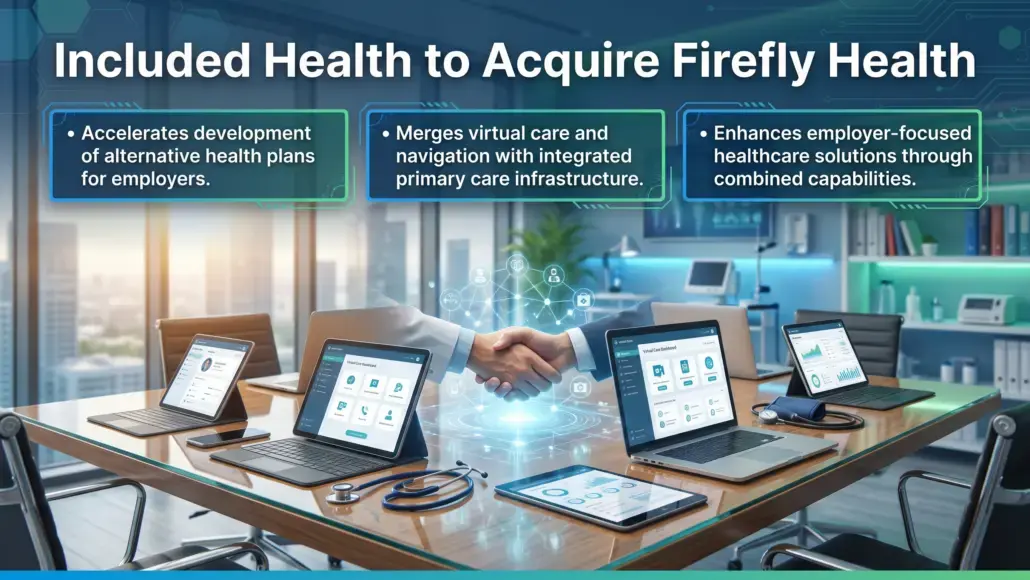
Included Health has announced plans to acquire Firefly Health in a strategic move to accelerate its development of alternative health plans for employers. The acquisition brings together Included Health’s virtual care and navigation platform with Firefly Health’s clinically integrated primary care and health plan infrastructure. Based in San Francisco, Included Health provides a comprehensive suite of virtual and in-person care coordination services, while Watertown-based Firefly Health offers a model that combines primary care, mental healthcare, and specialty navigation. This integration is designed to address the increasing demand for high-engagement benefit models that can effectively lower total cost of care without compromising quality.
The deal is expected to close in the third quarter of 2026, subject to standard regulatory review. Owen Tripp, CEO of Included Health, noted that the goal is to merge Firefly’s clinically integrated health plan with Included Health’s AI-native navigation and clinical scale. “Over time, the goal is to bring together Firefly’s clinically integrated health plan with Included Health’s AI-native navigation, clinical platform, and scale to create a single, connected benefits experience for employers and members nationwide,” Tripp stated. He added that the combination is designed to integrate plan design, administration, and comprehensive care to reduce friction and improve employee health.
Strategic Integration of Primary Care and Navigation
The acquisition follows Included Health’s recent launch of a new plan design centered on primary care and transparent upfront costs. This model leverages an AI assistant named Dot for 24/7 member support, ensuring that patients can access immediate answers or be seamlessly transitioned to human support when necessary. By incorporating Firefly’s ecosystem—which includes more than 2,300 in-person, in-home, and specialty partners—Included Health can offer a more robust infrastructure for alternative health plans. This architecture aligns financial incentives so that high-quality, primary care-led interventions become the most affordable choice for both the employer and the member.
Firefly Health CEO Fay Rotenberg highlighted that the traditional healthcare model often fails to deliver the results employers require, necessitating a shift toward dynamic plan design. “Firefly flips the traditional model on its head. We’ve built a true health plan alternative where advanced primary care, data-driven navigation, and dynamic plan design work in harmony,” Rotenberg stated. She observed that together with Included Health, the organization is bringing a trust-first model to a national stage, providing the technology and clinical reach required to serve employers across various geographies.
Addressing Rising Healthcare Costs for Employers
The move comes at a time when employers are facing record-high healthcare expenditures. According to data from the Business Group on Health, approximately 17% of employers have already adopted non-traditional or alternative health plans, with another 36% considering such models for the near future. Included Health’s strategy aims to leverage network optimization and a concierge member experience to create a sustainable path to long-term savings. Tripp emphasized the shared belief that investing in primary care and navigating members toward high-quality providers are the primary levers for reducing unnecessary medical costs while maintaining access to essential services.
While the financial terms of the acquisition were not disclosed, the combined entity is positioned to provide a unified benefits experience that simplifies administration for HR leaders. By bringing together care delivery and plan architecture, the partnership seeks to deliver clinical and financial results that follow naturally from aligned incentives. As the healthcare industry continues to move toward value-based models, the integration of Firefly Health into the Included Health platform represents a significant expansion of the available tools for employers seeking to modernize their health benefit offerings and stabilize their long-term clinical outcomes.