












The global landscape of medicine production is undergoing a profound metamorphosis driven by the rapid convergence of digital innovation and advanced mechanical engineering. As the demand for personalized medicine grows and regulatory scrutiny intensifies, the adoption of pharmaceutical manufacturing technology trends has transitioned from a competitive advantage to a fundamental necessity for survival. This evolution is not merely about replacing manual labor with machines but involves the total reimagining of the production lifecycle to ensure that efficacy, safety, and scalability remain uncompromised in an increasingly volatile global market.
The Rise of the Smart Factory and Pharma 4.0
At the core of this transformation is the concept of the smart factory, often referred to as Pharma 4.0. Unlike traditional facilities where data silos often hinder decision-making, smart factories utilize interconnected systems that communicate in real-time. By integrating the Internet of Things (IoT) with sophisticated manufacturing execution systems, companies can now achieve a level of visibility that was previously unthinkable. This interconnectedness allows for the continuous monitoring of every variable, from ambient humidity in a cleanroom to the precise torque of a tablet press, ensuring that every batch meets the highest quality standards without the need for retrospective testing.
Autonomous Systems and Robotics in Production
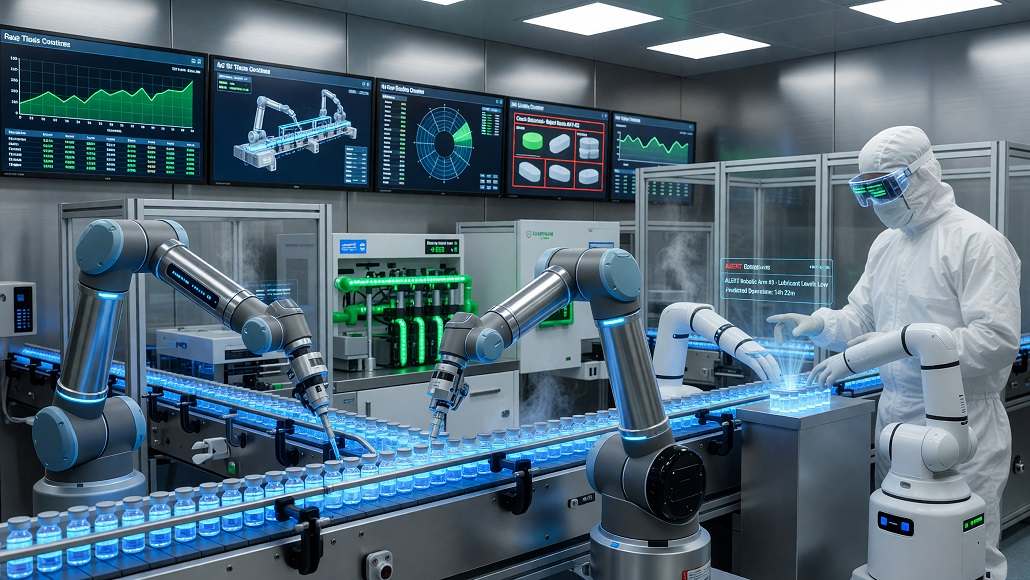
Within these smart environments, the role of pharma automation has expanded significantly. Robotics are no longer confined to simple packaging tasks but are now deeply embedded in the more sensitive stages of the manufacturing process. High-precision robotic arms are increasingly used in aseptic filling lines, where human intervention is the primary source of contamination. By removing the human element from sterile manufacturing zones, companies can significantly reduce the risk of batch failures while simultaneously increasing the speed of production. These autonomous systems are designed to operate with a degree of precision and repeatability that manual processes cannot match, which is critical when dealing with high-potency drugs or delicate biologics.
Digital Quality Systems and Real-Time GMP Compliance
Regulatory adherence remains the most significant hurdle in the pharmaceutical industry, and the shift toward digital quality systems is revolutionizing how companies maintain GMP compliance. The transition from paper-based logs to electronic batch records (EBR) has done more than just reduce clutter; it has created an environment of “compliance by design.” In a digital system, every action is timestamped and verified against predefined SOPs in real-time. If a deviation occurs, the system can immediately halt the process, preventing the waste of expensive raw materials and ensuring that only compliant products reach the market.
Advanced Analytics for Predictive Maintenance
One of the most impactful pharmaceutical manufacturing technology trends is the use of big data and predictive analytics to manage facility health. Traditional maintenance schedules often involve either over-servicing equipment, which is costly, or waiting for a failure, which leads to downtime. Predictive analytics uses sensor data to identify the early warning signs of mechanical wear, allowing technicians to intervene before a breakdown occurs. This proactive approach ensures that the pharma supply chain remains robust and that production schedules are not derailed by unforeseen equipment failures.
The Impact of Continuous Manufacturing on Scalability
The shift from batch processing to continuous manufacturing represents one of the most significant architectural changes in the history of drug production. While batch manufacturing requires large facilities and significant downtime for cleaning and verification between lots, continuous manufacturing allows for a steady flow of materials through the production line. This not only reduces the physical footprint of the factory but also allows for much faster scale-up during public health emergencies. The ability to adjust production volumes simply by running the line for longer periods, rather than building new batch facilities, provides a level of agility that is essential for modern pharmaceutical manufacturing technology trends.
Enhancing Global Supply Resilience
The global disruptions of recent years have highlighted the fragility of traditional supply networks. In response, manufacturers are leveraging digital twins and supply chain mapping tools to build greater resilience. By creating a virtual model of the entire supply chain, companies can simulate various “what-if” scenarios, from natural disasters to geopolitical shifts. This allows for the development of robust contingency plans and the diversification of sourcing strategies, ensuring that life-saving medications continue to reach patients regardless of external pressures.
Artificial Intelligence and Machine Learning in Formulation and Process Optimization
The role of artificial intelligence in pharmaceutical manufacturing technology trends has transitioned from theoretical exploration to practical implementation. AI algorithms are now being used to analyze vast datasets from past production cycles to identify the optimal conditions for drug formulation. This level of analysis, which would take a team of human scientists months to complete, can be accomplished in minutes. By identifying the subtle correlations between temperature, humidity, and chemical stability, AI-driven systems can suggest minor adjustments to the manufacturing process that result in significantly higher yields and more consistent product quality.
Autonomous Quality Control and Visual Inspection
In the final stages of production, AI-powered vision systems are replacing human inspectors for the detection of defects in tablets, capsules, and vials. These systems use deep learning models trained on millions of images to identify even the most minute imperfections, such as hairline cracks in glass or subtle discolorations in a coating. Unlike human inspectors, who may suffer from fatigue and variability, these autonomous systems provide consistent, high-speed inspection that ensures 100% of the product meets the required specifications. This advancement in pharmaceutical manufacturing technology trends is a critical component of maintaining zero-defect production in high-volume environments.
Sustainable Manufacturing and the Green Pharma Movement
As global concerns regarding environmental impact grow, pharmaceutical manufacturing technology trends are increasingly focused on sustainability. Traditional drug manufacturing is often energy-intensive and produces significant chemical waste. To address this, many companies are adopting “green chemistry” principles and integrating energy-efficient technologies into their smart factories. This includes the use of biocatalysts, which operate at lower temperatures and produce fewer toxic byproducts, as well as the implementation of advanced water recycling systems that minimize the facility’s overall footprint.
Waste Reduction through Precision Dosing
Precision manufacturing technologies are also playing a major role in waste reduction. By using highly accurate dosing systems, manufacturers can ensure that every milligram of active pharmaceutical ingredient (API) is utilized effectively, reducing the amount of material that is lost during the filling and finishing process. This focus on resource efficiency not only benefits the environment but also significantly reduces the cost of production, making life-saving medications more affordable for patients worldwide.
The Workforce of the Future and the Digital Skills Gap
The rapid adoption of these technologies has created an urgent need for a new type of pharmaceutical worker. The traditional image of a factory worker is being replaced by that of a data-literate technician who can manage complex software systems and collaborate with robotic assistants. This shift in pharmaceutical manufacturing technology trends requires a massive upskilling effort across the industry. Companies are increasingly investing in virtual reality (VR) and augmented reality (AR) training programs, which allow workers to practice complex procedures in a safe, simulated environment before stepping onto the production floor.
Collaborative Robots and Human-Machine Interaction
Rather than replacing humans entirely, many of the newest pharmaceutical manufacturing technology trends focus on enhancing human capabilities. Collaborative robots, or cobots, are designed to work alongside human operators, taking over repetitive or physically demanding tasks while the human worker focuses on high-level decision-making and quality oversight. This symbiotic relationship between man and machine is a hallmark of the modern pharma facility, where technical expertise and digital fluency are equally valued.
Cybersecurity: Protecting the Interconnected Factory
As factories become more connected, they also become more vulnerable to cyber threats. A significant portion of pharmaceutical manufacturing technology trends is now dedicated to ensuring the integrity and security of production data. A single breach could not only result in the loss of proprietary intellectual property but could also compromise the safety of the medication itself if production parameters were maliciously altered. To combat this, manufacturers are implementing multi-layered security protocols, including blockchain for secure data sharing and advanced intrusion detection systems that monitor network traffic for any signs of suspicious activity.
Ensuring Data Integrity and Traceability
Data integrity is the bedrock of GMP compliance, and the use of blockchain technology is emerging as a powerful tool in this area. By creating an immutable ledger of every step in the manufacturing and distribution process, blockchain ensures that the data cannot be altered after the fact. This provides an unprecedented level of transparency and traceability, allowing regulators and patients to verify the authenticity and quality of a medication with absolute certainty. This focus on digital trust is one of the most critical pharmaceutical manufacturing technology trends of the current era.
Future Outlook: From Mass Production to Personalized Medicine
Looking ahead, the ultimate goal of these pharmaceutical manufacturing technology trends is to enable the production of personalized medicines at scale. The current “one-size-fits-all” approach to drug manufacturing is gradually giving way to a model where medications can be tailored to an individual patient’s genetic profile or specific clinical needs. This requires a level of manufacturing flexibility that is only possible through the widespread adoption of modular production units and 3D printing technologies.
3D Printing and Modular Production Units
3D printing, or additive manufacturing, is already being explored for the production of complex dosage forms that are difficult to create using traditional methods. This technology allows for the precise control of drug release profiles and the combination of multiple APIs into a single “polypill.” When combined with modular production units self-contained manufacturing pods that can be easily transported and deployed these advancements will allow for localized production, bringing life-saving treatments closer to the point of care.
The integration of these advanced technologies is not without its challenges, particularly regarding the high initial capital investment and the need for a global regulatory framework that can keep pace with innovation. However, the benefits of embracing pharmaceutical manufacturing technology trends are undeniable. As the industry continues to move toward more complex modalities like cell and gene therapies, the reliance on automation, digital quality systems, and smart factory architecture will only increase. By investing in these foundational technologies today, manufacturers are not only ensuring compliance and efficiency but are also paving the way for the next generation of medical breakthroughs that will define the future of global healthcare.