













A Harvard-led study has found that advanced artificial intelligence systems can outperform human physicians in emergency room diagnostics and management tasks, marking a significant development in clinical decision-making capabilities. The findings, published in Science, demonstrate that AI models can match or exceed expert-level performance in high-pressure medical environments, particularly during early-stage triage when limited information is available. This AI emergency triage advancement signals a notable shift in how digital tools may be integrated into frontline healthcare delivery.
Study Design and Key Findings
The research, conducted by teams from Harvard and Stanford, evaluated OpenAI’s “o1 preview” reasoning model across multiple clinical scenarios. The AI system was tested on 76 real emergency room cases in a Boston hospital, with performance assessed at three critical stages: initial triage, first physician interaction, and patient admission.
Key outcomes include:
- The AI achieved diagnostic accuracy of 67% in early-stage triage, compared to 50–55% for human physicians
- Accuracy increased to 82% with additional patient information, versus 70–79% for doctors
- In management reasoning tasks, including treatment planning, the AI scored 89%, significantly outperforming physicians at 34%
- The system demonstrated strong capability in identifying rare and complex diseases using established clinical case benchmarks
These findings highlight the growing capability of AI emergency triage systems to process structured medical data and deliver high-quality clinical reasoning under time-sensitive conditions.
Clinical and Operational Implications
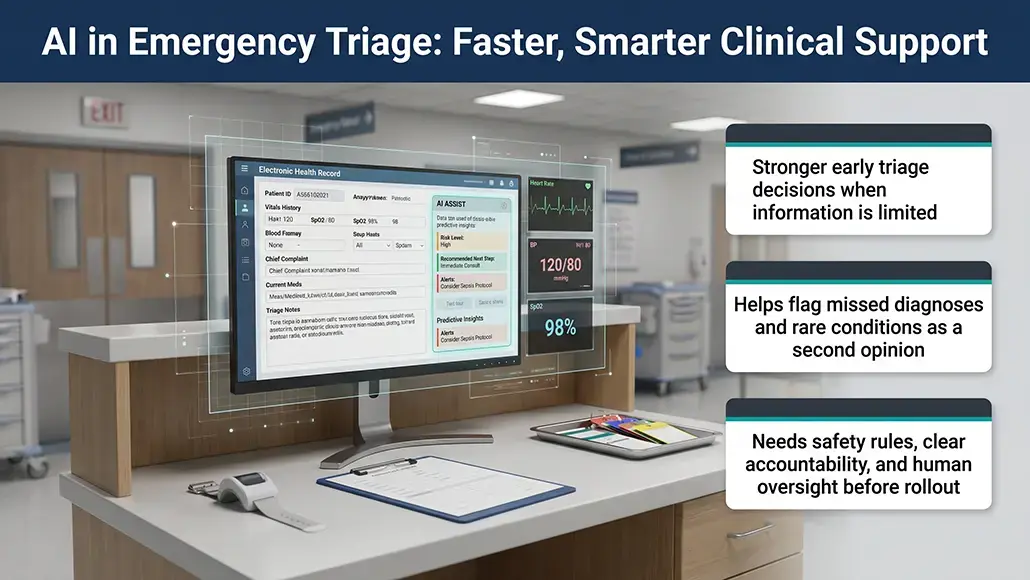
The study underscores the potential of AI to augment healthcare workflows, particularly in emergency departments where rapid decision-making is critical. Researchers noted that AI systems could serve as a second-opinion tool, helping physicians identify diagnostic errors or overlooked conditions by analyzing electronic health records in real time.
According to the findings, AI models excel in environments where data is primarily text-based, enabling them to synthesize patient histories, vital signs, and clinical notes efficiently. This capability positions AI as a valuable support mechanism in triage processes, where incomplete or noisy data often complicates decision-making.
Regulatory and Safety Considerations
Despite the promising results, researchers emphasized that the study does not support replacing physicians with AI. The evaluation was limited to text-based inputs, excluding critical clinical elements such as imaging, physical examinations, and patient interaction cues.
Concerns around accountability, liability, and patient safety remain unresolved. There is currently no standardized regulatory framework governing AI-driven clinical decisions, raising questions about responsibility in cases of diagnostic error. Additionally, experts highlighted the risk of over-reliance on AI outputs, which could influence independent clinical judgment.
The study calls for controlled, prospective clinical trials to assess the safe deployment of AI systems in real-world healthcare environments.
Strategic Outlook for Healthcare Systems
The findings suggest that AI will play an increasingly collaborative role in clinical practice rather than acting as a replacement for human expertise. Researchers anticipate a hybrid care model where physicians, patients, and AI systems operate in tandem to improve outcomes.
The technology’s strength in complex case analysis and rare disease identification further reinforces its potential as a decision-support tool in specialized care pathways. However, its limitations in interpreting non-textual data and contextual patient factors highlight the continued importance of human oversight.
From an industry perspective, HHM Global notes that this development reflects a broader shift toward AI-enabled healthcare delivery, where digital tools are positioned to enhance and not replace clinical expertise.