











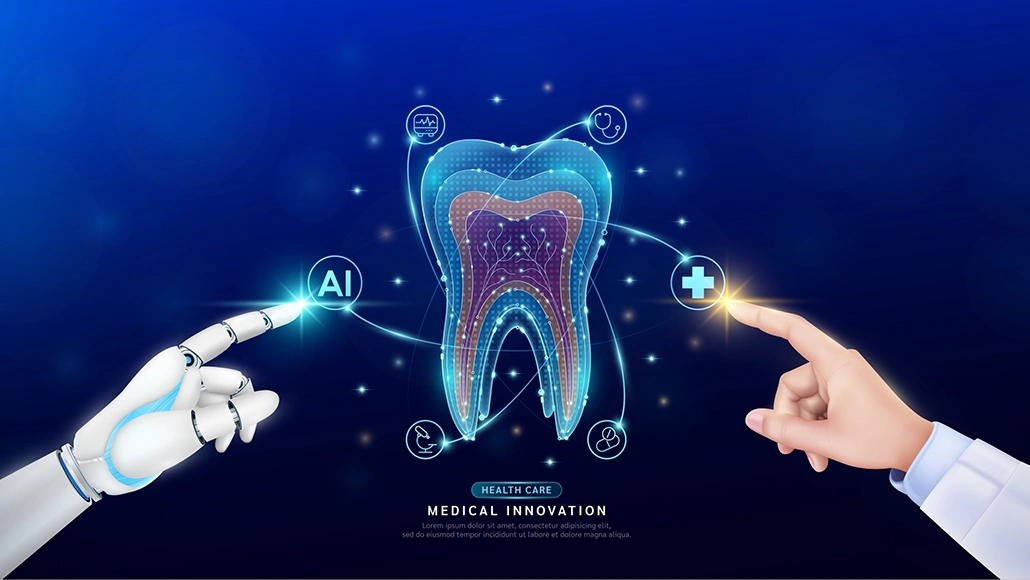
A digital dental revolution is in full swing as dental professionals incorporate advanced digital technologies into their practices. Digital case planning, artificial intelligence (AI) models, and digital radiographic imaging provide greater accuracy and predictive power, while intraoral 3D scanning and 3D printing are changing the future of tooth restoration. By leveraging these cutting-edge tools, dentists enhance efficiency, precision, treatment outcomes, and patient satisfaction.
Delivering a measurable impact
AI and robotics in dentistry have evolved into a multilayered ecosystem of tools that affect nearly every aspect of practice operations and patient care. The clearest measurable impact of these tools is evident in the following categories:
- Diagnostic imaging. Several U.S. Food and Drug Administration (FDA)-cleared AI tools integrate directly with most imaging software and significantly affect case acceptance and diagnostic consistency. Patients can see what the doctor sees, often for the first time.
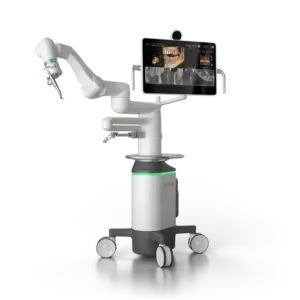
- Restorative and surgical robotics. Robotics are beginning to transform clinical procedures and laboratory workflows. There is currently one FDA-cleared robotic-assisted dental surgery system for implant placement, with additional next-generation platforms emerging. In surgical applications, robotic tools help clinicians execute treatment plans, particularly in complex cases where submillimeter accuracy is essential. Robotics also augments associate training by providing guided workflows with real-time support. Beyond the practice, dental laboratories are leveraging robotic automation to mill restorations and manufacture prosthetics with greater speed and consistency. As robotics technology matures, its role is expected to expand into additional treatment and workflow applications.
- Practice operations and revenue cycle. Some technologies can automate insurance verification, recall management, scheduling optimization, and after-hours patient communication. Voice AI agents now handle inbound call triage and appointment booking. This is where the return on investment (ROI) is often most defensible, as labor savings are quantifiable. Newer analytics tools not only calculate key performance indicators (KPIs) but also flag outliers and trends for review, uncovering issues that warrant attention while leaving interpretation and action to the clinician.
- Clinical documentation and patient education. Ambient scribes auto-populate clinical notes from chairside conversations. Some systems also document periodontal findings, improving efficiency and reducing administrative burden. Patient education platforms translate findings into language patients can more easily understand while maintaining Health Insurance Portability and Accountability Act (HIPAA) compliance.
- Associate dentist onboarding and calibration. Various diagnostic AI software platforms help calibrate newly hired associate dentists to a practice’s established standard of care. For example, a preoperative radiograph and results from the AI imaging software help clinicians evaluate whether diagnoses and treatment plans meet the practice’s clinical expectations.
These technologies are shaping the future of dentistry by enhancing operational efficiency, increasing precision, optimizing treatment outcomes, and boosting patient satisfaction.
Improving overall patient care
AI can enhance patient care within clinical workflows in several ways. For example, research shows that AI matches or exceeds general practitioner sensitivity for interproximal caries detection on bitewings, periapical lesion detection on periapical radiographs (PAs), and bone-loss measurement on full-mouth series. AI does not replace the doctor’s review. Rather, it uncovers what fatigue, time pressure, or visual habituation might cause clinicians to miss on the 18th radiograph of the day.
AI can also aid treatment planning. In prosthodontics, AI-driven smile design and full-arch planning tools compress hours of mockup work into minutes. The doctor still directs the case, but AI reduces manual workload and planning time.
In patient education, visual annotations of a patient’s radiograph or scan, combined with AI-driven highlighting and color coding, are more persuasive than stock illustrations. Predictive analytics that identify which patients are at risk of periodontal progression, implant failure, or recall attrition are emerging, but are not yet mature enough for unsupervised clinical decision-making. Used as flagging tools, however, they can provide meaningful value.
Reshaping dental education and training
Dental education has historically been slow to adopt new technology, as curriculum changes require accreditation review and faculty buy-in. AI is driving the issue faster than computer-aided design and computer-aided manufacturing (CAD/CAM) did previously, accelerating the pace of change throughout dental education and training.
In predoctoral education, schools are integrating AI-assisted radiograph interpretation into preclinical and clinical training. Students learn to interpret radiographs with and against AI output, which reinforces fundamental diagnostic skills. They then defend why they agree or disagree with the model’s interpretation.
Prosthodontics, oral surgery, and oral and maxillofacial surgery (OMFS) programs are integrating digital workflows that are now AI-enhanced by default. A resident graduating today has likely used guided surgery, AI-assisted cone-beam computed tomography (CBCT) segmentation, and digital denture workflows, experiences that the previous generation often did not encounter until years into practice.
Keys to successful AI and robotic integration
It’s crucial to carefully evaluate the trade-offs of integrating AI and robotics into the dental industry and practice workflows. When AI and robotics are successfully incorporated, the clinical team is not talking about AI, and the doctor is not fighting the software. Instead, the team uses it effectively, and the doctor trusts the software to provide a valuable second opinion. Patients are not confused; they are more informed.
Successful integration also means that the doctor reviews AI findings before a patient sees them. Treatment coordinators are trained on how to discuss AI-flagged findings without overstating certainty. Front-desk staff are redeployed from verification to relationship-building roles. Workflow KPIs such as case acceptance, accounts receivable (A/R) days, no-show rates, and production per hour are tracked before and after implementation. This helps practice owners analyze spending and improve profitability.
Clinicians have several factors to consider when incorporating AI and robotics. For example, a robotic system might make sense for a practice that places 200 or more implants per year, but not for one that places 30 annually. Diagnostic AI scales down to almost any practice. Robotics typically do not.
It is essential to consider speed versus relationships. Voice AI can answer every call in two rings, but a personal voice on the line may be part of the brand for high-end, fee-for-service practices. The right answer is likely a hybrid approach. Being deliberate about maintaining clinical autonomy is another important consideration. Let technology influence what clinicians see, not what they diagnose.
Finding the balance between technology and human contact
Practices ultimately determine how to adopt AI to enhance, not diminish, patient experience and the human element of care. For example, use AI to remove friction, not replace presence, by automating tasks like insurance verification, recall reminders, and postoperative follow-up. Fiercely protect elements of care, such as the doctor’s time at the chair, the assistant’s hand on the patient’s shoulder, and the coordinator’s eye contact during treatment presentations.
Make AI visible correctly. When patients see their CBCT with AI-annotated findings, the response is almost always “Now I understand.” When experiencing AI as an automated text that misreads the situation, the response is “This practice doesn’t know me.”
It’s vital that a practice’s AI approach is hybrid by default. Voice AI can handle a call at 11 p.m., but a human needs to return the call the next morning. An automated text confirms the appointment, but a person greets the patient at the door. The patient experiences continuity, and the practice gains efficiency.
Audit the patient journey at least quarterly. Determine where patients feel acknowledged and where they feel processed. AI tends to optimize what is easy to measure, which isn’t always what matters.
The clinicians who thrive will sharpen their fundamentals while using AI as a second set of eyes and a workflow accelerator. AI will either deepen the human element of dentistry or hollow it out. Protect the moments where presence and judgment matter. The practices getting this right will own the next decade of dentistry.