

















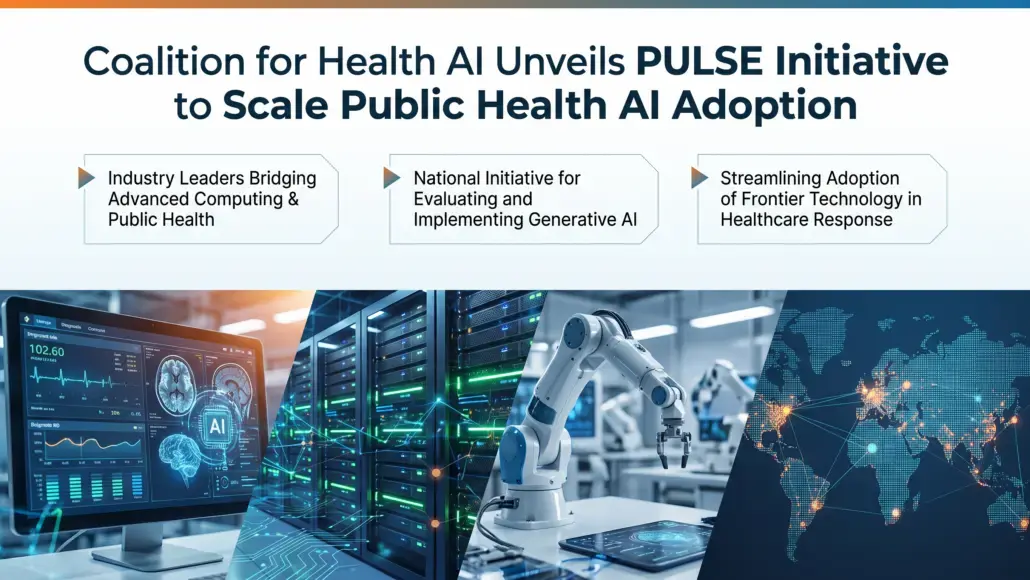

The modernization of national public health infrastructure is entering a new phase of technological integration as industry leaders move to bridge the gap between advanced computing and governmental healthcare response. In a significant effort to streamline the adoption of frontier technology, the Coalition for Health AI (CHAI) officially launched a national initiative on Thursday designed to assist public health agencies across the United States in the evaluation and implementation of generative AI solutions. Known as PULSE (Public health Use case and Learning Scaling Engine), the program provides a structured framework for agencies to responsibly scale these technologies within secure and governed environments. The initiative is supported by strategic contributions from OpenAI and Anthropic, which have collectively donated 10 enterprise licenses, providing approximately 2,000 seats for public health practitioners to test and deploy AI tools in real-world settings.
The PULSE initiative arrives at a critical juncture for public health teams that are increasingly tasked with expanding their operational capacity despite constrained resources. Elizabeth Kelly, head of beneficial deployments at Anthropic, emphasized that the program is designed to provide the necessary guardrails and privacy protections required for sensitive health data. “PULSE matters because it lets practitioners test these tools in their own environments, with privacy, governance, and responsible use built in from the start,” Kelly stated. Applications for the program are currently open through August 6, with participants being selected by CHAI’s leadership council. The selected 10 jurisdictions will each be permitted to register up to 200 team members to participate in specialized use case communities during the six-month program.
Strategic Use Cases and Operational Guardrails
The first cohort of the PULSE program is scheduled to begin pilots this fall, focusing on five specific use cases that represent critical pain points in public health management. These include biosurveillance, specifically for drug wave prediction, and the mapping of Social Determinants of Health (SDoH) to better understand regional health disparities. Additionally, the program will address operations and efficiency through the analysis of community feedback and public communications via a multilingual translation hub. A fifth use case focuses on automated clinical data retrieval using an FHIR Query Engine, which aims to improve the interoperability and speed of data access across disparate health systems.
The structure of the initiative is designed to build trust and practical experience among agencies that may have previously lacked the technical infrastructure to support generative AI solutions. Brian Anderson, M.D., CEO of CHAI, noted that the COVID-19 pandemic highlighted the consequences of long-term underinvestment in public health technology. “PULSE is designed to help public health agencies build trust, practical experience, and a path to responsible implementation of this powerful technology,” Anderson explained. By providing a vehicle for agencies to share their findings and best practices, the program aims to accelerate responsible innovation that strengthens the national health response.
Building a Foundation for Responsible Healthcare AI
The launch of PULSE is part of a broader, systemic effort by CHAI to establish baseline controls and practical guidance for the healthcare sector. In late May, the organization released a series of in-depth playbooks aimed at providing health systems with standardized protocols for safe AI implementation. This followed a September partnership with the Joint Commission on the Responsible Use of AI in Healthcare (RUAIH) guidance document, which outlined the principles of organizational management for AI in health systems. The Joint Commission has since built upon this partnership by launching an AI certification program in June, which is available to any healthcare organization regardless of their existing accreditation status.
By aligning these various initiatives—from practical use case testing in the PULSE program to formal certification and standardized playbooks—CHAI is attempting to create a comprehensive ecosystem for healthcare technology governance. The goal is to move beyond experimental use and toward a state of mature, scalable, and responsible AI adoption. As public health agencies begin their pilots this fall, the data and lessons learned from the 10 participating jurisdictions will likely inform the next generation of healthcare technology policies and implementation strategies across the United States.