









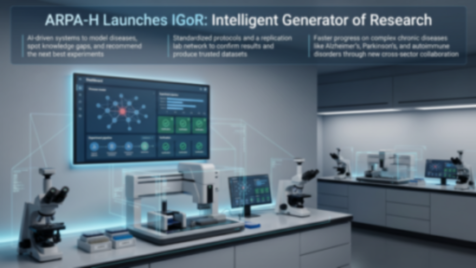
The Advanced Research Projects Agency for Health has officially launched a new initiative titled the Intelligent Generator of Research, or IGoR, aimed at streamlining the discovery process within the health sector. By integrating advanced computational systems, the program seeks to address persistent obstacles in scientific study, such as fragmented workflows, a lack of interdisciplinary cooperation, and the replication crisis currently impacting the field. The core mission of this initiative is to leverage AI in biomedical research to generate, validate, and refine studies more efficiently, with a particular focus on complex and chronic conditions like Alzheimer’s disease, Parkinson’s disease, and various autoimmune disorders.
System Infrastructure and Objectives
To facilitate this, the IGoR program will provide funding to multidisciplinary teams specializing in artificial intelligence, computational biology, experimental science, and laboratory infrastructure. These teams are tasked with constructing connected systems capable of modeling diseases, identifying critical knowledge gaps, and recommending specific experiments that improve overall scientific understanding. Furthermore, the agency intends to establish standardized experimental protocols alongside a network of labs designed to replicate studies and produce validated data. This resulting dataset is expected to continuously enhance underlying disease models, fostering a more adaptive and systematic research ecosystem.
Enhancing Data Validation and Collaboration
ARPA-H Director Alicia Jackson emphasized that the initiative aims to modernize how evidence is generated, shared, and validated, noting that families should not have to wait for breakthroughs while knowledge moves slowly through existing literature. The agency expects this approach to allow research, including work beyond its current accelerated science portfolio, to deliver results in years rather than decades. By fostering these new partnerships with startups, technology companies, and academic researchers, the program represents a significant move toward advancing AI in biomedical research in a way that directly addresses the biological complexity that has historically outpaced traditional research methodologies.