















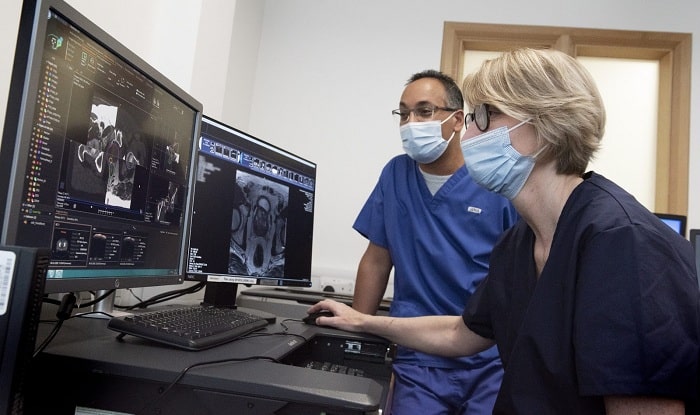

Addenbrooke’s Hospital in Cambridge is set to be the first hospital in the world to use InnerEye, an AI deep-learning tool from Microsoft Research Cambridge that accelerates the treatment of cancer patients. The technology computes hospital data to accurately identify tumours on patient scans, cutting CT processing times and treatment planning by up to 90%.
The toolkit could potentially reduce the waiting time for cancer treatment that has built up over the pandemic without compromising on the quality of care. Microsoft has also made the InnerEye software opensource and freely available in order to democratise care and ensure that as many people as possible can benefit from the tool.
When performed manually, a clinical oncologist or specialised technician must segment CT images obtained during a screening individually in a process called contouring. The medical professional outlines what are tumours and what are healthy organs on the scan, a process that can take several hours. The InnerEye toolkit processes these images 13 times faster than when done manually, utilising the hospital’s own data to improve accuracy and presenting the data to be carefully checked by the consultant oncologist.
Up to half of people in the UK will be diagnosed with cancer at some point in their life. According to Cancer Research, the pandemic has meant an estimated three million people in the UK have missed out on cancer screenings due to hospital restrictions, creating a severe backlog of patients waiting for treatment. The InnerEye toolkit, which is hosted securely on Microsoft’s Azure cloud, enables clinicians to spend more time with more patients whilst ensuring their treatment plans are tailored to them individually.
AI and deep learning are becoming a growing presence in digital care in the UK, with the government recently announcing a £20 million injection of funds into AI research.
Dr Rajesh Jena, an oncologist at Addenbrooke’s and co-lead of InnerEye, said: “The results from InnerEye are a game-changer. To be diagnosed with a tumour of any kind is an incredibly traumatic experience for patients. So as clinicians we want to start radiotherapy promptly to improve survival rates and reduce anxiety. Using machine learning tools can save time for busy clinicians and help get our patients into treatment as quickly as possible.”
“There is no doubt that InnerEye is saving me time,” said Yvonne Rimmer, consultant clinical oncologist at Addenbrooke’s. “It’s speeding up the process so I can concentrate on looking at a patient’s diagnostic images and tailoring treatment to them. But it’s important for patients to know that the AI is helping me in my professional role; it’s not replacing me in the process. I double check everything the AI does and can change it if I need to. The key thing is that most of the time, I don’t need to change anything.”
Javier Alvarez-Valle, principal research manager at Microsoft Research Cambridge, said: “AI models trained with InnerEye are changing the way cancer is treated, speeding up the process to give patients greater peace of mind and empowering clinical oncologists with an AI assistant. The AI works in the background, so clinical oncologists just open up the scans on their computer and they can see what their AI model has highlighted. The clinical oncologist then decides what to do with that information.”