












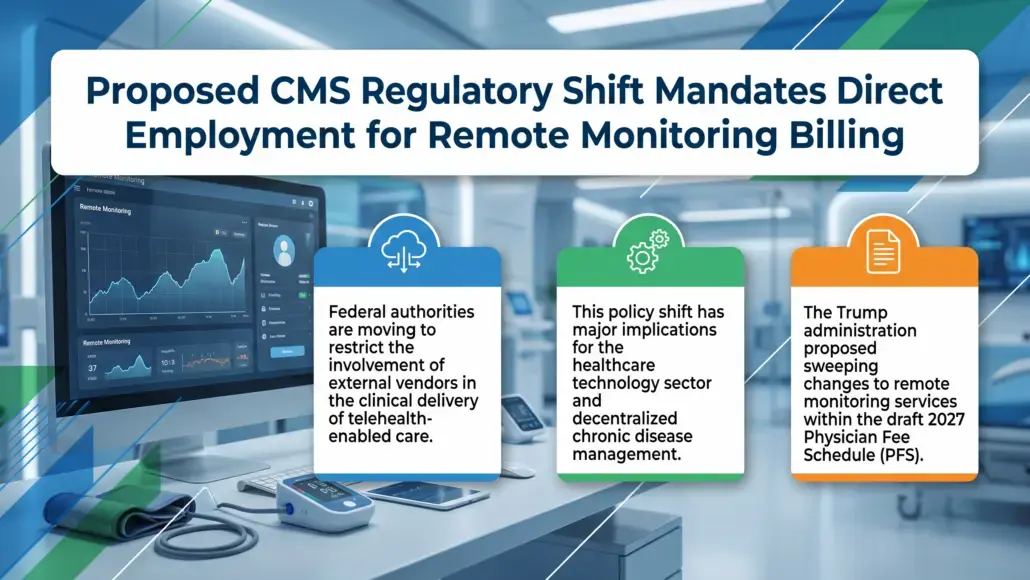
The established operational model for decentralized chronic disease management faces a significant regulatory challenge as federal authorities move to restrict the involvement of external vendors in the clinical delivery of telehealth-enabled care. In a policy shift that has major implications for the healthcare technology sector, the Trump administration has proposed sweeping changes to remote monitoring services within the draft 2027 Physician Fee Schedule (PFS). The proposal, issued by the Centers for Medicare and Medicaid Services (CMS) on Tuesday, seeks to mandate that all clinical staff involved in remote physiologic monitoring (RPM) and remote therapeutic monitoring (RTM) be directly employed by the billing practitioner’s practice. If finalized, this rule would effectively prohibit physicians, hospitals, and health systems from contracting out these services to third-party companies, a move that industry leaders warn will upend the current infrastructure supporting approximately one million Medicare beneficiaries.
The proposed restrictions are scheduled to take effect on January 1, 2027, creating a rigorous timeline for healthcare providers to either internalize complex monitoring capabilities or terminate existing programs. CMS regulators have justified the move by citing deep concerns regarding program integrity and the potential for fragmented care. The agency argues that outsourcing these critical functions to third-party entities can lead to insufficient physician oversight and a lack of clinical integration. “We believe outsourcing RPM/RTM services to a third party can fragment care, lead to insufficient involvement and oversight of the billing practitioner, or result in services that do not actually represent or facilitate all required aspects of RPM or RTM services,” regulators wrote in the 1,592-page draft rule. This regulatory pivot marks a sharp departure from the recent trend of expanding tech-enabled care, potentially creating a significant barrier for small and rural providers who lack the resources to build in-house monitoring departments.
Program Integrity and the Regulatory Rationale
The impetus for the proposed direct-employment mandate stems from a heightened focus on federal oversight and the rapid scaling of remote monitoring technologies. CMS referenced a September 2024 report from the HHS Office of Inspector General (OIG), which found that while the use of RPM in Medicare increased dramatically between 2019 and 2022, approximately 43% of enrollees did not receive all three required components of the service. Financial data underscores this rapid expansion; payments for RPM jumped 31% from $408 million in 2023 to $536 million in 2024. In the same period, the number of enrollees utilizing these services grew by 27%, nearing the one-million-patient milestone.
Regulators have expressed concern that the “loose association” between some third-party vendors and treating practitioners detracts from the quality of care. By requiring direct employment, CMS aims to ensure that monitoring data is parsed and acted upon by clinical teams that are fully integrated into the patient’s primary medical home. This focus on “longitudinal, patient-centered care” is central to the agency’s argument that third-party contracted staff may not provide the sufficient physician oversight necessary to justify Medicare Part B reimbursement. However, industry advocates like Christopher Adamec, executive director of the Alliance for Connected Care, argue that many vendors are already “tightly integrated” with ordering providers and function as essential members of a coordinated care team.
Infrastructure Barriers and the Burden on Providers
The practical reality of delivering high-quality remote monitoring services involves significant investment in specialized devices, complex data integration platforms, and advanced analytics. For many primary care practices and health systems, building these capabilities from scratch within a six-month window is considered unfeasible. “Prohibiting vendors is going to mean that healthcare providers are given the choice of either ending these programs or building all that capability in-house,” Adamec stated. He predicted that a majority of providers would choose to terminate their programs rather than attempt to navigate the technical and budgetary hurdles of in-house development.
This burden is expected to be particularly acute for rural healthcare providers. These organizations often use third-party vendors as “shovel-ready” solutions to address workforce shortages and geographic barriers to care. The Alliance for Connected Care has pointed out that these programs act as an “early warning system” that has historically driven a dramatic reduction in unnecessary hospitalizations. If the policy is enacted, health tech leaders fear that Medicare beneficiaries will lose access to the very services that are currently preventing emergency interventions and improving the management of chronic conditions like hypertension and diabetes.
Clinical Outcomes and the Market Response
Major players in the RPM space, such as Cadence, have responded to the proposal by highlighting the clinical evidence supporting the third-party model. Cadence, which manages more than 100,000 active patients across 20 health systems, shared data showing that its clinically integrated model has driven a 27% reduction in hospital admissions and a $1,302 per-patient annual reduction in the total cost of care. Additionally, a study published in the Journal of the American College of Cardiology found that Cadence’s hypertension program led to a 70% improvement in blood pressure control.
In a statement, Cadence executives noted that the proposed rule “does not distinguish between low-quality RPM and clinically integrated programs” that are actively helping systems manage chronic disease. They argued that a blanket direct-employment requirement would make it difficult for even the largest health systems to deliver these services at scale. The company suggested that instead of a total ban, CMS should implement guardrails such as requiring ACO participation, 24/7 clinical support, and documented evidence of clinical integration.
Legislative Conflict and Future Outlook
The proposed CMS restrictions represent a stark contrast to recent legislative actions aimed at expanding the health tech ecosystem. For instance, the $50 billion Rural Health Transformation Program and the recently advanced Rural Patient Monitoring Access Act both signal a congressional intent to broaden, not restrict, reimbursement for these technologies. Furthermore, the Trump administration itself has promoted outcomes-driven care through initiatives like the ACCESS and MAHA ELEVATE models.
The draft rule also includes secondary requirements, such as mandating that RTM services only be furnished to “established patients” and requiring an initiating visit before billing for monitoring can begin. As CMS opens the proposal for public comment, the industry is expected to push for a long-term payment framework that recognizes the complexity of multi-chronic condition management without dismantling the vendor partnerships that currently underpin the sector’s growth. The final decision on the 2027 Physician Fee Schedule will ultimately determine whether the U.S. continues toward a decentralized, tech-enabled care model or moves back toward a more traditional, centralized infrastructure.