










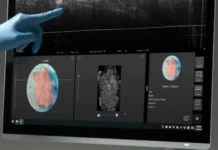



New ultrasound technology promises to give urologists a new tool to reposition kidney stones and stone fragments for easier clearance, researchers said here at the 2010 American Urological Association (AUA) Annual Meeting.
The device is being developed by a team of urologists and ultrasound physicists at the University of Washington, Seattle, Washington.
There are a variety of devices and technologies used in everyday practice to deal with renal stones, according to Anup Shah, MD, University of Washington Center for Industrial and Medical Ultrasound. Urologists routinely shatter stones into smaller fragments that can pass out of the kidney, but once stones have been broken into fragments, little can be done to speed their passage.
"The goal of elective treatment is render the patient stone free," he said on June 2. "The reality is that neither shock wave lithotripsy nor ureteroscopic treatment have any active mechanism to clear stones. To date, there is no technology to actively deal with stone fragments or to move fragments from one part of the kidney to another for more effective clearance."
Lower pole kidney stone and fragment clearance is particularly difficult compared with other locations due to dependent positioning and difficult access, Dr. Shah explained. Residual stone fragments trapped in the lower pole often lead to increased morbidity and an increased rate of secondary surgery.
Researchers are developing a focused ultrasound device that can manipulate stone fragments within the kidney using a hand-held transcutaneous device. The goal is to move fragments from a dependent position in the lower pole to a more superior position within the collection system where natural flushing activity can clear residue from lithotripsy or other treatment.
Porcine trials of the device were described during a podium presentation.
The newly developed probe consists of an 8-element annular array with a nominal frequency of 2.0 MHz, acoustic power output of 5 to 20 watts, and programmable focal depth of 4.5 to 8.5 cm, Dr. Shah reported. An opening in the centre of the therapeutic probe contains an HDI P4-2 imaging probe that provides 2-dimensional ultrasound imaging guidance. Diagnostic ultrasound and fluoroscopy showed that both artificial and human kidney stones placed in transparent kidney phantoms and live porcine kidneys can be reliably guided and moved under operator control.
The stones used were between 2 and 6 mm in the largest dimension, Dr. Shaw reported. These early tests showed stones moving up to 3 cm within the kidney at a velocity of about 1 cm per second. Newer iterations of the device can deliver motive energy deeper than 8.5 cm, making it possible to reposition stones in more obese patients whose kidneys are 10 cm and deeper below the skin.
"We believe that ultrasound can move stones through the kidney in a therapeutically effective manner," Dr. Shaw said. "There was no evidence, gross or microscopic, of any thermal or mechanical injury to the kidney. We are working at less than 50 watts, orders of magnitude less than the energy used in HIFU [high-intensity focused ultrasound]."