











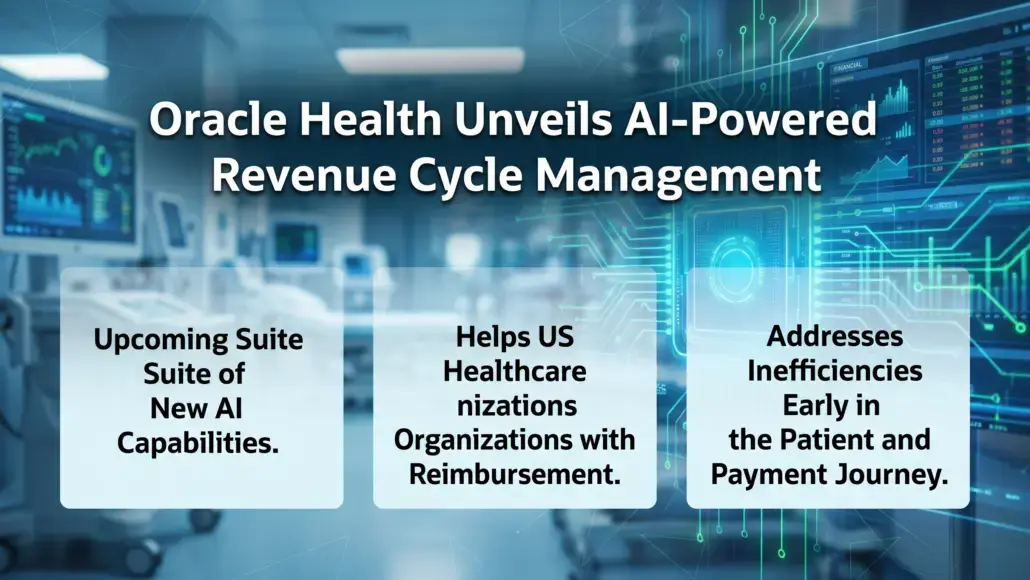

Oracle Health has announced a suite of new artificial intelligence capabilities across its revenue cycle management portfolio, planned for release in the coming months, aimed at helping healthcare organizations in the United States address reimbursement challenges early in the patient and payment journey. The announcement was made at the Oracle Health and Life Sciences Summit in Orlando, Florida.
Addressing Revenue Cycle Inefficiencies at the Source
Revenue cycle teams across the country continue to lose significant time and financial resources managing downstream problems — including claim denials, missing documentation, authorization failures, inaccurate charge capture, and delayed payments. Oracle Health is responding to these systemic challenges by embedding AI upstream across the full revenue cycle spectrum: from scheduling and financial clearance through clinical documentation, charge capture, billing, and payment processing.
The goal, as articulated by Oracle Health, is to identify risks early, streamline routine workflows, and connect clinical, financial, payer, and operational data before these gaps translate into payment delays and revenue loss.
Seema Verma, Executive Vice President and General Manager of Oracle Health and Life Sciences, spoke directly to the strategic intent behind the initiative: “AI gives us an opportunity to prevent revenue cycle problems before they lead to denials and delayed payments. Oracle Health is delivering a comprehensive revenue cycle solution that brings AI across the front, middle, and back office, connecting clinical and financial workflows from the first patient interaction through payment. This can help healthcare organizations reduce administrative work and revenue leakage, get paid faster, and strengthen their financial stability so they can stay focused on delivering excellent patient care.”
Connecting Fragmented Systems Through Native AI
A core challenge facing many healthcare organizations today is the fragmentation of clinical, financial, payer, provider, and operational activities across disconnected systems and manual processes. These disconnects create inefficiencies, reimbursement delays, and mounting administrative burdens.
Oracle Health’s AI revenue cycle approach addresses this by connecting workflows across patient access, clinical documentation, patient accounting, contract intelligence, payment operations, enterprise analytics, and financial management — all within existing Oracle Health infrastructure. Organizations can adopt these embedded AI capabilities at their own pace, without the disruption of wholesale system replacement.
New Embedded AI Capabilities
The newly announced AI capabilities, planned for general availability in the coming months, span five key areas of the revenue cycle:
Prior Authorization — Checks coverage, retrieves and pre-fills documentation requirements, attaches clinical evidence, coordinates authorization activities, and supports payer interactions to reduce authorization-related delays and denials.
Clinical Document Quality Integrity — Reviews reimbursement-related documentation, identifies gaps, and surfaces contextual recommendations to improve documentation and coding quality.
Charge Capture and Integrity — Analyzes clinical and reimbursement context, including modifiers and service details within charge review workflows, to limit revenue leakage and optimize reimbursement outcomes.
Medical Coding for Professional Fees — Analyzes clinical documentation and patient context to surface coding recommendations within existing workflows, supporting reimbursable claim readiness.
Appeal Management — Analyzes remittance data, identifies payment variances, and automates the creation of appeal packets when an appeal decision is made, helping reduce turnaround times.
Integration with Enterprise Financial Operations
As part of its planned product direction, Oracle Health intends to extend the connectivity of AI revenue cycle workflows into broader enterprise financial operations. This includes financial reconciliation, revenue accounting, treasury management, and analytics through platforms such as Oracle Fusion Cloud Applications. The intent is to enable health systems to connect reimbursement activity, financial operations, and enterprise analytics to support more informed operational and financial decision-making.
Strengthening Financial Stability Across Healthcare Organizations
The overarching aim of these AI revenue cycle capabilities is to help healthcare organizations reduce administrative overhead, limit revenue leakage, accelerate payments, and maintain the financial stability required to sustain quality patient care. By embedding intelligence across both the clinical and financial sides of the revenue cycle, Oracle Health is positioning its portfolio as a connected, end-to-end solution for revenue performance optimization.