














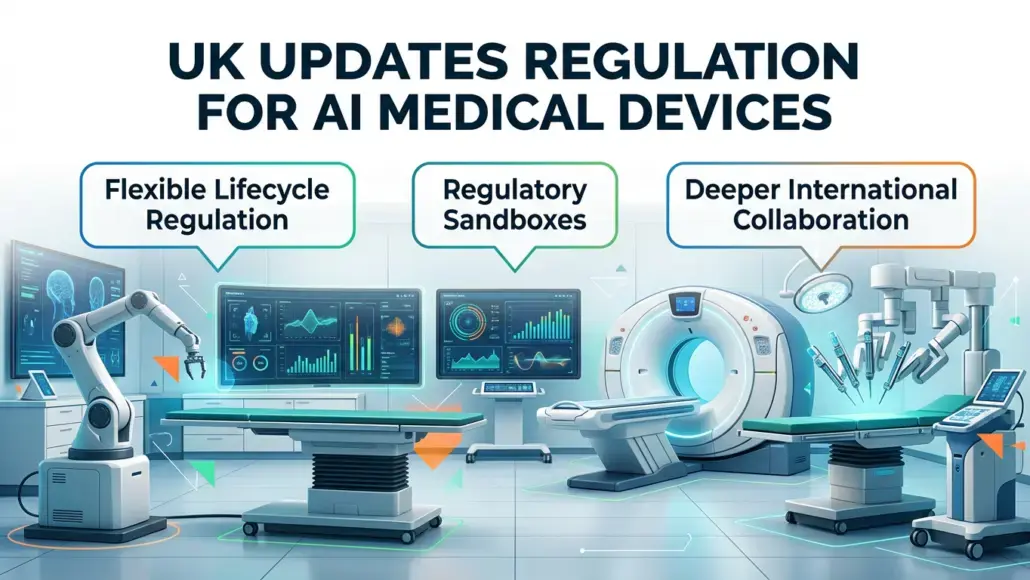

The United Kingdom’s Medicines and Healthcare products Regulatory Agency (MHRA) has unveiled its next phase of regulatory oversight for MedTech and artificial intelligence during the AdvaMed 2026 conference in the United States. Speaking on October 20, 2026, Jessica Paulsen, MHRA Deputy Director for AI and Software, detailed a developing approach that emphasizes flexible lifecycle regulation, the use of regulatory sandboxes, and deeper international collaboration. This announcement aligns with the broader MHRA 2030 Strategy, which aims to modernize the UK’s regulatory framework to accommodate the rapid advancement of personalized medicine and AI medical devices. By 2030, the agency intends to establish a global standard for safe and agile regulation, supporting faster market access for innovative technologies while maintaining rigorous patient safety protections.
Central to this new agenda is the creation of a modern, adaptive framework specifically designed for AI as a medical device. The MHRA is establishing a new Centre for AI and Digital Health to lead these efforts, focusing on improving device data traceability and transparency. This initiative follows the UK government’s recent acceptance of all 44 recommendations from the independent National Commission into the Regulation of AI in Healthcare. These recommendations support a proportionate, lifecycle-based regulatory model that acknowledges the iterative nature of software-driven tools. By transitioning from traditional static policies into active practice, the MHRA seeks to provide developers with greater clarity on requirements throughout the entire operational lifespan of their products.
The agency is already actively testing these regulatory concepts through the AI Airlock, a dedicated regulatory sandbox for AI medical devices. This program allows for the evaluation of innovative technologies in real-world health settings, generating critical evidence to inform future legislative approaches. The AI Airlock is complemented by strategic regional partnerships, including collaborations with NHS London and the Manchester University NHS Foundation Trust. These partnerships leverage the UK’s unique healthcare system and academic infrastructure to test how AI-enabled devices perform in clinical environments. This collaborative model is essential for developing regulation that can effectively respond to devices that evolve after they have been placed on the market.
International Collaboration and the Pioneer Programme
A significant pillar of the MHRA’s new agenda is the strengthening of ties with international regulatory bodies, most notably the U.S. Food and Drug Administration (FDA). The MHRA is currently implementing the Pioneer Programme, an initiative announced in June that establishes dedicated reciprocal liaison roles between the two regulators. This program is designed to facilitate deep day-to-day collaboration, scientific exchange, and coordinated responses to emerging regulatory challenges in the fields of MedTech and AI. While both agencies will continue to make independent regulatory decisions, the Pioneer Programme aims to harmonize scientific standards and reduce transatlantic barriers to market access for innovators.
To further solidify this relationship, the MHRA is currently recruiting a Regional Deputy Director of US Partnerships to be based in Washington, D.C. This senior official will serve as the agency’s dedicated Liaison Officer to the FDA, working to build stronger connections between the UK and US life sciences ecosystems. The role is a core component of the MHRA’s ambition to establish a proactive presence in the United States that delivers tangible benefits for patients and promotes the UK’s position in the global life sciences sector. By fostering closer alignment and reciprocity, the MHRA intends to explore greater use of international reliance routes, potentially accelerating the approval of devices that have already received clearance from trusted regulators like the FDA.
This international focus builds on a multi-year effort to streamline regulatory pathways across borders. At the 2025 AdvaMed conference, the MHRA first outlined its ambitions to strengthen regulatory reciprocity and explore international reliance routes. The current phase of this strategy moves these goals into the implementation stage, providing a clearer roadmap for manufacturers looking to navigate the UK and US markets simultaneously. Jessica Paulsen emphasized that because AI technologies are inherently global, close collaboration between regulators is critical to providing innovators with the necessary clarity while maintaining the strong protections required to safeguard public health in an increasingly digital landscape.
Future Regulatory Reform and Post-Market Oversight
Beyond the immediate focus on AI and international partnerships, the MHRA is progressing with wider medical device reforms intended to create a more responsive future regulatory framework. These reforms include significantly improved post-market surveillance mechanisms and proposed legislative changes that will update the requirements for all devices placed on the UK market. The goal is to ensure that the regulatory system can keep pace with the speed of technological change, particularly in areas like software and personalized health tools. By modernizing these standards, the UK aims to support the long-term objectives of the government’s Life Sciences Sector Plan and the 10 Year Health Plan.
The overall direction of these reforms is governed by the MHRA 2030 Strategy, which sets a clear timeline for delivering a world-leading regulatory environment. Recent actions, such as the establishment of the health innovation sandboxes in London and Manchester, demonstrate the agency’s commitment to practical, evidence-based regulation. As the MHRA continues to evolve its approach, it will remain focused on balancing the need for rapid innovation with the fundamental requirement for patient safety. This comprehensive agenda, presented to US industry leaders at AdvaMed, underscores the UK’s intent to lead the global conversation on the regulation of the next generation of medical technologies.
The Medicines and Healthcare products Regulatory Agency’s commitment to modernising its approach reflects a broader strategic shift towards agile, data-driven governance. By integrating real-world evidence from clinical settings directly into the legislative process, the UK regulator is building a framework that is both robust and flexible. This approach is intended to provide a predictable environment for industrial investment, ensuring that the United Kingdom remains a premier destination for the development and deployment of advanced therapeutic solutions. As these reforms are implemented over the coming years, the MHRA will continue to prioritise transparency and international cooperation to deliver optimal outcomes for patients and the global healthcare sector.
Furthermore, the emphasis on lifecycle regulation ensures that the safety of complex technologies is monitored continuously rather than at a single point in time. This is particularly relevant for systems that utilise machine learning, where performance can shift as new data is processed. The MHRA’s focus on improved traceability and data quality will provide a foundation for this continuous oversight, allowing for rapid intervention if unexpected issues arise. By setting these standards now, the UK is helping to define the future of global MedTech regulation, fostering an ecosystem where innovation and safety are not mutually exclusive but are instead mutually reinforcing principles that drive the industry forward into a new era of healthcare.
The recruitment of dedicated liaison staff and the establishment of formal reciprocal roles with the FDA further demonstrate the depth of the UK’s commitment to international regulatory alignment. This structural infrastructure is designed to survive political cycles and provide a stable basis for long-term scientific cooperation. As the Pioneer Programme matures, it is expected to serve as a model for how regulators in different jurisdictions can work together to address the unique challenges of the 21st century. The MHRA’s presence at AdvaMed 2026 serves as a clear signal to the global life sciences community that the United Kingdom is open for business and is actively shaping the rules that will govern the future of medical technology. Through these concerted efforts, the agency is ensuring that the UK remains at the forefront of clinical excellence and regulatory innovation.