















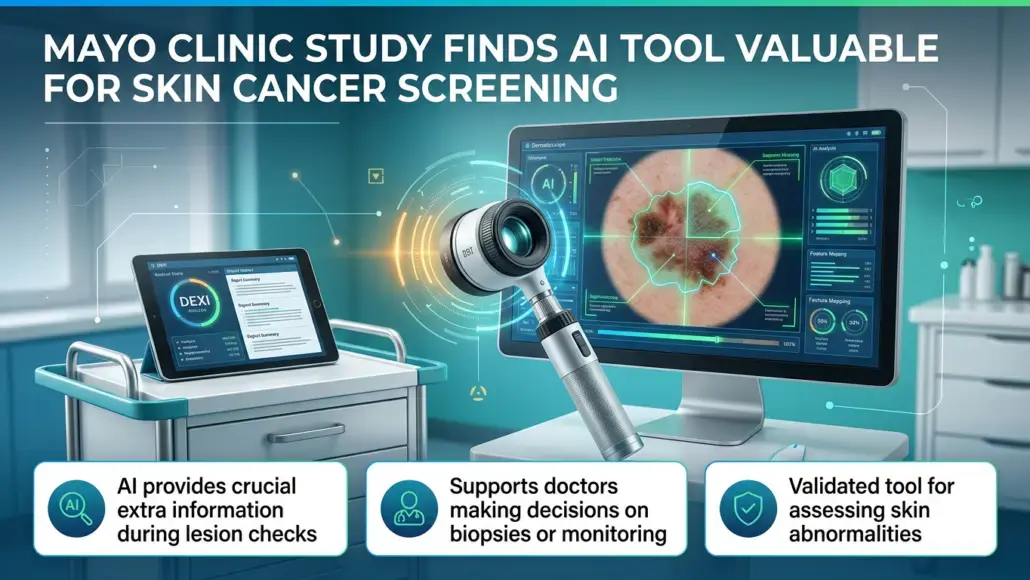

Researchers at Mayo Clinic have found that an artificial intelligence tool may give dermatologists valuable additional information when assessing whether skin lesions are cancerous, according to a study published in Mayo Clinic Proceedings. The findings support the use of AI-assisted scoring as a supplementary resource in clinical decision-making around biopsy or monitoring of skin lesions.
Understanding the Scoring System
The AI tool, known as Dermoscopy Explainable Intelligence (DEXI), is integrated within an advanced imaging system that dermatologists already use to capture and track skin lesions over time. This AI skin lesion tool assigns each lesion a score ranging from 0.0 to 10.0, based on image characteristics associated with cancer risk. It further identifies specific features — including asymmetry, border, and color — that contribute to the overall score, offering dermatologists a structured layer of information to consider alongside their own clinical evaluation.
DEXI is a deep-learning model trained on more than 66,000 annotated dermoscopy images. Beyond generating a risk score, the tool employs explainable AI techniques to highlight which visual features influenced its output, giving clinicians a clearer window into how the score was derived.
Patient Population and Lesion Analysis
The retrospective study enrolled 178 patients who had undergone total-body photography, sequential digital dermoscopy imaging, and subsequent biopsy of one or more skin lesions. Researchers analyzed a total of 261 lesions, each with both a DEXI score and a confirmed diagnosis based on tissue examination.
The lesions were categorized into noncancerous and cancerous groups, with the cancerous group further divided into melanoma and nonmelanoma skin cancers. This structure allowed the research team to compare scoring patterns across different lesion types and determine whether the tool’s output aligned meaningfully with clinical outcomes.
How Scores Differed Across Lesion Types
The results showed a clear separation in average DEXI scores between benign and malignant lesions. Noncancerous lesions recorded an average score of 2.5, while nonmelanoma skin cancers averaged 7.8 and melanomas averaged 6.0. Cancerous lesions as a group carried significantly higher DEXI scores than noncancerous ones.
Using a threshold of 3.0 — whereby a score at or above that level was treated as a positive indicator for potential skin cancer — the AI skin lesion tool correctly identified 93.4% of cancerous lesions and 75% of noncancerous lesions. Based on these figures, the researchers identified 3.0 as a potential threshold that could meaningfully inform dermatologists when deciding whether a lesion warrants biopsy or continued monitoring.
“Prior to the study, I would review a patient’s DEXI score, but I wouldn’t know exactly what to do with the number,” said Jenny Link, M.D., dermatologist at Mayo Clinic and the study’s lead author. “Now I can confidently use the score as another piece of data to inform my clinical judgment on whether I recommend a biopsy or monitoring.”
Dr. Link further noted, “We identified 3.0 as a potential DEXI score threshold that could provide useful information when dermatologists are considering whether to monitor a lesion or perform a biopsy.”
Areas Requiring Further Refinement
The research team was also candid about the tool’s current limitations. DEXI does not account for patient-specific factors such as age, current medications, or a personal history of melanoma. The tool was also found to be less effective when evaluating severely atypical nevi — commonly known as skin moles — and early evolving melanomas, both of which present specific diagnostic challenges.
“Our study demonstrated that DEXI is a useful and valuable tool to support clinicians as they evaluate cancerous and noncancerous skin lesions, but it should not be used in isolation. The score must be interpreted alongside clinical findings and patient-specific factors, and the tool requires further validation and refinement,” said Dr. Link.
The study underscores that while skin cancer detection technologies continue to advance, clinical judgment and patient context remain essential components of the diagnostic process. The DEXI score is positioned as one additional input within that broader evaluative framework, not a standalone diagnostic instrument.