












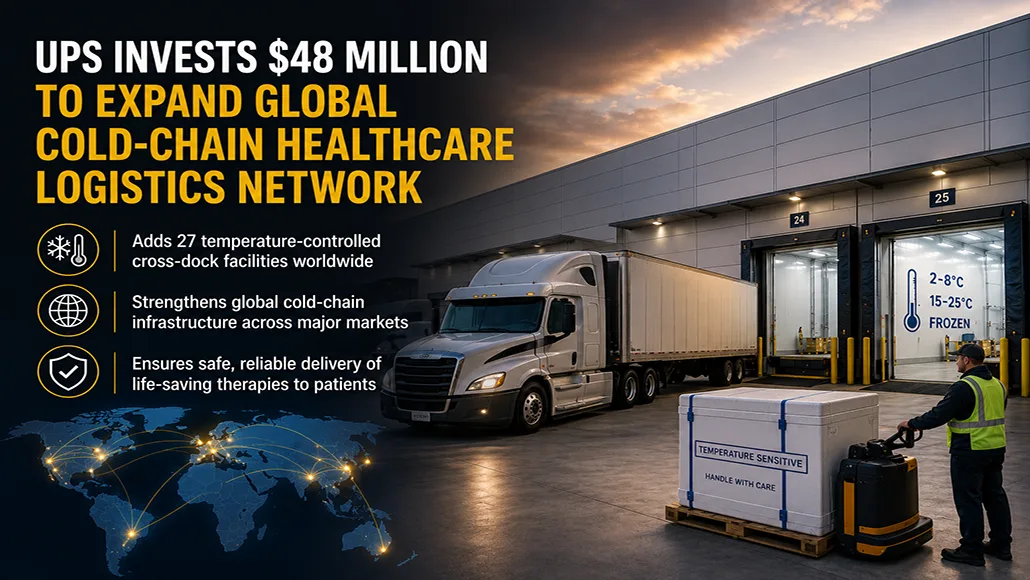
UPS has announced a $48 million investment to expand its healthcare logistics capabilities through the addition of 27 temperature-controlled freight cross-dock facilities across major markets in the United States, Europe, Asia and the Americas. Designed to support rapid transfers between air and ground transportation, the facilities provide short-term storage while maintaining strict temperature requirements. The move strengthens the company’s global cold-chain infrastructure as demand increases for medicines requiring storage ranges of 2 to 8 degrees Celsius, 15 to 25 degrees Celsius and frozen conditions. According to Growth Market Reports, the market for temperature-sensitive biologics is expected to grow at a compound annual growth rate of 8.3% through 2033, reaching an estimated value of $39.1 billion. The expansion of Cold-Chain Healthcare Logistics is aimed at supporting the safe movement of these therapies from production facilities to patients.
“We have aligned our investments with our Healthcare customers’ specialised needs. Our global cross-dock facilities strengthen our end-to-end cold-chain capabilities to ensure critical treatments are delivered safely and reliably to patients around the world,” said Kate Gutmann, EVP and President of International, Healthcare and Supply Chain Solutions at UPS. “This effort – and all of our work in healthcare logistics – extends from a deep understanding that we’re doing more than moving packages. We are helping patients access the medications and treatments they need.” The company stated that all 27 facilities comply with IATA CEIV Pharma certification standards for pharmaceutical handling and quality. By operating within a single integrated network, UPS said it can reduce provider handoffs, improve oversight and strengthen accountability for high-value, temperature-sensitive shipments. The network is also supported by a 24/7/365 control tower that monitors shipments, identifies potential risks and enables intervention when necessary.
The growing number of biologic medicines entering the market is adding complexity to healthcare supply chains. PharmaSource estimates that around one-third of newly approved medicines are biologics, with more than 85% requiring temperature-controlled handling. Treatments including cell and gene therapies, mRNA platforms and GLP-1 injectables are increasing demand for specialised logistics services. Industry estimates indicate that cold-chain failures can cost up to $35 billion annually, while the WHO has linked such failures to as much as 50% of global vaccine waste. “Biologics and personalized treatments are driving better, more targeted care for patients,” said John Bolla, President of UPS Healthcare. “These investments reflect our commitment to continue to align our leading end-to-end supply chain to protect innovative treatments and diagnostics, supporting better patient outcomes.”
The investment builds on UPS’s broader healthcare logistics strategy, supported by acquisitions including Bomi Group, Frigo Trans and BPL in Europe, as well as Andlauer Healthcare Group in North America. The company also recently expanded its Incheon, Korea air hub to support pharmaceutical trade flows, with Observatory of Economic Complexity data showing South Korea imported nearly $9.7 billion in pharmaceutical products during 2025. UPS said the enhanced network is designed to support seamless movement of time- and temperature-sensitive healthcare products across air, ocean, ground and final-mile transportation channels. Through these investments, the company is further strengthening Cold-Chain Healthcare Logistics capabilities to manage increasing industry demand and operational complexity.