















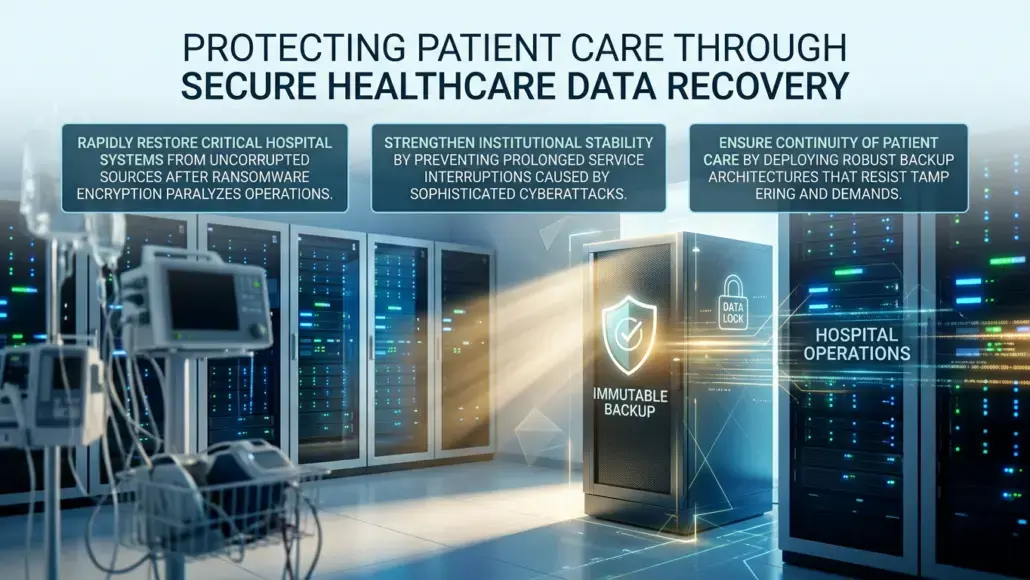

Ransomware attacks against healthcare institutions have escalated in both frequency and sophistication, posing a direct threat to patient care and institutional stability. Unlike traditional malware that seeks to steal data, modern ransomware focuses on encrypting critical systems to paralyze hospital operations, demanding a ransom for the decryption keys. In this high-stakes environment, the ability to restore systems from a clean, uncorrupted source is the difference between a minor service interruption and a catastrophic clinical shutdown. Implementing immutable backup architecture has emerged as the most effective defense against the growing trend of attackers targeting backup servers themselves to ensure that victims have no choice but to pay the ransom.
An immutable backup is a version of data that cannot be altered, deleted, or overwritten for a specific duration after it has been created. In a hospital setting, where data integrity is paramount, this write-once-read-many capability ensures that even if an attacker gains administrative privileges within the network, they cannot destroy the backup files. This architectural approach shifts the power dynamic back to the healthcare provider, allowing them to ignore ransom demands and focus on rapid restoration. By securing the last line of defense, hospital IT departments can maintain operational resilience in the face of increasingly aggressive digital extortion attempts. The peace of mind provided by these systems allows clinical leaders to focus on patient outcomes rather than negotiating with cyber criminals.
The Technical Foundations of Write-Once Storage
The implementation of immutable backup architecture relies on specialized storage technologies that enforce data permanence at the hardware or firmware level. Many modern storage solutions use object lock features or hardened Linux repositories to create a logical air gap between the production environment and the backup storage. When a backup job is completed, the system applies a lock bit that prevents any modifications until the retention period expires. This ensures that the data remains in its original state, protected from both malicious encryption and accidental deletion by well-meaning but unauthorized staff. For hospitals, where data volumes are massive and constantly growing, these systems must be capable of handling high-speed ingestion without compromising the immutability of the stored objects. This high-performance requirement is essential for capturing frequent snapshots of active clinical databases.
Beyond simple storage, the entire backup workflow must be designed with security in mind. This involves the use of multi-factor authentication for any administrative access to the backup console and the separation of duties between the storage administrator and the backup administrator. By ensuring that no single individual has the authority to both create and delete data, the hospital reduces the risk of an insider threat or a compromised account being used to sabotage the recovery plan. Many organizations are now utilizing cloud-based immutable storage as an off-site repository, providing an additional layer of protection against physical disasters or data center compromises. This distributed approach ensures that even a total site loss does not result in the permanent destruction of the medical history records.

Optimizing Recovery Time Objectives in Clinical Settings
While data preservation is the primary goal, the speed of recovery is equally critical in a healthcare environment. Clinical workflows are highly dependent on real-time access to patient records, imaging data, and laboratory results. A delay of even a few hours can lead to the cancellation of surgeries or the diversion of ambulances to other facilities. Therefore, an immutable backup architecture must be paired with high-performance recovery tools that can restore virtual machines and databases directly from the backup storage. This instant recovery capability allows hospital services to resume while the data is being moved back to primary storage in the background, significantly reducing the impact on patient care. This minimized downtime is the true measure of success for any backup and recovery program.
To ensure that the recovery process is as efficient as possible, hospital IT teams must regularly audit their backup catalogs and recovery scripts. The effectiveness of these data protection measures is often validated through regular cyber incident simulations that test the speed and accuracy of the recovery process. These simulations help identify bottlenecks in the network or issues with data consistency before a real attack occurs. By practicing the restoration of critical systems under pressure, the technical team can refine their procedures and ensure that every member knows their specific role during an emergency. This proactive approach transforms the backup system from a passive insurance policy into an active component of the hospital’s incident response strategy. Regular drills also help in training new staff members on the complexities of the hospital’s unique recovery environment.
Protecting the Integrity of the Electronic Health Record
The electronic health record is the most vital asset in a modern hospital, containing the comprehensive medical history of every patient. A ransomware attack that corrupts the electronic health record database can have devastating consequences, potentially leading to incorrect medication dosages or the loss of critical allergy information. Immutable backup architecture provides a verified gold copy of the records that can be used to compare against production data if a compromise is suspected. By maintaining a history of immutable snapshots, the hospital can pinpoint the exact moment an infection occurred and roll back to the last known clean state with minimal data loss. This level of granularity is essential for maintaining the trust of both patients and regulatory bodies.
In addition to the electronic records, other clinical systems such as Picture Archiving and Communication Systems also require specialized backup considerations. These data often consist of millions of small files, such as X-rays and CT scans, which can be difficult to manage using traditional backup methods. Modern immutable solutions are optimized for these high-file-count environments, ensuring that imaging data remains available even during a large-scale network outage. By integrating imaging data and other specialized clinical systems into the central immutable framework, the hospital creates a unified data protection strategy that covers every aspect of the patient journey. This holistic view of data protection ensures that no clinical department is left vulnerable to an attack.
Strategic Planning and Budgetary Considerations
Transitioning to an immutable backup architecture requires a significant initial investment in hardware, software, and staff training. However, the cost of a successful ransomware attack (including ransom payments, legal fees, regulatory fines, and lost revenue) far exceeds the expense of a proactive security program. Hospital executives must view data protection as a strategic priority rather than a line-item expense. When evaluating new solutions, procurement teams should look for vendors that offer native immutability features and can demonstrate successful recoveries in similar healthcare environments. The ability to provide a clear return on investment through reduced downtime and improved risk posture is a powerful argument for securing the necessary funding from the board of directors.
Beyond the technical acquisition, the hospital must also invest in the human element of the backup strategy. This includes training IT staff on the latest recovery techniques and ensuring that clinical leaders understand the limitations and capabilities of the backup system. Clear communication regarding recovery time objectives and recovery point objectives is essential for managing expectations during a crisis. When everyone from the chief executive to the department head understands the plan, the organization can respond to an attack with calm and clinical precision. This organizational alignment is the final piece of the puzzle, ensuring that the technology is supported by a culture of resilience and readiness. A well-informed leadership team is less likely to make panicked decisions during the early stages of a ransomware outbreak.
Advancing Toward a Zero Trust Data Protection Model
The final step in securing the hospital’s data involves moving toward a zero trust model for backups. This means that no user or system is automatically trusted, and every request to access or modify backup data is strictly verified. In an immutable backup architecture, this principle is enforced by disabling all deletion commands and requiring multiple approvals for any changes to retention policies. This preventative measure ensures that even if a global administrator account is compromised, the attacker cannot wipe out the data that the hospital needs to survive. By combining immutability with zero trust access controls, healthcare organizations create a virtually impenetrable vault for their most sensitive information.
Implementing a comprehensive data protection strategy involves several key technical and operational steps:
- Selection of storage hardware that supports native hardware-level immutability or object locking through the storage protocol.
- Implementation of strict access controls, including multi-factor authentication for all backup systems and administrative consoles.
- Regular testing of recovery procedures through structured technical drills and clinical simulations that involve frontline medical staff.
- Separation of backup networks from the main production network to prevent the spread of malware during a lateral movement attack.
- Automation of backup verification processes to ensure that every snapshot is viable, malware-free, and ready for immediate deployment.
- Integration of off-site or cloud-based repositories to provide geographic redundancy for critical data in the event of a physical catastrophe.
- Comprehensive training programs for IT and clinical staff to ensure that everyone understands their role in the data recovery lifecycle.
By adhering to these principles, healthcare organizations can build a defense-in-depth strategy that effectively neutralizes the threat of ransomware. The peace of mind that comes with knowing that critical patient data is stored in an unalterable format allows hospital leaders to focus on their primary mission: providing the best possible care to their community. As the digital threats continue to evolve, the adoption of immutable backup architecture will remain a cornerstone of a modern, resilient healthcare enterprise. This commitment to data integrity not only protects the hospital’s reputation but, more importantly, it ensures the safety and well-being of the patients who depend on its services.