











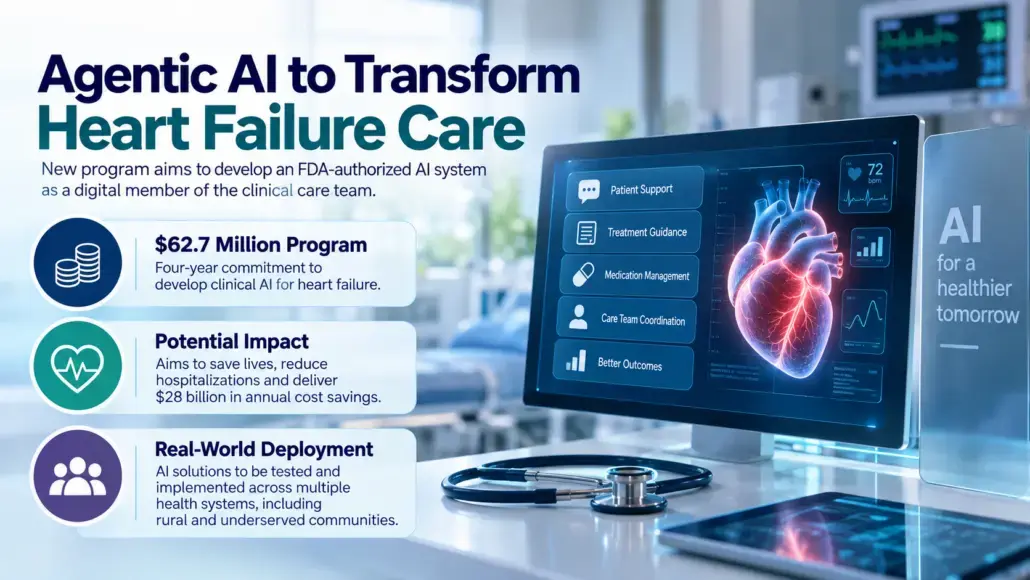

The Advanced Research Projects Agency for Health (ARPA-H) has awarded contracts under its Agentic AI-Enabled CardioVascular CAre TransfOrmation (ADVOCATE) program, aimed at creating a reliable, FDA-authorized clinical agentic AI system capable of functioning as a digital member of the clinical care team. The program carries a four-year total commitment of $62.7 million, with up to $33.7 million allocated in the first year alone.
If successful, ARPA-H estimates that ADVOCATE will save lives, reduce preventable hospitalizations, and generate an estimated $28 billion in annual cost savings across the heart failure population.
The ADVOCATE program is organized across three technical areas, each with a distinct mandate.
TA1: Patient-Facing Clinical AI Agent
Teams in this area are tasked with developing a patient-facing clinical AI agentic system capable of autonomously supporting patients with heart failure between healthcare visits, while escalating to the human care team when necessary.
Atman Health will build a clinical AI agentic system on an evidence-based clinical decision engine. The system uses large language models (LLMs) with a voice-first interface, dynamically adjusting the diagnostic questions it poses to each patient based on real-time conversational input.
Tempus AI will develop its clinical AI agentic system by extending its existing Olivia patient health app, incorporating continuous monitoring and deeper clinical analysis triggered by meaningful changes in a patient’s health status.
UpDoc will build a clinical AI agentic system in which conversational intelligence is kept separate from clinical authority through a clinician-built rules system that validates every proposed action against approved protocols before execution. The UpDoc team includes OpenAI, Microsoft, and NVIDIA. UpDoc was selected in part because it already holds FDA clearance for a software medical device that uses a patient-facing LLM and has an established track record in developing highly guardrailed autonomous clinical AI within provider EHR workflows.
Under ADVOCATE’s timeline, TA1 teams must submit a first-of-its-kind FDA-authorization package for this product within 24 months of contract award.
TA2: Supervisory AI Agent
Stanford University has been selected to design and build the disease-agnostic supervisory AI system that will continuously monitor the TA1 clinical agents following successful deployment. This includes real-time detection of unsafe recommendations and out-of-distribution behavior, providing an ongoing assurance layer for the FDA, health systems, patients, and clinicians.
Stanford’s approach uses a three-stage, compute-escalating pipeline — outlier filtering, rule-based screening, and a deep-research auditing agent — that produces inspectable, per-claim rationales.
Performers across TA1 and TA2 will work closely together throughout the program to develop technical interfaces, safety benchmarks, and evaluation protocols.
TA3: Scalable Implementation in Health Systems
Teams in this area, anchored in prominent health systems, are responsible for designing and executing the real-world implementation strategy to bring ADVOCATE technology to patients and clinicians across diverse care settings, with a particular focus on rural and underserved communities where cardiology access is most constrained.
Duke University will provide a multi-site validation platform testing ADVOCATE agents across five health systems and rural sites, operating on both Epic and Cerner/Oracle electronic health records (EHRs), amplified by the national reach of the American Heart Association.
Kaiser Permanente will lead an enterprise-scale deployment across 21 medical centers and more than 260 clinics, embedding ADVOCATE agents into Epic EHR workflows for heart failure patients and generating reusable deployment blueprints through shadow-mode deployments and pragmatic randomized clinical trials.
High-Risk Clinical Functions at the Core of ADVOCATE
Speaking at a recent meeting of the NIH Collaboratory Grand Rounds, ADVOCATE Program Manager Haider Warraich, M.D., a practicing cardiologist, outlined the program’s ambitions. Beyond lower-risk functions such as care navigation, appointment scheduling, and cost estimation, the program is deliberately focused on higher-risk clinical capabilities.
“These include making treatment recommendations based on the patient’s prompts, but also the patient’s data from the electronic health record, being able to provide a diagnosis and perform triage. Triage is going to be one of the really important functions of these technologies, and you can’t really do triage unless you can make a diagnosis,” said Dr. Warraich.
He further elaborated on the program’s scope: “We really want to specifically focus on things that are unambiguously high-risk. We’re really focused on being able to change or renew or refill existing prescriptions, or even write new prescriptions. And the prescriptions that you would focus on for the purposes of this program are going to be what we describe as in scope to the primary indication, which in this case is patients with heart failure. In-scope medications would be either guideline-directed medical therapy for heart failure or diuretic management.”
Broader Implications for Clinical Care
ARPA-H has noted that ADVOCATE could establish a pathway for cardiovascular agentic AI to emerge as a new autonomous member of the clinical team, extending its potential beyond heart failure to patients across a wide range of conditions. The program represents a coordinated effort that brings together academic medical centers, major technology companies, and prominent health systems to advance the development of FDA-authorized agentic AI in clinical settings.