









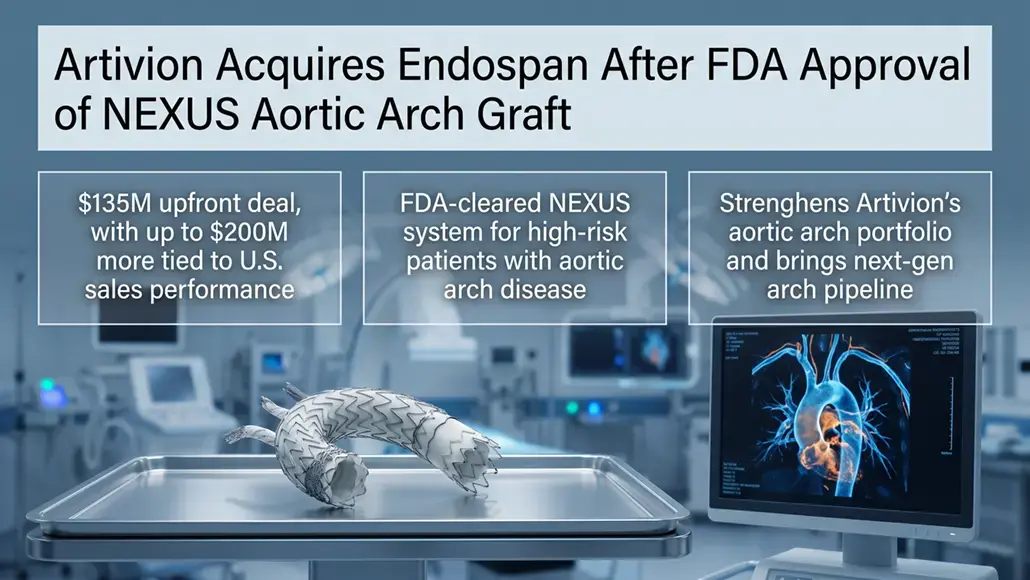

US-based medical device company Artivion has completed its acquisition of Israeli medical technology firm Endospan in a deal valued at $135 million upfront, triggered by the US Food and Drug Administration’s approval of Endospan’s NEXUS aortic graft stent system. The move formally exercises a license option that Artivion had secured under a strategic agreement signed back in 2019, which gave the company the right to acquire Endospan upon the system receiving FDA clearance.
The FDA granted approval for the NEXUS system on 7 April, clearing the device for use in high-risk surgical patients suffering from aortic arch disease a category that encompasses conditions such as chronic dissections of the aorta and aortic arch syndrome. The aorta, the body’s largest blood vessel and a cane-shaped structure that circulates blood from the lower-left chamber of the heart, is the anatomical focus of the NEXUS system’s therapeutic application.
Beyond the $135 million upfront payment, the Artivion Endospan acquisition includes provisions for additional payments of up to $200 million, contingent on NEXUS’s commercial performance in the United States over the next two years. This performance-linked component reflects the commercial expectations tied to the system’s rollout in what is expected to be a significantly underserved patient market.
Artivion had already been serving as the exclusive distributor of the NEXUS system across Europe, the Middle East, and Africa since 2019, giving the company established operational familiarity with the technology ahead of this formal acquisition.
Artivion CEO Pat Mackin described the acquisition as completing the company’s “three-pronged aortic arch portfolio.” The company’s existing product lineup addressing aortic arch pathologies includes the Arcevo LSA stent graft and the AMDS prosthesis, which is designed to treat aortic dissection DeBakey Type I with malperfusion. The addition of the NEXUS aortic graft system rounds out this portfolio with a device specifically engineered for the ascending and aortic arch anatomy.
Mackin further noted that the Artivion Endospan acquisition brings with it a pipeline of next-generation arch technologies currently in development, which the company anticipates will expand and strengthen its position in the aortic arch market over time.
Aortic arch syndrome affects the great arteries branching from the aortic arch, reducing blood supply to the regions those vessels serve. Research indicates that more than 120,000 patients across the US and Europe are diagnosed with the condition annually. Despite this significant patient population, only approximately 25% of those affected are ever diagnosed or treated.
Endospan attributes this low treatment rate to multiple factors. Patients presenting with excessive risk factors may not meet the eligibility criteria for conventional surgery. Additionally, the anatomical complexity of the aortic arch itself presents significant challenges that limit treatment options for many patients a gap that the NEXUS aortic graft system is specifically designed to address.
Endospan CEO Kevin Mayberry acknowledged the significance of the FDA clearance and the transition into Artivion’s broader device ecosystem. Mayberry stated that the FDA approval of the NEXUS system represented a meaningful development for aortic surgeons seeking a technology purpose-built for the ascending aorta and aortic arch. He also noted that within Artivion’s portfolio which supports open, endovascular, and hybrid surgical approaches the NEXUS system is positioned within a company that understands the multidisciplinary demands of the aortic space.
The Artivion Endospan acquisition positions both the NEXUS aortic graft and Endospan’s development pipeline within a commercial and clinical framework aimed at expanding access to treatment for a patient population that remains largely underserved despite a well-documented disease burden.