

















The National Health Service is moving forward with plans to introduce a single patient record system across England a reform designed to consolidate fragmented health data into one unified, accessible profile for every patient. The initiative forms a central pillar of the NHS’s broader digital transformation agenda and is expected to reshape how clinicians access and act on patient information at the point of care.
For decades, patient data across the NHS has remained siloed across dozens of disconnected systems GP records, hospital trusts, mental health providers, and community care teams each holding separate, often incompatible records. The result has been persistent gaps in care, repeated diagnostic tests, and clinical decisions made without full visibility of a patient’s history.
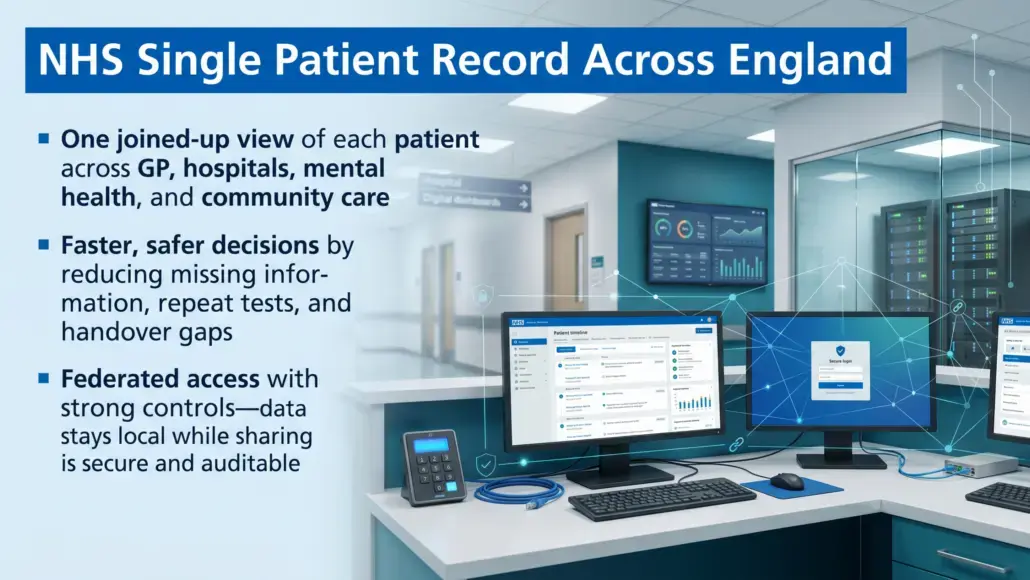
The NHS single patient record initiative directly addresses this fragmentation. Under the proposed model, authorised healthcare professionals would be able to access a comprehensive, real-time view of a patient’s medical history, medications, diagnoses, allergies, and previous care interactions regardless of which part of the system that patient has previously engaged with.
The consolidated record is intended to bring together information currently scattered across primary, secondary, and community care settings. This includes GP records, hospital discharge summaries, diagnostic results, prescribed medications, and relevant social care data. Clinicians treating a patient in an emergency, for example, would no longer need to rely on incomplete information or wait for records to be manually transferred.
The NHS federated data platform is expected to play a key role in enabling this infrastructure. Rather than creating a single centralised database, the federated model allows data to remain within local systems while still being accessible in a joined-up way addressing both technical and governance concerns around data centralisation.
A key aspect of the plans involves giving patients greater agency over their own health information. The proposals include mechanisms for individuals to view their own records and, where appropriate, control how their data is shared across care settings. This reflects growing expectations around transparency and data rights within the public sector.
Data security and consent frameworks are central to the implementation design. NHS England has indicated that robust safeguards would govern who can access records and under what circumstances, with strict audit trails and access controls built into the system architecture.
From a healthcare operations standpoint, a functioning single patient record system carries substantial implications for NHS efficiency. Duplication of tests and procedures a known cost driver within the health service could be reduced significantly if clinicians have immediate access to prior results. Clinical handovers between teams and care settings, frequently a point of risk in patient safety terms, would also benefit from more complete and consistent information sharing.
The NHS digital transformation agenda has placed data interoperability at its core, and the single patient record represents one of the most tangible expressions of that direction. Healthcare modernisation at this scale requires not only technological investment but also changes in clinical workflow, staff training, and cross-organisational data agreements.
NHS England is progressing the initiative as part of its wider data and digital strategy. While a full national rollout will take time, the direction of travel is clearly set toward a more connected, data-driven health system. Integrated care systems across England are expected to play a role in the local delivery of this programme, given their remit to coordinate care across providers within defined geographies.
For healthcare industry executives and system leaders, the advancement of the NHS single patient record signals a concrete shift in how the health service intends to manage patient data moving from a fragmented, institution-by-institution model toward one built around the patient journey as a whole.
The NHS federated data platform and the broader push for healthcare modernisation reflect a system-level commitment to making patient data work harder, more safely, and more equitably across the entire care continuum.