













Close
Digital Health & Ai Innovation summit 2026
Medical Taiwan 2026

Global Revenue of Gene Therapy Estimated to Touch a Valuation of US$ 5 Bn by 2026, Concludes Fact.MR

Note* - All images used are for editorial and illustrative purposes only and may not originate from the original news provider or associated company.

Subscribe

- Never miss a story with notifications

- Gain full access to our premium content

- Browse free from any location or device.

Media Packs

Expand Your Reach With Our Customized Solutions Empowering Your Campaigns To Maximize Your Reach & Drive Real Results!

– Access the Media PackNow

– Book a Conference Call

Leave Message for Us to Get Back

Related stories

Healthcare Financing Models Supporting Modern Care...

The transformation of the economic foundations of medicine from a volume-based to a value-based model represents the most significant shift in clinical administration in over a generation. In an era of rising costs and an aging population, the traditional "fee-for-service" approach is being replaced by sophisticated financial structures that incentivize high-quality outcomes and long-term health maintenance. By integrating insurance innovation, sustainable investment strategies, and data-driven cost optimization, healthcare financing models supporting modern care delivery are becoming the primary driver of clinical sustainability and innovation. This evolution ensures that financial resources are allocated where they have the most impact improving the lives of patients and ensuring that the healthcare system remains resilient and accessible for every member of society.

Regulatory Compliance in Healthcare Technology Advancements

The rapid integration of sophisticated digital tools into clinical practice requires a robust and adaptive oversight framework to ensure that innovation never comes at the expense of patient safety or data integrity. As medical technologies evolve from simple mechanical devices to complex, AI-driven diagnostic and therapeutic systems, the role of governmental and professional standards becomes increasingly critical. By establishing clear certification processes and rigorous risk management protocols, regulatory compliance in healthcare technology advancements is becoming the primary guardian of quality in the modern medical landscape. This commitment to oversight ensures that the benefits of high-tech medicine such as improved accuracy and more personalized treatments are delivered within a secure and ethically sound environment, effectively bridging the gap between scientific discovery and safe clinical application.

Healthcare Interoperability Enabling Connected Care Systems

The ability of disparate digital platforms to seamlessly exchange and interpret clinical information represents the critical infrastructure upon which modern medicine is built. In a complex care environment where patients often interact with multiple specialists, pharmacists, and community health providers, the lack of data connectivity can lead to fragmented care and significant safety risks. By establishing a unified framework for data exchange and electronic health records integration, healthcare interoperability enabling connected care systems is becoming the primary driver of clinical coordination and efficiency. This transformation ensures that the right information reaches the right provider at the right time, creating a comprehensive "clinical narrative" that supports better decision-making and a more patient-centered approach to healing.

Gene therapies have emerged as a promising treatment approach to address various diseases such as cancer, and certain inherited disorders with a single curative dosage. Although they are poised to ensure cost savings in the long run, their high initial expenses and uncertainties regarding their prolonged efficacy are an existing challenge for market players.

Government agencies including, the Food and Drug Administration (FDA), and the European Medicines Agency (EMA), have approved the usage of drug – Kymriah, and Yescarta – to treat elapsed/refractory B-cell Acute Lymphoblastic Leukemia (ALL), and diffuse large B-cell lymphoma (DLBCL). However, the market uptake of both these gene therapy products have been below par.

Despite the ongoing issues, the worldwide revenue of gene therapy market will surpass US$ 5 Bn by 2026, exhibiting a stellar growth rate. At-scale investments in the field of gene-related R&D, and increasing number of late-stage gene therapy candidates in oncology and other genetic disorders are likely to oil the growth engine.

Key Takeaways of the Gene Therapy Market:

  • In terms of revenue, Yescarta holds prominence in the gene therapy market, while Luxturna stays ahead in terms of annual growth rate.
  • Over half of gene therapy research studies are focused on the field of oncology, attributable to notable rise in caseloads of various cancer types.
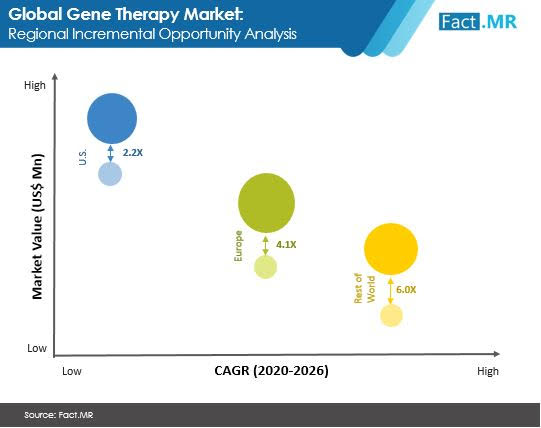
  • The US currently represents the most lucrative opportunities in the gene therapy market; while Europe is expected outpace the region towards the end of forecast period.
  • Fast uptake of regulatory bodies in the US and Europe for approval and commercialization of gene therapy products are likely to propel market growth.

Cancer types including, DLBCL, and acute lymphoblastic leukemia (ALL) are among the major causes of mortalities across the globe, especially in developed regions. Realizing the immense potential of gene therapy in treating rare diseases, governments are investing in gene therapy treatment centers to increase access to enhanced patient pool”, Says an Analyst at Fact.MR.
Market Players to Establish Proprietary Manufacturing Units

Amidst rising pool of patients suffering from cancer, governments, biopharmaceutical companies, and research institutes are significantly driving their attention towards gene-centric R&D projects. This is setting high hopes for gene therapy market players. However, as a response to increasing costs and delays associated with pulling in third-party contract manufacturers, leading market players are establishing proprietary manufacturing plants.

For instance, Novartis AG has invested US$ 500 Mn to set up its own gene therapy manufacturing facility, following Pfizer Inc. which has allocated US$ 600 Mn for the same. Such a tactic will help manufacturers safeguard proprietary production techniques and deal with concerns issued by regulatory authorities more efficiently.

As third-party contract manufacturers house limited production capacity for upcoming gene therapy methods under development stage, internal manufacturing units in the long run is an imperative for gene therapy market players.

Key players with strong market presence in global gene therapy market are, but not limited to, Novartis AG, Gilead Sciences Inc., Spark Therapeutics Inc., Sibiono GeneTech Co. Ltd., Spark Therapeutics, Inc., CELGENE CORPORATION, and Orchard Therapeutics Limited, among others.

Looking for more information?

The research study on the gene therapy treatment market by Fact.MR includes an in-depth analysis of major demand-driving factors and trends and a comprehensive evaluation of crucial aspects that are projected to carve the growth of the gene therapy market during 2020–2026. Market statistics have been elucidated based on product (Yescarta, Kymriah, Luxturna, Strimvelis, and Gendicine), application (Ophthalmology, Oncology, and Adenosine Deaminase-deficient Severe Combined Immunodeficiency (ADA-SCID)) and across key regions (The US, Europe and Rest of World).

To Get More Insights on Gene Therapy Treatment Market, Visit- https://www.factmr.com/connectus/sample?flag=S&rep_id=4648


Fact.MR
Company Logo
MEDICAL FAIR ASIA 2026

Latest stories

Related stories

Healthcare Financing Models Supporting Modern Care Delivery

The transformation of the economic foundations of medicine from a volume-based to a value-based model represents the most significant shift in clinical administration in over a generation. In an era of rising costs and an aging population, the traditional "fee-for-service" approach is being replaced by sophisticated financial structures that incentivize high-quality outcomes and long-term health maintenance. By integrating insurance innovation, sustainable investment strategies, and data-driven cost optimization, healthcare financing models supporting modern care delivery are becoming the primary driver of clinical sustainability and innovation. This evolution ensures that financial resources are allocated where they have the most impact improving the lives of patients and ensuring that the healthcare system remains resilient and accessible for every member of society.

Regulatory Compliance in Healthcare Technology Advancements

The rapid integration of sophisticated digital tools into clinical practice requires a robust and adaptive oversight framework to ensure that innovation never comes at the expense of patient safety or data integrity. As medical technologies evolve from simple mechanical devices to complex, AI-driven diagnostic and therapeutic systems, the role of governmental and professional standards becomes increasingly critical. By establishing clear certification processes and rigorous risk management protocols, regulatory compliance in healthcare technology advancements is becoming the primary guardian of quality in the modern medical landscape. This commitment to oversight ensures that the benefits of high-tech medicine such as improved accuracy and more personalized treatments are delivered within a secure and ethically sound environment, effectively bridging the gap between scientific discovery and safe clinical application.

Healthcare Interoperability Enabling Connected Care Systems

The ability of disparate digital platforms to seamlessly exchange and interpret clinical information represents the critical infrastructure upon which modern medicine is built. In a complex care environment where patients often interact with multiple specialists, pharmacists, and community health providers, the lack of data connectivity can lead to fragmented care and significant safety risks. By establishing a unified framework for data exchange and electronic health records integration, healthcare interoperability enabling connected care systems is becoming the primary driver of clinical coordination and efficiency. This transformation ensures that the right information reaches the right provider at the right time, creating a comprehensive "clinical narrative" that supports better decision-making and a more patient-centered approach to healing.

Patient Engagement Technologies Enhancing Care Experience

The evolution of clinical care from a provider-centric model to one that actively involves the individual represents a profound shift in the modern medical landscape. By integrating digital communication tools, comprehensive patient portals, and intuitive mobile health applications, healthcare institutions are empowering individuals to take a leading role in their own wellness journeys. This transformation is not merely about the introduction of new software; it is about fostering a collaborative environment where information flows freely and the patient-provider relationship is built on a foundation of mutual transparency and respect. As these systems become more sophisticated, patient engagement technologies enhancing care experience are becoming the primary catalyst for improved health outcomes and a more personalized standard of care.

Subscribe

- Never miss a story with notifications

- Gain full access to our premium content

- Browse free from any location or device.

Media Packs

Expand Your Reach With Our Customized Solutions Empowering Your Campaigns To Maximize Your Reach & Drive Real Results!

– Access the Media Pack Now

– Book a Conference Call

Leave Message for Us to Get Back

Translate »