













Key Takeaways
- AI-driven QSAR models predict pharmacokinetic properties with 85-90% accuracy, reducing the number of compounds advancing to animal testing by 50%
- Machine learning toxicity prediction prevents costly late-stage clinical trial failures by identifying potential safety liabilities at early screening stages
- Predictive efficacy models enable patient stratification, identifying which patient populations will respond best to specific drug candidates
- In silico drug-drug interaction predictions reduce adverse event discoveries during clinical trials by 35-40%
- Machine learning models analyzing vast datasets identify novel biomarkers predicting individual patient responses to therapeutics
- Real-world evidence integration enables continuous model refinement, improving predictions as new clinical data emerges
The pharmaceutical industry confronts a sobering reality: approximately 90% of drug candidates fail during development, with most failures occurring in expensive clinical trial phases. The financial and human costs are staggering billions spent on compounds that ultimately prove ineffective or unsafe. This waste persists despite our advanced understanding of biology and chemistry. Predictive drug development modeling powered by artificial intelligence offers a transformative solution, enabling researchers to identify problematic compounds and unsuitable populations before investing massive resources in clinical testing.
The Foundation: Understanding Pharmacokinetics Through Prediction
Pharmacokinetics how the body absorbs, distributes, metabolizes, and excretes drugs represents one of the most critical yet challenging aspects of drug development. A compound might show exquisite activity against its intended target in laboratory tests, yet fail clinically because the body rapidly metabolizes it or fails to achieve adequate concentrations at the disease site. Historically, determining pharmacokinetic properties required expensive animal studies and eventual human testing.
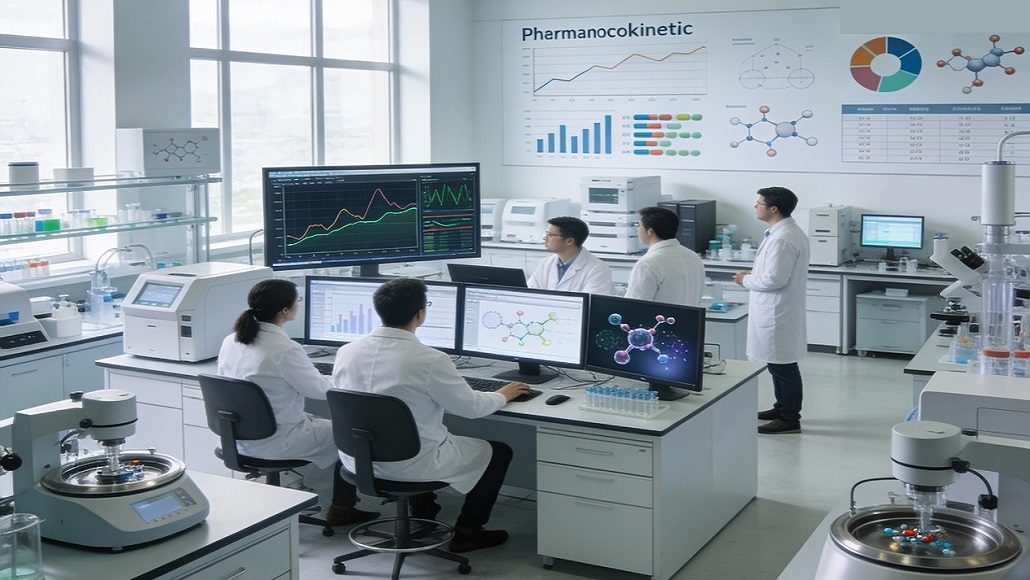
Machine learning has revolutionized this landscape. Predictive drug development modeling systems trained on thousands of known drugs can now forecast pharmacokinetic properties from molecular structure alone, often with remarkable accuracy. These models learn the relationship between chemical structure and how the human body processes compounds, then apply that understanding to novel molecules.
The sophistication of these approaches varies. Simple machine learning models might achieve 75-80% prediction accuracy for basic properties like blood-brain barrier penetration. Advanced deep learning systems considering three-dimensional molecular geometry, lipophilicity, molecular weight, and hydrogen bonding patterns achieve 85-90% accuracy for complex predictions. While not perfect, these predictions provide extraordinary value early in development, allowing researchers to eliminate compounds unlikely to reach therapeutic target tissues or that will be rapidly eliminated from the body.
Quantitative Structure-Activity Relationships and AI
Quantitative Structure-Activity Relationship (QSAR) modeling represents the grandfather of computational drug design, but artificial intelligence has revitalized this approach. Traditional QSAR models used statistical methods to relate molecular properties to biological activity. Modern AI-enhanced QSAR combines these classical principles with machine learning sophistication.
Contemporary predictive drug development modeling systems employ neural networks, ensemble methods, and deep learning architectures to understand structure-activity relationships with unprecedented nuance. Rather than relying on hand-selected molecular descriptors, these systems can learn which structural features matter most for a given target. A compound with a particular side chain substitution might be critical for binding a viral protease but irrelevant for a kinase inhibitor, and sophisticated models can learn these target-specific patterns.
Graph neural networks represent a particularly promising advancement. These architectures represent molecular structures as interconnected nodes (atoms) and edges (bonds), allowing the algorithm to understand both local chemical environments and global molecular topology. This approach has proven especially valuable for predicting ADMET (Absorption, Distribution, Metabolism, Excretion, Toxicity) properties the comprehensive set of factors determining whether a compound will achieve therapeutic success.
Forecasting Toxicity Before Human Exposure
Perhaps the highest-value application of predictive modeling in pharmaceutical development involves forecasting toxicity. Discovering that a compound is toxic in humans after years of development represents not merely financial loss but potential harm to trial participants. Computational toxicity prediction provides early warning systems for such problems.
Machine learning toxicity models are trained on extensive datasets of chemical structures and their known toxicological properties. These systems can predict various toxicity endpoints hepatotoxicity (liver damage), cardiotoxicity (heart damage), mutagenicity (potential to cause mutations), and others. The algorithms identify molecular features associated with toxicity risk.
Notably, predictive drug development modeling systems excel at identifying compounds with unusual toxicity risks. A molecule might pass standard safety testing but contain obscure structural features associated with rare but serious adverse effects. Sophisticated machine learning models, trained on comprehensive toxicology datasets, can flag these concerns before animal testing begins.
The business impact is substantial. A compound that advances through animal studies only to show unacceptable toxicity in human trials can cost $50-100 million and severely damage company reputation. Computational toxicity prediction prevents many such failures, redirecting development efforts toward inherently safer compounds.
Efficacy Prediction and Target Engagement Assessment
Beyond safety considerations, predictive models forecast drug efficacy whether a compound will actually produce the desired therapeutic effect. This involves understanding how well the compound binds to its intended target and whether that binding produces the desired biological consequence.
Molecular docking simulations, increasingly powered by machine learning, predict how well a small molecule fits into a protein binding site and with what strength. Deep learning models trained on crystallographic data of protein-ligand complexes have achieved remarkable prediction accuracy. When new compounds are docked, these models provide rapid assessment of binding probability.
However, binding prediction is only part of efficacy modeling. Predictive drug development modeling must also consider whether target engagement produces the desired effect. A compound might bind exquisitely to its target but fail therapeutically because the target is not the actual disease-causing mechanism, or because blocking that target produces problematic off-target effects. Sophisticated models attempt to predict these functional relationships by integrating target biology, pathway analysis, and disease mechanism understanding.
Patient-level efficacy prediction represents an emerging frontier. Rather than asking whether a compound will work in the general population, advanced models ask whether it will work in specific patient subpopulations. Some people metabolize drugs rapidly due to genetic variations, rendering standard doses ineffective. Others have genetic or biochemical factors making them exquisitely sensitive to the same dose. Predictive models increasingly attempt to identify these patient-level variations, enabling patient stratification strategies.
The ADMET Bottleneck and AI Solutions
The pharmaceutical industry identifies ADMET properties as a critical bottleneck in drug development. Many compounds with excellent target binding fail because they cannot be absorbed orally, are rapidly metabolized, or accumulate in tissues causing toxicity. Historically, ADMET problems were discovered late in development through expensive animal studies and early human trials.
Machine learning has transformed ADMET prediction. Comprehensive models now forecast multiple ADMET endpoints from molecular structure:
Absorption Prediction involves forecasting whether compounds can cross the gastrointestinal tract and enter systemic circulation. Factors include molecular weight, lipophilicity, hydrogen bonding capability, and topological polar surface area. Machine learning models trained on thousands of compounds can predict absorption probability with 80%+ accuracy.
Distribution Prediction forecasts where compounds localize within the body. High brain penetration is desired for neurological drugs but problematic for peripheral compounds (where brain penetration risks side effects). Low plasma protein binding is often preferred. Predictive models consider lipophilicity, size, and charge distribution to forecast these properties.
Metabolism Prediction identifies which enzymes will metabolize a compound and how quickly. Rapid metabolism in some individuals requires higher doses; excessive metabolism in everyone renders a compound therapeutically impractical. Machine learning models, trained on extensive cytochrome P450 metabolism data, predict metabolic rates and primary metabolite structures.
Excretion Prediction forecasts whether compounds will be renally eliminated, hepatically eliminated, or sequestered in tissues. Accumulation problems warrant careful monitoring in repeat-dose studies. Predictive models inform preclinical safety strategies.
Toxicity Prediction, as discussed previously, identifies safety concerns.
Integration of these predictions into a unified predictive drug development modeling platform gives researchers comprehensive ADMET understanding early in development, enabling intelligent decisions about which compounds merit further investment.
Integration with Real-World Evidence and Clinical Data
Historically, drug development relied on primary research data animal studies, clinical trials to inform decisions. Modern predictive drug development modeling increasingly incorporates real-world evidence from electronic health records, patient registries, and post-market surveillance data. This approach provides additional learning signals to improve model accuracy.
Machine learning systems trained on real-world outcomes data can identify patterns humans might miss. For example, patient response variability to existing drugs might indicate which genetic variants or biomarkers predict individual efficacy and safety. These insights, integrated into predictive models for new compounds, enable better candidate selection and patient stratification strategies.
Furthermore, as new drugs achieve regulatory approval and accumulate safety/efficacy data, this information feeds back into predictive models. A compound’s actual pharmacokinetics in humans might differ slightly from predictions; these deviations inform algorithm refinement. Over time, models become increasingly accurate as they learn from actual outcomes.
Accelerating Clinical Trial Design and Patient Selection
Predictive models inform not only which compounds advance to trials but how those trials are designed. Machine learning can optimize trial size, duration, and patient population selection based on predicted compound properties and disease-specific factors.
Patient stratification represents a particularly valuable application. Rather than enrolling all comers into a trial, predictive models identify which patient subpopulations are most likely to respond to a compound. This approach enables smaller, faster trials focused on responsive populations, accelerating development timelines and improving apparent efficacy.
Biomarker prediction represents related territory. Predictive models, analyzing compound properties and target biology, can suggest which patient characteristics (genetic markers, protein expression levels, etc.) predict response. Clinical trials can then enroll patients selected based on these predicted biomarkers, improving trial efficiency and increasing probability of regulatory approval.
Overcoming Data Limitations and Algorithmic Challenges
Despite impressive progress, predictive drug development modeling faces genuine challenges. Machine learning models require substantial training data, yet proprietary pharmaceutical data remains closely guarded. Public datasets exist but are often biased toward compounds companies chose to develop further, creating survivorship bias in training data.
Additionally, predictions must account for the complexity of biological systems. A compound’s effect depends not merely on its chemical structure but on cellular context, tissue distribution, metabolic enzymes present in specific individuals, and thousands of other factors. No model, regardless of sophistication, can perfectly predict outcomes in complex biological systems.
Leading pharmaceutical companies address these challenges through collaborative approaches. Sharing anonymized chemical and biological data across companies increases training dataset size and diversity, improving model generalizability. Academic institutions contribute diverse perspectives and methodologies. Federal initiatives encourage predictive model development for rare diseases where company data is limited.
The Future of Predictive Modeling: Integration and Personalization
The trajectory of predictive drug development modeling points toward increasingly integrated systems. Rather than predicting individual endpoints (pharmacokinetics, toxicity, efficacy) separately, next-generation models will simultaneously optimize across all critical factors. This multi-objective optimization will enable discovery of compounds that balance safety, efficacy, manufacturability, and cost.
Personalized medicine integration represents another frontier. Rather than developing single compounds for general populations, pharmaceutical teams will increasingly design therapeutics for specific patient subpopulations identified through predictive modeling of their unique biology. For rare genetic diseases, this approach is already emerging identifying the tiny patient population that will respond to a specific compound.
Artificial intelligence will continue advancing these capabilities. Transfer learning approaches, where models trained on one disease transfer knowledge to related diseases, promise faster development of compounds for conditions with limited historical data. Few-shot learning systems may ultimately enable accurate predictions from minimal training examples.