









Key Takeaways
- Real-time data analytics from connected devices reduce hospital readmissions by 25-35% through early detection of clinical deterioration
- Continuous monitoring data enables clinical interventions 24-48 hours before acute events, shifting care from reactive to proactive
- Predictive analytics from device data streams identify 80-85% of patients at risk for adverse events before clinical manifestation
- Machine learning models analyzing continuous vital sign data improve diagnostic accuracy by 15-25% compared to episodic assessments
- Real-time analytics enable medication and treatment adjustments based on actual physiological response, optimizing personalized care
- Population health analytics from aggregated device data identify community disease patterns and inform targeted public health interventions
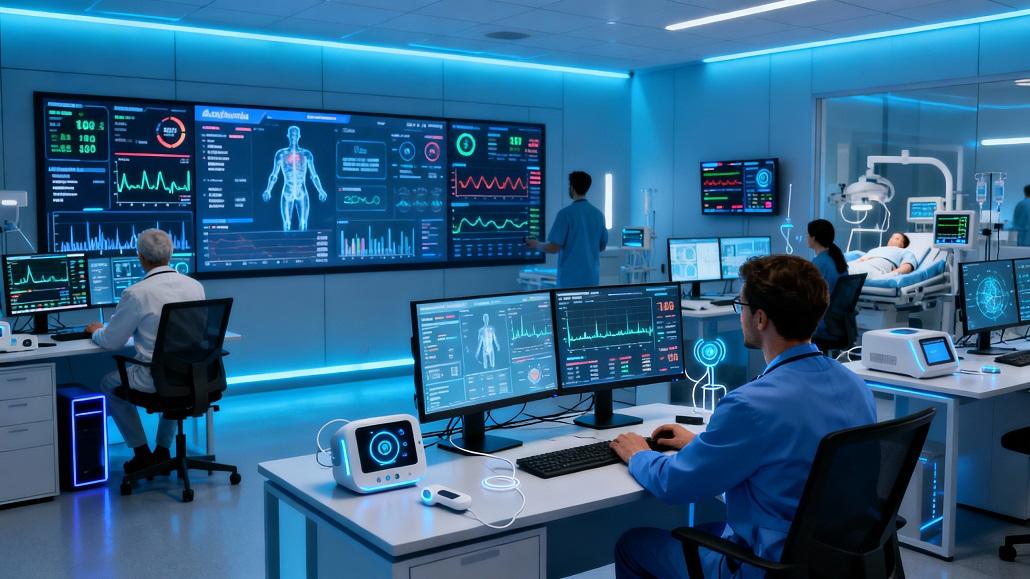
Healthcare traditionally operates on episodic information. Patients see providers at intervals annual physicals, quarterly appointments for chronic disease management, urgent visits for acute problems. Each visit generates a snapshot of health at that moment, which providers use to make decisions. The extensive periods between visits remain mysteries; clinicians don’t know how patients actually function day-to-day, which interventions work, or when problems emerge. Real-time healthcare data analytics from connected devices transforms this model fundamentally, providing clinicians with continuous information streams enabling truly data-informed decision-making.
The Revolution in Healthcare Data Availability
Connected devices wearables, home monitoring equipment, implantable devices, connected medication dispensers generate vast data streams. Heart rate measurements every minute, blood pressure readings several times daily, glucose measurements every 5 minutes from continuous monitors, weight measurements at consistent times. Collectively, these information streams provide extraordinarily detailed understanding of patient physiology and behavior far richer than any traditional assessment.
The volume is remarkable. A single patient using multiple connected devices might generate tens of thousands of data points monthly. Aggregated across healthcare populations, this data volume exceeds petabytes. Traditional analysis methods cannot process this volume manually. Real-time healthcare data analytics systems employing advanced algorithms distill this data torrent into clinically actionable insights.
Continuous Monitoring Versus Episodic Assessment
The contrast between episodic and continuous monitoring reveals data analytics’ power. Consider hypertension management. Traditional approach: patient visits office quarterly, blood pressure is measured once, medication adjusted if needed. Patient goes home unaware of actual daily blood pressure patterns. Perhaps their pressure is consistently elevated; perhaps they have white coat hypertension (elevated only in clinical settings); perhaps readings vary wildly day-to-day. One office visit cannot distinguish these scenarios.
Real-time healthcare data analytics examining 90 days of home blood pressure readings reveals actual patterns. Is pressure consistently elevated (supporting medication increase)? Is pressure normal with occasional spikes (suggesting situational stress, not requiring medication change)? Is there clear circadian pattern with morning elevations responsive to specific interventions? This detailed understanding enables precision treatment adjustments impossible with episodic data.
The advantage extends beyond medication management. Patients often ask “Is my blood pressure controlled?” Traditional answer: “Yes, your office reading was acceptable.” Reality: office measurement might not represent their actual status. Real-time analytics examining comprehensive data provide authoritative answers grounded in actual physiology.
Real-Time Alert Systems and Immediate Interventions
Connected devices integrated with analytics systems enable real-time alerting when dangerous conditions develop. A diabetic patient’s glucose plummets toward dangerous lows; their continuous glucose monitor alerts them to consume carbohydrates immediately, preventing severe hypoglycemia. A heart failure patient’s weight suddenly increases 3 pounds overnight, suggesting fluid accumulation; the system alerts both patient and provider that diuretics might need adjustment.
These real-time alerts transition patient monitoring from information gathering to intervention triggering. Rather than waiting for office visits to discover problems, alerts enable immediate response. Studies demonstrate that this real-time responsiveness reduces hospitalizations, improves outcomes, and increases patient satisfaction simultaneously.
Real-time healthcare data analytics algorithms must distinguish true concerning changes from noise. Normal variation in daily weight (1-2 pounds) shouldn’t trigger alarms; sustained 3+ pound increases warrant attention. Heart rate varies considerably; recognizing abnormal patterns amid normal variation requires sophisticated algorithms. Machine learning models trained on extensive physiological data can make these distinctions reliably.
Predictive Analytics and Preventive Intervention
Beyond identifying current problems, analytics systems predict future risk based on data trends. Machine learning algorithms analyzing vital sign patterns, activity levels, medication adherence, and other factors can identify patients likely to experience adverse events hospitalization, emergency department visit, clinical deterioration within coming weeks or months.
These predictions enable proactive intervention. A patient predicted at high risk of hospitalization receives intensified monitoring, increased provider touchpoints, and preventive interventions. Perhaps their disease-specific treatment is optimized; perhaps they receive additional education; perhaps they’re scheduled for preventive provider consultation. Whatever intervention occurs, it happens before crisis develops rather than reactively after.
The predictive accuracy is often surprising. Algorithms analyzing heart failure patients’ data can identify within 30 days which patients will require hospitalization with 80-85% accuracy. This accuracy enables targeted preventive efforts toward those most likely to benefit, focusing limited clinical resources efficiently.
Machine Learning Models Improving Diagnostic Accuracy
Diagnostic accuracy improves substantially when algorithms analyze comprehensive continuous data rather than episodic information. Consider fever evaluation. Is patient’s elevated temperature indicating infection requiring antibiotics, or benign viral illness resolving naturally? Clinicians use pattern recognition from experience, often imperfectly.
Machine learning models analyzing comprehensive temporal patterns temperature trajectory, associated symptoms, activity levels, immune markers if available can improve diagnostic accuracy by 15-25% compared to single-timepoint assessment. The algorithm learns subtle patterns predicting bacterial versus viral infection, differentiating serious infections from minor illness. While not replacing clinical judgment, these algorithmic insights augment human expertise.
Similar improvements appear across diagnostic scenarios. Algorithms analyzing continuous glucose and physical activity data can differentiate Type 1 and Type 2 diabetes, informing treatment selection. Algorithms analyzing sleep and activity patterns can differentiate depression from other conditions causing fatigue. Real-time healthcare data analytics provides richer diagnostic information than episodic clinical assessment.
Personalized Treatment Optimization
Treatment response varies substantially between individuals. A blood pressure medication that works excellently for one patient proves ineffective for another. A diabetes treatment that achieves perfect glucose control in one individual requires adjustment in another. Traditional medicine manages this variability through sequential trials try treatment, assess response, adjust if needed. This process takes weeks or months.
Real-time healthcare data analytics accelerates this optimization process. Rather than waiting weeks to assess medication response through patient report and office measurements, continuous data provides immediate response information. Did the blood pressure increase follow the medication initiation? Do glucose readings change following dietary modification? Rapid feedback enables faster treatment optimization.
Moreover, algorithms can predict treatment response before initiating therapy. Machine learning models trained on thousands of patients can learn which patient characteristics predict responsiveness to specific treatments. While not perfect, these predictions guide initial treatment selection, reducing trial-and-error cycles. A patient likely to respond poorly to Drug A should trial Drug B instead, accelerating route to effective treatment.
Population Health Analytics and Disease Patterns
While individual patient data provides personalized insights, aggregated population data reveals broader patterns. Real-time healthcare data analytics examining community-level health data identifies disease patterns, environmental influences, and population health trends.
For example, aggregated asthma patient data might reveal correlation between air quality and symptom exacerbation, enabling public health alerts. Cardiovascular data across populations might show seasonal patterns in myocardial infarctions, supporting preventive efforts during high-risk seasons. Disease surveillance systems analyzing connected device data can detect disease outbreaks earlier than traditional surveillance, enabling rapid public health response.
Privacy-preserving analytics techniques enable population health insights without compromising individual privacy. De-identified data aggregated across hundreds of thousands of patients reveals patterns individual records cannot. Health systems and public health agencies increasingly use this approach for surveillance and population health management.
Clinical Decision Support Systems
Connected device data feeds into clinical decision support systems providing providers with evidence-based guidance. When a patient presents with symptoms, the system accesses their continuous monitoring data. Rather than relying on patient memory (“How have your symptoms been?”), the system shows objective data activity patterns, vital sign trends, symptom tracking from patient reports. This objective information guides provider assessment.
Decision support algorithms suggest diagnoses to consider based on symptom patterns and available data. Treatment recommendations incorporate patient-specific factors: medication history, comorbidities, prior treatment response. Rather than generic guidelines, recommendations reflect individualized factors. Providers can accept or override suggestions; the system’s role is augmenting judgment, not replacing it.
These systems improve care quality while reducing cognitive load. Providers don’t need to synthesize vast data streams; algorithms handle this. Providers focus on integrating information, discussing options with patients, and making final treatment decisions.
Integration Challenges and Data Standardization
Despite potential, real-time healthcare data analytics faces integration challenges. Connected devices from various manufacturers generate data in different formats using proprietary standards. Integrating this heterogeneous data into unified health records requires substantial technical work. Standards development efforts like FHIR (Fast Healthcare Interoperability Resources) aim to simplify integration, but progress remains incomplete.
Data quality issues present another challenge. Sensors malfunction, producing erroneous readings. Patients forget to charge devices or wear them inconsistently, generating incomplete data. Algorithms must handle missing data and outliers gracefully without compromising reliability. Machine learning approaches increasingly incorporate uncertainty quantification, reporting confidence levels alongside predictions.
Privacy and security considerations add complexity. Patient data traveling across networks faces interception risks. Storing vast health data attracts criminal attention. Regulatory compliance with HIPAA, GDPR, and other frameworks requires substantial infrastructure. Successfully navigating these challenges enables analytics value while protecting patient privacy.
Addressing Algorithm Bias and Fairness
Machine learning algorithms can perpetuate or amplify existing healthcare disparities. Algorithms trained disproportionately on data from privileged populations may perform poorly for minorities. Algorithms trained on hospital data reflecting healthcare access disparities might inappropriately guide resource allocation. Real-time healthcare data analytics systems must deliberately address bias.
Forward-thinking organizations examine algorithm performance across demographic groups, explicitly testing for disparities. They diversify training data to represent all populations their systems serve. They involve affected communities in algorithm development, incorporating patient perspectives. They remain transparent about algorithm limitations and caveats.
The Future: Edge Computing and Artificial Intelligence at Scale
The trajectory of real-time healthcare data analytics points toward increasingly distributed, intelligent systems. Rather than all data streaming to centralized servers, future systems might employ edge computing processing occurring on wearable devices themselves. Smartwatches would perform sophisticated analysis locally, reporting only clinically significant findings to the cloud. This approach reduces data transmission, improves privacy, and enables faster response.
Artificial intelligence will increasingly automate clinical tasks. Rather than humans manually reviewing trending data, AI systems will execute entirely autonomous interventions within defined parameters. An AI system might autonomously adjust insulin pump infusion rates based on continuous glucose data and predictive models. These autonomous systems, while maintaining human oversight and the ability to intervene, enable truly continuous optimization impossible with human intervention.