










The landscape of medical technology is being fundamentally reshaped by a wave of digital and mechanical innovation that is making the production of complex devices faster, more precise, and more reliable than ever before. In an era where patient safety and device efficacy are under constant scrutiny, the role of medical device manufacturing and automation has transitioned from a high-tech luxury to a baseline requirement for global competitiveness. By integrating robotics, artificial intelligence, and advanced sensing technologies into the production floor, manufacturers are not only increasing their throughput but also achieving a level of quality consistency that manual processes simply cannot replicate.
The Integration of Robotics and Precision Engineering
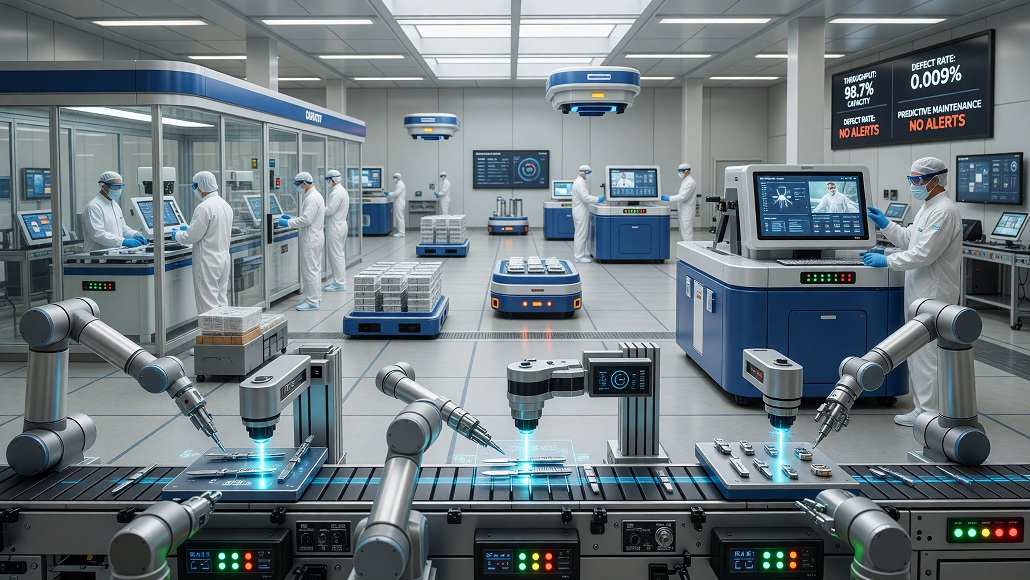
At the heart of modern MedTech production is the synergy between robotics and precision engineering. Modern medical devices, ranging from micro-scale implants to complex surgical robots, require tolerances that are measured in microns. Human operators, while skilled, are subject to fatigue and variability that can lead to subtle defects. In contrast, the systems used in medical device manufacturing and automation are designed for perfect repeatability. Robotic arms equipped with high-resolution vision systems can perform intricate assembly tasks, such as micro-soldering or the placement of tiny sensors, with a level of accuracy that ensures 100% adherence to design specifications every time.
Collaborative Robots (Cobots) in the Cleanroom
One of the most significant shifts in medical device manufacturing and automation is the rise of collaborative robots, or “cobots.” Unlike traditional industrial robots that operate in isolated cages, cobots are designed to work safely alongside human technicians. This hybrid approach allows for the best of both worlds: the cognitive flexibility and problem-solving skills of a human worker combined with the tireless precision of a machine. In a cleanroom environment, cobots can handle repetitive, ergonomically taxing tasks, such as the loading and unloading of injection molding machines, while the human operator focuses on high-level quality oversight and process optimization.
Smart Manufacturing and the Industrial Internet of Things (IIoT)
The concept of the “smart factory” is becoming a reality in the MedTech industry through the widespread adoption of the Industrial Internet of Things (IIoT). By embedding sensors into every piece of production equipment, manufacturers can create a continuous stream of data that provides a real-time view of the facility’s health. Within the framework of medical device manufacturing and automation, this data is used for predictive maintenance, allowing technicians to identify and fix potential equipment failures before they result in downtime. This interconnectedness also allows for “dynamic scheduling,” where the production line can automatically adjust to changes in raw material availability or shifts in customer demand.
Scalable Production and the Path to Global Market Access
As the global demand for healthcare continues to grow, the ability to achieve scalable production is essential. Automation allows manufacturers to increase their capacity rapidly without a linear increase in labor costs. This scalability is particularly important for devices that are produced in high volumes, such as diagnostic test kits or disposable surgical supplies. By leveraging medical device manufacturing and automation, companies can ensure that they can meet the needs of diverse global markets while maintaining the strict cost controls required by modern healthcare payers.
Maintaining Quality Standards and ISO Compliance
Compliance with international standards, such as ISO 13485, is the bedrock of the medical device industry. Automation plays a critical role in ensuring that every batch meets these rigorous requirements. In an automated system, every production step is tracked and logged in real-time, creating an electronic record that is far more accurate and easier to audit than traditional paper logs. This focus on “compliance by design” means that quality checks are integrated into the process itself. For example, in-line vision systems can inspect 100% of the products on a moving conveyor belt, automatically rejecting any unit that does not meet the predefined quality benchmarks.
Digital Twins and the Virtual Testing Environment
The use of “digital twins” virtual replicas of physical production lines is a cutting-edge trend in medical device manufacturing and automation. Before a single piece of equipment is installed, engineers can simulate the entire manufacturing process in a digital environment. This allows them to identify potential bottlenecks, optimize the layout for maximum efficiency, and even test “what-if” scenarios, such as the impact of a machine failure or a change in raw materials. By solving problems in the virtual world, companies can significantly reduce the time and cost associated with bringing a new production facility online.
The Role of AI and Machine Learning in Process Optimization
Artificial intelligence and machine learning are the “brains” behind the next generation of medical device manufacturing and automation. These technologies can analyze the vast amounts of data generated by the smart factory to identify subtle patterns and correlations that are invisible to the human eye. For instance, an AI algorithm might discover that a specific combination of humidity and cooling time results in a slightly stronger plastic part. By continuously learning from every production cycle, these systems can suggest optimizations that result in higher yields and more robust products.
Automation in Packaging and Post-Production Logistics</h3>
The benefits of automation extend far beyond the assembly line. Packaging and sterilization are critical stages in the medical device lifecycle that are also being transformed. Automated packaging systems can ensure that every device is perfectly sealed and labeled, reducing the risk of sterility breaches or labeling errors. Furthermore, the integration of automation into post-production logistics such as the use of autonomous mobile robots (AMRs) in the warehouse ensures that devices are moved through the facility and out to customers with maximum efficiency and minimal human contact.
Challenges and Opportunities in the Automated Era
While the move toward medical device manufacturing and automation offers immense benefits, it is not without its challenges. The initial capital investment can be significant, and the need for a highly skilled workforce that can maintain and program these complex systems is a major hurdle for many companies. However, for those who successfully navigate this transition, the rewards are substantial. Not only can they produce better products at a lower cost, but they also gain the agility needed to respond to an increasingly volatile global market.
The Workforce of the Future and the Need for Upskilling
The transition to an automated environment requires a total rethinking of the traditional manufacturing workforce. Rather than manual assemblers, the MedTech companies of the future will need data scientists, robotics engineers, and quality specialists who are as comfortable with software as they are with hardware. This shift highlights the importance of ongoing training and education. Many leading manufacturers are now partnering with technical schools and universities to develop specialized programs that prepare the next generation of workers for the demands of medical device manufacturing and automation.
The integration of advanced automation into medical device manufacturing is a transformative journey that is just beginning. As technologies like AI, robotics, and IIoT continue to mature, the possibilities for innovation are virtually limitless. By embracing medical device manufacturing and automation, companies are not just improving their bottom line; they are ensuring that the world has access to the safe, effective, and high-quality medical devices that are essential for modern healthcare. The future of MedTech is automated, and those who lead the way in this digital revolution will be the ones who define the future of patient care.