
















Ireland has introduced a national strategy outlining how artificial intelligence (AI) will be deployed across health and social care services between 2026 and 2030, with the aim of improving clinical care, operational efficiency, research capabilities, and population health management.
The strategy, titled AI for Care establishes a national framework for the safe, responsible, and effective use of AI across the health system. The initiative sets out four strategic pillars clinical care, operations, research and innovation, and public health and positions AI as a key enabler of healthcare system transformation.
According to the government, the strategy is intended to modernise healthcare services through faster diagnoses, improved patient flow, earlier disease detection, reduced administrative workloads, and greater consistency in care delivery across the country.
Carroll MacNeill, minister for health, described the initiative as a structured roadmap for integrating emerging technologies into healthcare delivery while maintaining strong governance and clinical oversight.
“AI for Care marks an important step toward creating a safer, smarter, and more sustainable healthcare service,” MacNeill said.
“It provides a clear and practical roadmap for adopting AI in ways that are safe, transparent, truly enhance patient care, and support clinicians.
“The strategy focuses on using technology to strengthen, rather than replace the vital human relationships at the core of healthcare.”
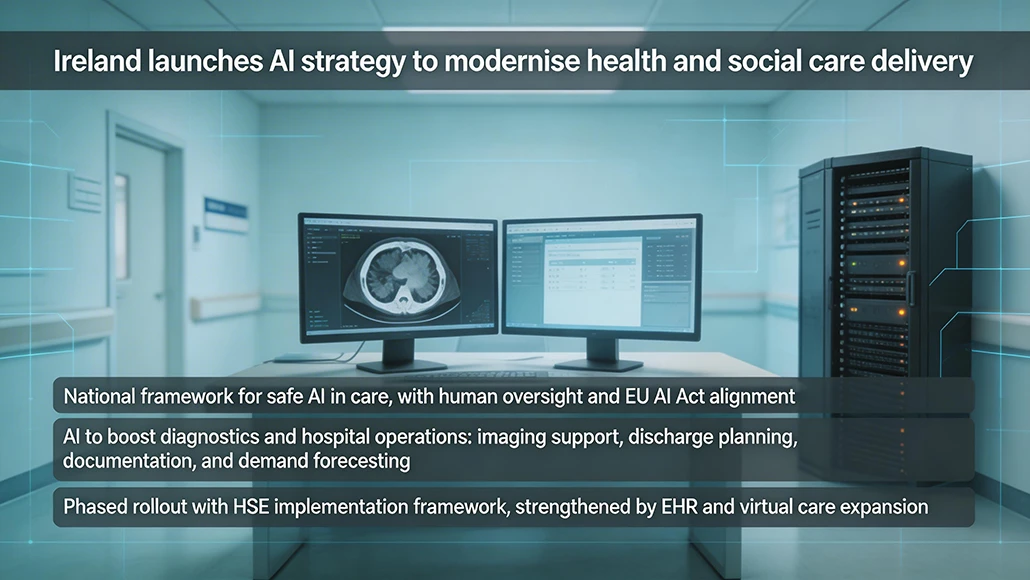
The strategy emphasises safeguards around AI deployment, including mandatory human oversight, alignment with the EU AI Act, and forthcoming national guidance from the Health Information and Quality Authority (HIQA).
Clinical and operational applications
The government outlined several areas where AI technologies will be applied to support clinical practice and hospital operations. Certified AI systems will assist radiologists in analysing medical images more rapidly, enabling earlier detection of conditions such as strokes, cancers and fractures.
Other proposed applications include AI-supported discharge planning, AI scribe tools to automate clinical documentation, screening tools for early disease detection, and predictive analytics to forecast demand and improve resource allocation.
The strategy also identifies AI tools that can support clinicians by improving diagnostic accuracy, personalising treatment plans, and providing decision-support capabilities.
AI tools are also expected to play a role in documenting medical records by capturing and summarising clinical encounters, producing discharge summaries and correspondence, and translating medical terminology.
Beyond clinical care, operational uses include predicting patient flow, improving scheduling, allocating hospital resources more effectively, and automating routine administrative tasks. The strategy also highlights the use of AI in forecasting demand, reducing waste, and supporting supply chain management within healthcare systems.
Research, innovation and public health
In research and innovation, AI will be used to streamline ethical approvals, automate evidence appraisal, optimise data integrity, and support clinical audit processes. Automated collection of clinical data from electronic health records (EHRs) and imaging systems is also planned to accelerate research and quality improvement initiatives.
For public health, the strategy outlines the use of AI-driven analytics to support population health surveillance, predictive modelling, and population-based screening programmes.
More accurate processing of evidence and health data is expected to enable better healthcare planning and reduce variation in care delivery across regions.
To support implementation, the HSE plans to publish an AI Implementation Framework to guide consistent deployment across health regions.
Phased implementation
The government outlined a phased rollout plan beginning with applications that have already demonstrated proven results. In the first year, deployments will focus on clinical diagnostics, reducing administrative workloads, improving demand forecasting, and increasing operational productivity.
During years two and three, the strategy aims to scale successful implementations, improve patient experience, advance diagnostic capabilities, optimise treatment pathways, and translate research outcomes into clinical applications.
Years four and five will explore additional AI opportunities as the technology evolves, with the goal of integrating successful innovations into routine health service operations.
Broader digital transformation
The strategy forms part of a wider digital transformation agenda within Ireland’s health system.
Recent initiatives include the rollout of virtual care programmes designed to relieve hospital capacity pressures. Two pilot acute virtual wards at St. Vincent’s University Hospital and University Hospital Limerick recorded 1,500 admissions, equating to 13,800 virtual bed days.
Additional virtual wards have since been launched at Our Lady of Lourdes Drogheda, Midland Regional Hospital Tullamore, Mercy Hospital Cork, and St Luke’s Hospital Kilkenny, with a fifth planned at Galway University Hospital in early 2026.
Separately, procurement is set to begin for a national Electronic Health Record (EHR) system following government approval. The programme will establish a single integrated digital health record for every patient in Ireland, with vendor shortlisting and tender processes now underway and phased implementation planned across all health regions.
Minister MacNeill described the EHR initiative as a “landmark step” in building a more connected health service.
“The National Electronic Health Record programme will be central to patients receiving safer, faster, and more integrated care, supporting clinicians and improving outcomes for everyone,” she said.
Alongside these initiatives, the government has also published a national digital mental health strategy focused on expanding access to digital tools, strengthening governance frameworks, and building a digitally enabled workforce across the health system.