
















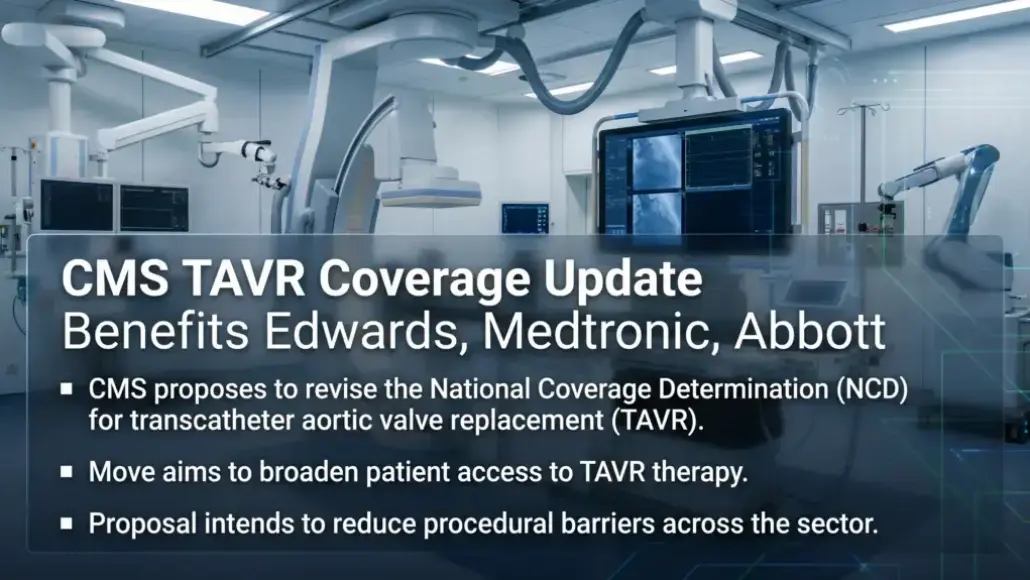

The U.S. Centers for Medicare and Medicaid Services (CMS) has put forward a proposal to revise its National Coverage Determination (NCD) for transcatheter aortic valve replacement (TAVR) therapy, a move that could broaden patient access and reduce procedural barriers across the sector. The agency began its review in December 2025 after accepting a request from Edwards Lifesciences, a leading player in the market, seeking an update to the existing coverage framework.
Under the proposal, which is scheduled for completion on Sept. 13, 2026, CMS would extend coverage to asymptomatic procedures while removing the coverage with evidence (CED) requirement currently applied to symptomatic TAVR procedures. The proposal also eliminates hospital volume requirements and removes specific operator criteria for newly established TAVR programs. The changes represent a significant update to the reimbursement landscape and are expected to simplify access to treatment for both providers and patients. The TAVR Coverage proposal maintains a CED requirement for asymptomatic procedures, a measure that BTIG analysts Marie Thibault, Alexandra Pang and Sam Eiber said was largely anticipated. They also noted that the volume thresholds required for TAVR programs remain attainable and should not create meaningful operational burdens.
According to the analysts, the proposed revisions are favorable not only for Edwards but also for other companies active in the space, including Medtronic and Abbott. They added that the broader TAVR market could benefit as well, potentially extending to Boston Scientific, which recently indicated plans to re-enter the market through an investment in MiRus. Discussing the impact of the proposal, the analysts said: “These are all positive changes that we expect will remove barriers and can eventually lead to higher TAVR procedure volumes.” They further stated: “We think this proposal is a good thing for TAVR volumes and if finalized, will serve as a tailwind for TAVR market leader [Edwards].” If adopted, the TAVR Coverage changes could help support greater procedure volumes across the industry.