
















The demand for high precision and consistent quality in the production of life saving technology has reached a point where traditional manual manufacturing methods are increasingly insufficient. As the complexity of modern medical instruments grows, the tolerances for error shrink, requiring a level of accuracy that only mechanical systems can reliably provide. This has led to a significant shift in the medtech production sector, where companies are investing in new technologies to maintain their competitive edge. The focus on medical device assembly has become a strategic priority for manufacturers who must balance the need for rapid output with stringent global requirements.
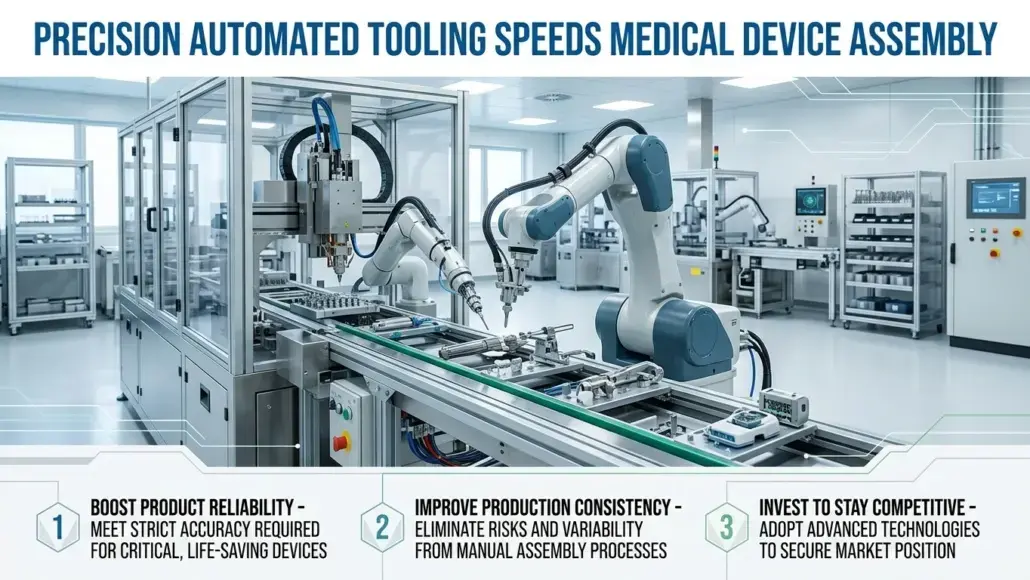
Precision automation involves the use of highly specialized robotic systems to handle the intricate tasks of putting together complex medical products. These systems can perform repetitive motions with a degree of consistency that is impossible for human workers to maintain. Whether it is the microscopic soldering of an implantable sensor or the high speed packaging of diagnostic test kits, the role of industrial automation is expanding. By reducing the variability inherent in human labor, manufacturers can ensure that every unit that leaves the production line meets the exact specifications required for patient safety.
Custom Engineering and Cleanroom Environments
The integration of manufacturing automation into the workflow requires a significant upfront investment. Engineers must design custom tooling and programming that is specific to each product, a process that requires a deep understanding of both the mechanical and the clinical requirements of the device. However, the long term benefits are substantial. Increased throughput and a reduction in the rate of defects lead to a lower cost per unit, allowing manufacturers to remain profitable. This economic efficiency is a key driver for the adoption of smart manufacturing techniques.
One of the primary challenges in medical device assembly is the need for a clean and controlled environment. Even a microscopic particle of dust can compromise the sterility or the function of a medical instrument. Automated systems are ideally suited for operation in cleanroom environments, as they do not introduce biological contaminants in the way that human workers do. By minimizing human presence on the production floor, manufacturers can maintain higher standards of cleanliness and reduce the risk of product recalls, which can be devastating for a company’s financial stability.
Data-Driven Quality and Operational Agility
The evolution of device manufacturing is also being shaped by the rise of data-driven production. Modern automated lines are equipped with sensors that monitor every aspect of the assembly process in real-time. This data is used to identify potential issues before they lead to a full-scale production failure. For example, if a robotic arm begins to deviate slightly from its programmed path, the system can alert the maintenance team to intervene. This proactive approach to quality control is a hallmark of the smart manufacturing era and is essential for maintaining high standards.
Scalability is another critical advantage of utilizing precision automation. When a manufacturer needs to increase production rapidly, an automated line can be scaled up much more easily than a manual one. New robotic cells can be added and programmed in a fraction of the time it would take to hire and train a new shift of workers. This agility allows the industry to respond to sudden changes in demand with a level of speed and efficiency that was previously unthinkable. The ability to manage medical device assembly with such flexibility is a significant strategic asset.
Workforce Evolution and Workplace Safety
The role of human workers is also changing as automation becomes more prevalent. Instead of performing repetitive physical tasks, workers are now being trained to manage and maintain complex mechanical systems. This shift requires a different set of skills, focusing on robotics and data analysis. Medtech companies are investing in vocational training and apprenticeship programs to ensure that their workforce is prepared for the demands of the modern factory. This evolution of the labor force is a necessary component of the broader transition toward industrial automation.
Safety on the production floor is also improved by the presence of robots. Many tasks in medical device assembly involve the handling of sharp instruments or hazardous materials. By assigning these dangerous tasks to automated systems, manufacturers can reduce the risk of workplace injuries and create a safer environment for their employees. Modern collaborative robots are designed to work safely alongside humans, providing the benefits of mechanical strength and precision while maintaining the flexibility of human judgment.
Regulatory Compliance and Global Standards
The regulatory environment for device manufacturing is becoming increasingly rigorous, with agencies requiring detailed documentation of every step in the production process. Automated systems excel at this level of record keeping, providing a digital audit trail that tracks every component and every action taken during assembly. This transparency is vital for ensuring compliance and for providing the evidence necessary to gain market approval. The use of automation simplifies the complex task of regulatory documentation.
The global nature of the medtech supply chain means that manufacturers must maintain consistent standards across multiple production sites. Industrial automation allows for the standardization of processes on a global scale. A production line in one country can be programmed to perform exactly the same tasks as a line in another, ensuring that the quality of the medical device assembly remains uniform regardless of the location. This global consistency is essential for maintaining brand integrity and meeting the needs of healthcare providers in multiple markets.
In conclusion, the transition toward precision automation is an essential step for the medical device industry as it strives to meet the growing demands of modern healthcare. By improving quality and efficiency, these technologies are setting a new standard for the production of life saving instruments. It is clear that the focus on medical device assembly through the application of advanced automation is the only way to achieve the scale and the precision required in the 21st century.