











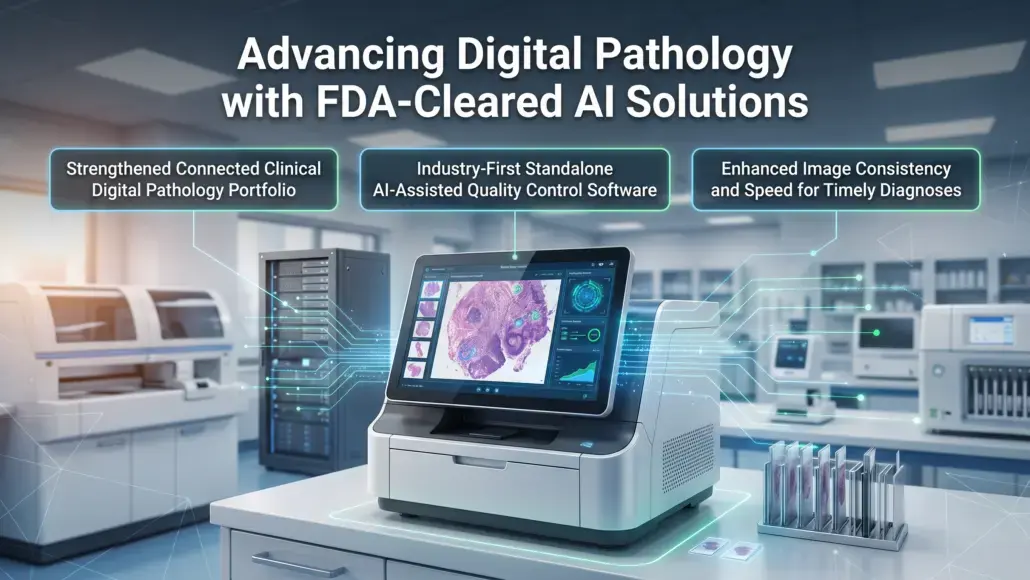

Leica Biosystems, a Danaher company, has announced multiple U.S. Food and Drug Administration 510(k) FDA clearances designed to strengthen its connected clinical digital pathology portfolio, including the industry’s first standalone, AI-assisted quality control software. These regulatory decisions are aimed at helping pathology laboratories deliver high-quality digital images with enhanced consistency and speed, supporting timely and confident diagnoses as healthcare facilities encounter rising case volumes, staffing pressures, and increasing diagnostic complexity.
These FDA clearances support the company’s efforts to help clinical laboratories transition beyond basic digitization into fully connected, standardized, and scalable diagnostic workflows. The updated portfolio introduces Aperio iQC DX software, adds the Aperio GT 180 DX scanner, and incorporates enhanced features for the Aperio GT 450 DX scanner.
AI-Assisted Quality Control Software for Clinical Workflows
The newly cleared Aperio iQC DX software is the industry’s first FDA 510(k)-cleared quality control software designed for AI-assisted digital pathology in a clinical environment. Whole slide images are frequently subject to quality issues caused during tissue preparation, staining, coverslipping, or scanning. These issues include air bubbles, pen marks, clipped tissue, missing tissue, out-of-focus regions, and image striping.
By automatically detecting these six common slide artifacts while slides remain on the scanner, the software allows laboratories to recognize and resolve potential quality issues earlier in the process. This automated capability reduces the necessity for rescanning or rework, limits downstream delays, and promotes reproducible image review.
In a real-world data study conducted with the Institute of Pathology at Heidelberg University, the AI models identified up to 24% more artifacts missed by histotechnicians and reduced hands-on review time by 69%, enabling laboratories to reallocate skilled personnel to higher-value operational tasks.
Expanding Clinical Scanning Capabilities Across Laboratories
To accommodate diverse laboratory caseloads, Leica Biosystems is extending its clinical scanning systems. The high-throughput Aperio GT 450 DX clinical scanner, which features a 450-slide capacity and small operational footprint, now includes new manual scan capabilities for complex slides, advanced DICOM capabilities, and z-stacking functionality for clinical environments.
Additionally, the company has added the Aperio GT 180 DX clinical scanner to serve mid-volume laboratories. Featuring a 180-slide capacity alongside the same scanning speeds and core feature set as the GT 450 DX, the GT 180 DX assists laboratories in constructing streamlined clinical scanning procedures tailored to their specific operational needs and staffing models, furthering connected diagnostic workflows across institutions.
“Every improvement in the pathology workflow matters because patients and clinicians are waiting for answers that guide care,” said Naveen Chandra, Vice President and General Manager of Digital Pathology at Leica Biosystems. “These FDA 510(k) clearances demonstrate Leica Biosystems’ leadership in advancing digital pathology beyond individual products toward connected, standardized workflows that help laboratories operate with greater confidence and consistency. By embedding AI-assisted quality control directly into the scanning workflow and expanding clinical scanning options, we are enabling laboratories to scale digital pathology in ways that support timely diagnosis, pathologist efficiency and better care for patients.”
As part of Danaher’s connected ecosystem of life sciences and diagnostics companies, Leica Biosystems supports nearly 2 million cancer tests globally each week, providing end-to-end solutions spanning from initial biopsy to final diagnosis.