
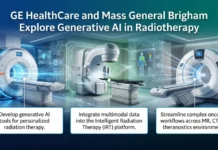







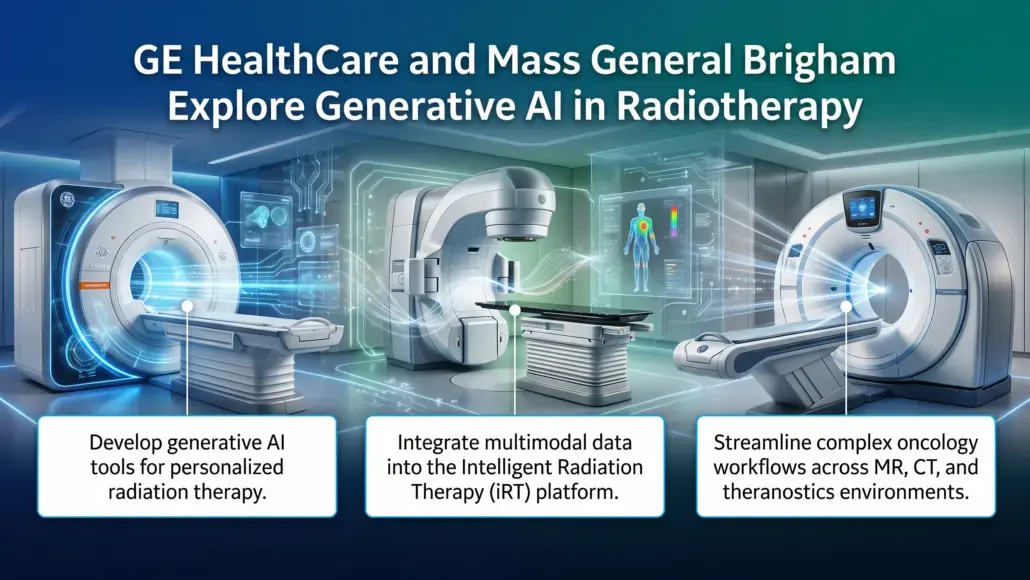

GE HealthCare and Mass General Brigham have initiated a research collaboration focused on the development of generative AI tools to enhance personalized radiation therapy. This joint technical program seeks to integrate multimodal data processing into GE HealthCare’s Intelligent Radiation Therapy (iRT) platform, aiming to streamline complex oncology workflows across magnetic resonance (MR), computed tomography (CT), and theranostics environments. The initiative applies generative artificial intelligence to synthesize clinical data, accelerating the progression of patients from the initial diagnosis stage to active treatment.
Current operational bottlenecks in radiation oncology planning frequently involve coordinating complex data streams across disparate hardware and software systems. Clinical workflows often require up to 17 discrete manual stages for importing treatment parameters, and analyses of clinical cases indicate more than 44 variations in treatment planning pathways. These inefficiencies are primarily driven by unstructured information, such as clinical progress notes, pathology summaries, and disconnected imaging files. The collaboration evaluates an AI query system designed to extract and synthesize both structured electronic health record data and unstructured clinical assets, allowing clinicians to retrieve patient histories and anatomical landmarks using natural language queries.
Integration and Clinical Performance
The project evaluates a system architecture capable of parsing DICOM imaging sets, medical texts, and historical dosimetry plans into unified contextual profiles. This functional capability operates alongside the workflow orchestration engine of the iRT platform, which automates cross-department handoffs between medical physicists, dosimetrists, and radiation oncologists. By incorporating these generative AI tools, the research aims to minimize manual data curation and prevent configuration errors during the dose planning phase.
The current research builds upon previous software integration efforts between the two entities. Clinical workflow solutions implemented at Massachusetts General Hospital across more than 11,000 treatment plans successfully reduced the operational interval between patient intake and treatment initiation from 30 days to eight days. The ongoing deployment phase explores the integration of generative retrieval algorithms into broader multimodality oncology workflows, including MR-guided therapy and molecular radiotherapy guidance, to improve operational throughput in high-volume cancer centers.