










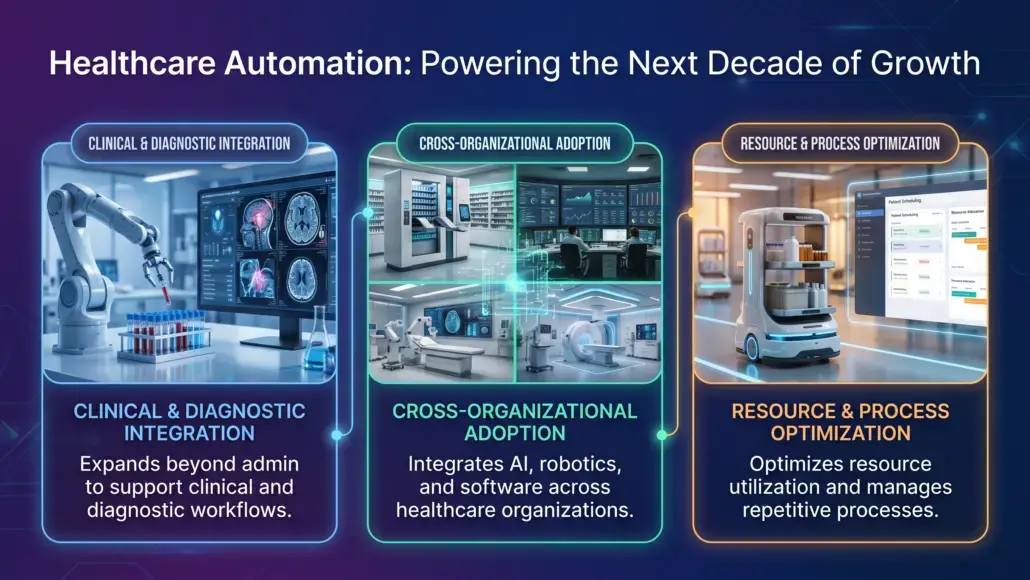

Healthcare automation is moving beyond isolated administrative tasks and becoming part of the infrastructure supporting clinical, diagnostic and operational workflows. Hospitals, laboratories, imaging centers, pharmacies and other healthcare organizations are increasingly using software, artificial intelligence, robotics and connected automation systems to manage repetitive processes, coordinate information and improve the utilization of healthcare resources.
The global healthcare automation tools market was valued at US$52.94 billion in 2025 and is projected to reach US$116.83 billion by 2033, representing a compound annual growth rate of 10.5% between 2026 and 2033. This expansion reflects a broader shift in healthcare technology adoption, with providers increasingly looking beyond individual automation projects toward connected systems capable of supporting multiple stages of clinical and administrative operations.
Healthcare Automation Expands Across Operational Workflows
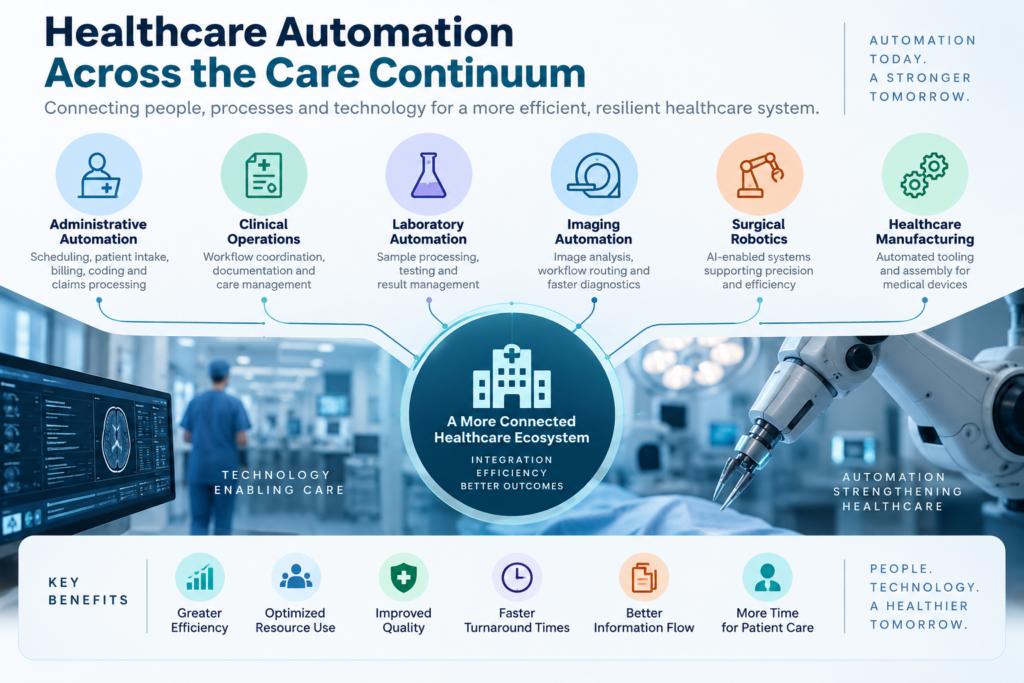
Administrative processes remain one of the most established areas for healthcare automation. Appointment scheduling, patient intake, eligibility verification, billing, coding and claims processing involve substantial volumes of repetitive work and information exchange. Automating these activities can reduce manual intervention while allowing staff to concentrate on processes that require greater judgment and direct interaction.
The same transition is increasingly visible within clinical environments. Healthcare automation tools are being used to streamline clinical operations, coordinate information and reduce repetitive activities across different stages of care. As these technologies become connected with electronic health records and other healthcare information systems, their role is expanding from individual task execution toward broader workflow coordination.
This evolution is important because healthcare organizations rarely operate through isolated processes. A delay in one department can affect several downstream activities, while incomplete or manually transferred information can create additional administrative work. Automation that connects related workflows can therefore address operational inefficiencies at a broader level.
AI Is Moving Automation Toward Predictive Operations
Artificial intelligence is expanding the scope of healthcare automation by enabling systems to analyze operational information and identify emerging constraints.
GE HealthCare announced CareIntellect for Operations on September 15, 2026, an AI-enabled software-as-a-service application designed to provide health systems with up to a 72-hour view of emerging operational bottlenecks. The system analyzes patient and operational data, including bed availability, patient delays, staffing and wait times, and provides recommendations related to capacity and throughput.
The development reflects a broader change in the automation model. Traditional automation generally performs a predefined action after a specific trigger. AI-enabled automation can instead analyze multiple signals, identify patterns and support earlier operational intervention.
For hospitals, this distinction can be significant. Patient flow involves interconnected activities such as admissions, imaging, transfers, staffing and discharge. Automation capable of identifying relationships between these processes can potentially help operational teams respond before a bottleneck spreads across departments.
The growth of AI-enabled automation also means that future healthcare automation platforms may increasingly be evaluated according to their ability to combine information from multiple systems rather than simply automate a single task.
Laboratory Automation Is Addressing Rising Workflow Complexity
Laboratories remain an important application area because diagnostic testing involves repetitive processes that can be standardized and integrated with information systems.
Automation can extend across sample processing, testing, result management and laboratory workflow coordination. The objective is not simply to reduce manual activity but also to provide laboratories with systems capable of handling complex testing requirements and larger workloads.
Siemens Healthineers announced on September 16, 2026 that its CN-3000 and CN-6000 automated hemostasis testing systems were available for patient testing in U.S. laboratories. The platforms consolidate several hemostasis testing methodologies and are designed to automate manual tasks while connecting with track-based laboratory automation and the Atellica Data Manager for centralized oversight.
The development highlights the increasing importance of connected laboratory automation. Instead of treating analyzers as independent systems, healthcare providers can increasingly integrate instruments with workflow automation and laboratory data-management platforms.
Automation is also expanding the scale of molecular diagnostics, with automated molecular testing supporting high-throughput disease tracking and the identification of multiple genetic markers. As diagnostic laboratories manage increasingly complex testing requirements, automation can help standardize repetitive analytical processes while supporting larger testing volumes.
Imaging Automation Is Accelerating Diagnostic Workflows
Medical imaging is another area where automation and artificial intelligence are becoming increasingly interconnected.
Diagnostic imaging can generate large volumes of information that require specialist interpretation. AI-enabled tools can assist with image processing and analysis, helping clinical teams identify relevant findings and prioritize cases within established workflows.
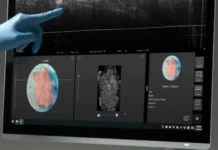
Automated scan analysis is accelerating the processing of medical images in acute-care environments, particularly where diagnostic information needs to be assessed quickly. Automation in this area can extend beyond image interpretation to include workflow routing, image reconstruction, protocol management and reporting support.
The broader opportunity is therefore not limited to individual AI algorithms. Imaging automation can become part of an integrated diagnostic workflow in which information moves between imaging equipment, analysis software, clinical systems and healthcare professionals.
This creates an important connection between automation and interoperability. The value of an automated imaging application can depend partly on how efficiently its outputs can be incorporated into the wider clinical workflow.
Surgical Robotics Is Broadening Healthcare Automation
Robotic technology is extending automation into procedural care and creating another major area of development within the healthcare automation market.
Johnson & Johnson received FDA De Novo authorization for its OTTAVA Robotic Surgical System on July 21, 2026. The system is a table-integrated soft-tissue robotic platform authorized for multiple general-surgery procedures involving the upper abdomen. The FDA’s database records the De Novo decision, while Johnson & Johnson says the system is designed to support operating-room capacity and clinical workflow efficiency.
The development demonstrates how surgical automation is increasingly being designed around the operating environment rather than the robotic arm alone. Integrating robotics with the operating table can influence how equipment, surgical teams and physical space are organized during procedures.
AI is also becoming more closely connected with robotic surgery. Medtronic introduced Touch Surgery Aide in July 2026, an AI-enabled surgical computing platform designed to provide real-time support during procedures. The platform uses computer vision, multimodal AI and accelerated computing, while its Instrument Exit Point application provides a visual notification when selected instruments move beyond the visible field during robotic procedures.
These developments point toward a convergence of robotics, computer vision and clinical software. Surgical automation is increasingly becoming a combination of physical systems and digital intelligence rather than a purely mechanical technology.
Automation Is Moving From Individual Tools to Connected Systems
As healthcare automation expands across administrative, diagnostic and clinical environments, interoperability is becoming increasingly important.
Healthcare organizations typically operate multiple technology environments, including electronic health records, laboratory information systems, imaging platforms, medical devices and financial applications. Automation can deliver limited value when these systems remain disconnected and staff still need to manually transfer information between them.
Consequently, the next phase of market development is likely to place greater emphasis on integration. Cloud, on-premises and hybrid deployment models can support different organizational requirements, but the ability to exchange information securely and consistently across systems remains central to automation performance.
This is particularly relevant as AI becomes embedded in healthcare workflows. Automated systems need access to appropriate data, while healthcare organizations also need mechanisms for oversight, validation and governance. The integration of automation with existing infrastructure can therefore be as important as the automation capability itself.
Automation Is Extending Into Medical Device Manufacturing
The automation opportunity also extends beyond hospitals and direct care delivery into the manufacturing infrastructure supporting healthcare.
Medical-device manufacturing involves highly repetitive processes where precision, consistency and production efficiency are important. Automated tooling and assembly technologies can support the handling and positioning of components while reducing dependence on repetitive manual operations.
Precision automated tooling is helping accelerate medical-device assembly while supporting consistent handling of components, reflecting the wider expansion of automation across the healthcare technology supply chain.
This creates a broader definition of the healthcare automation market. Automation is not restricted to software used by providers; it also encompasses technologies that support the production, testing and handling of medical technologies used throughout healthcare systems.
North America Leads While Asia-Pacific Builds Momentum
North America represents the largest regional share of the healthcare automation tools market, accounting for 42.09% in the available market assessment. Its position is supported by established healthcare IT infrastructure, adoption of electronic health records and significant investment in AI, robotics and connected healthcare technologies.
Asia-Pacific accounts for 22.04% and represents the fastest-growing regional market. Healthcare digitization, expanding hospital infrastructure and increasing adoption of AI-enabled diagnostics and medical robotics are contributing to market development across the region.
Japan is an important example of automation extending across different healthcare workflows. Recent developments include AI-supported diagnostic applications and automated medication inspection technologies, illustrating how automation is being incorporated into both clinical and pharmacy-related processes.
Europe represents approximately 20% of the market, supported by established healthcare infrastructure, digital-health investment and demand for greater operational efficiency. Latin America accounts for approximately 9%, while the Middle East and Africa represent about 7%, with healthcare modernization and digital transformation creating additional opportunities for automation adoption.
The Market Is Shifting From Task Automation to Intelligent Operations
The healthcare automation tools market is increasingly defined by the convergence of several technology categories.
HHM Global observes that healthcare automation is increasingly evolving from isolated task automation toward connected systems that support clinical, diagnostic and operational workflows.
Administrative automation continues to address repetitive processes. Laboratory automation is helping manage increasingly complex diagnostic workloads. AI is extending automation into operational forecasting and clinical workflows, while robotics and computer vision are bringing automated capabilities into procedural environments.
The projected increase from US$52.94 billion in 2025 to US$116.83 billion by 2033 reflects the expansion of these applications across healthcare settings. More importantly, the direction of technology development suggests that automation is gradually becoming an underlying operational layer rather than a collection of isolated tools.
The next stage of adoption will depend on how effectively these systems can integrate with existing healthcare infrastructure while delivering measurable improvements in workflow efficiency, capacity and information management. Hospitals and other healthcare organizations are likely to increasingly assess automation according to its ability to work across departments and systems rather than its ability to automate a single repetitive activity.
As AI, robotics, diagnostics and healthcare IT continue to converge, automation is becoming embedded in more stages of the healthcare value chain. The result is a market evolving from simple task automation toward increasingly connected and intelligent healthcare operations.