













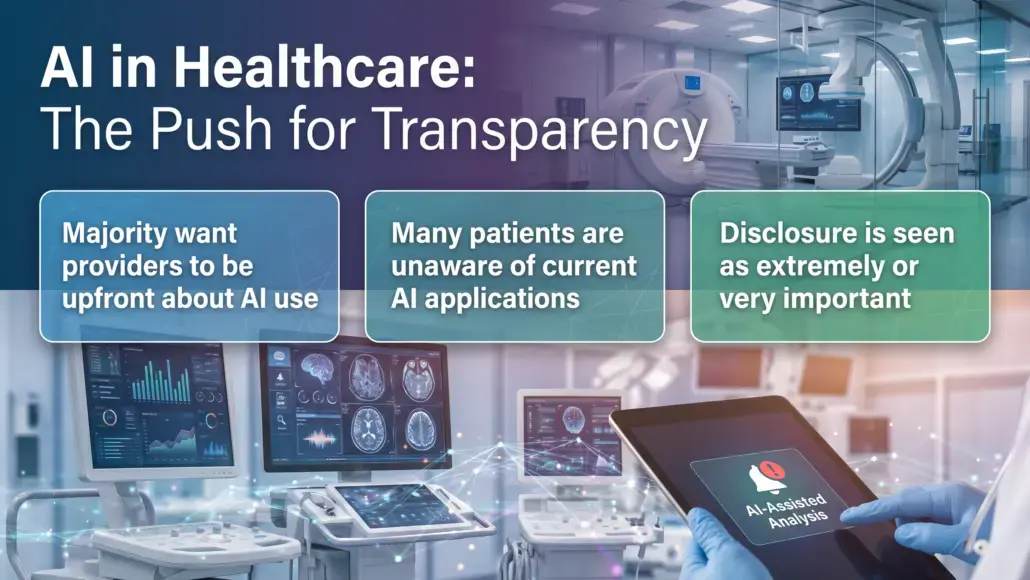

A new survey from the Pew Research Center reveals that a large majority of Americans want their healthcare providers to be upfront about using artificial intelligence — even as many patients remain unaware whether the technology has already been applied in their care.
The survey of 3,488 U.S. adults — conducted between June 22 and June 28 — found that nearly three-quarters of respondents said it is extremely or very important that doctors and other healthcare providers disclose when artificial intelligence is being used in their care. A further four in five said patients should be informed specifically when AI is used to analyze medical scans, make diagnoses, or explain laboratory results.
A Clear and Consistent Demand for Transparency
The demand for AI disclosure healthcare was notably consistent across demographic groups. Majorities across age, gender, education, and racial and ethnic backgrounds agreed that disclosure was extremely or very important. Adults aged 65 and older were somewhat more likely to prioritize disclosure compared to those under 30, but the overall consensus remained strong across all groups surveyed.
Transparency expectations extended beyond high-stakes clinical decisions. According to the Pew findings, 72% of respondents said providers should disclose when AI takes notes during an appointment, 64% said disclosure is warranted when AI orders prescription refills, and 56% said they want to be informed even when the technology is used for appointment scheduling.
Patients Report Limited Awareness and Control
Despite the broad appetite for transparency, the survey found a considerable gap between patient expectations and their actual experiences. Nearly half of all respondents — 46% — said they were not sure whether a provider had already used AI in their healthcare. Among those who reported having encountered AI in a clinical setting, only 22% said they understood extremely or very well how the technology had been used.
The sense of limited control was equally striking. Just 17% of adults said they have a great deal or quite a bit of control over whether providers use AI in their health care. A further 53% said they feel they have little or no say in the matter.
AI Adoption Among Providers Continues to Accelerate
The findings arrive at a time when artificial intelligence in healthcare is being adopted at a rapid pace. According to data from the Office of the National Coordinator, 71% of non-federal acute care hospitals reported using predictive AI in 2024, up from 66% the year prior. The fastest-growing applications included billing and scheduling functions.
Physician adoption has followed a similar upward trajectory. An American Medical Association survey conducted earlier this year found that 72% of physician respondents had incorporated at least one AI application into their practice — nearly double the share reported in 2023. Documentation and summarization tools were cited among the most common uses.
Echoes of Earlier Concerns
The latest Pew data revisits concerns the research organization had identified even before the current wave of AI adoption in clinical settings. In 2023, 60% of Americans said they would be uncomfortable if their provider relied on AI to diagnose conditions or recommend treatments. Three-quarters of respondents at that time were more concerned that providers would implement the technology too quickly than too slowly.
The current survey reinforces that those concerns have not dissipated — and in some respects, the gap between AI disclosure healthcare expectations and actual practice has widened alongside accelerating adoption across hospitals and physician practices alike.