















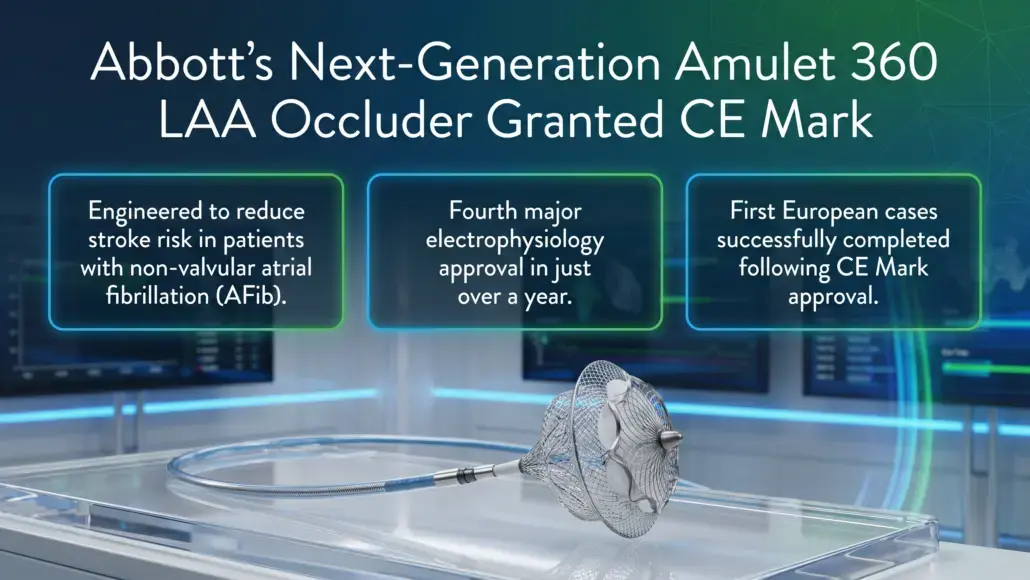

Abbott has received CE Mark approval for its Amulet 360 Left Atrial Appendage (LAA) Occluder, a next-generation device engineered to reduce stroke risk in patients living with non-valvular atrial fibrillation (AFib). The Amulet 360 CE Mark clearance marks the company’s fourth major electrophysiology approval in just over a year.
First European Procedures Successfully Completed
Following CE Mark approval, the first European cases using the Amulet 360 were completed by three leading physicians: Prof. Boris Schmidt at the Cardiovascular Clinic Bethanien in Frankfurt, Germany; Prof. Ingo Eitel at the University Heart Center in Lubeck, Germany; and Prof. Jens Erik Nielsen-Kudsk at Aarhus University Hospital in Aarhus, Denmark. Abbott has indicated it will continue to expand the device’s use across Europe over the coming weeks.
Understanding the Left Atrial Appendage and AFib
The left atrial appendage is a small, structurally complex pouch connected to the heart’s upper left chamber. In patients with AFib — an irregular heartbeat occurring in the heart’s upper chambers — blood can pool within the LAA, significantly increasing the likelihood of clot formation and, subsequently, stroke.
For AFib patients who are unable to tolerate long-term blood-thinning medication, physicians may opt for left atrial appendage closure through a minimally invasive procedure. Devices such as the Amulet 360 are designed to seal off the LAA entirely, offering a targeted pathway for atrial fibrillation stroke prevention.
Device Design and Dual-Seal Technology
The Amulet 360 is composed of two primary components. Its redesigned lobe — the body of the device — is softer and more conformable than Abbott’s previous-generation LAA occluder, enabling physicians to treat patients with a broader range of LAA anatomies. The lobe features smaller anchors than its predecessor to secure placement within the LAA. A second component, the outer disk, serves as an additional sealing layer to help close off the appendage entirely.
Together, the lobe and disk operate as a dual-seal system designed to prevent blood clot formation and reduce stroke risk.
“Amulet 360 builds on the proven legacy of our dual-seal design seen in the first-generation LAA occluder, which helped many people with AFib reduce their risk of stroke without the need for long-term blood thinners,” stated Christopher Piorkowski, M.D., Chief Medical Officer of Abbott’s electrophysiology business. “As the latest addition to Abbott’s portfolio of stroke prevention technologies, Amulet 360 reflects our commitment to advancing treatment options and improving outcomes for patients around the world.”
Abbott’s Expanding Electrophysiology Portfolio
The CE Mark approval of the Amulet 360 Left Atrial Appendage Occluder further broadens Abbott’s suite of technologies intended to help physicians manage cardiac arrhythmias. It follows U.S. and European approvals for the Volt PFA System in 2025 and the European approval of the TactiFlex Duo earlier this year.
Abbott’s broader AFib treatment ecosystem includes the TactiFlex Duo Ablation Catheter, Sensor Enabled, and the Volt PFA System — both of which utilise specialised energy to address the erratic cardiac signals associated with AFib — as well as the EnSite X EP System, which generates detailed three-dimensional maps of the heart to assist physicians in identifying and treating the source of irregular heartbeats. Procedures designed to combine left atrial appendage closure with AFib treatment simultaneously are currently under investigation in Europe.
The Amulet 360, built upon the foundation of Abbott’s Amplatzer Amulet LAA Occluder — in use in Europe since 2013 and in the United States since 2021 — is approved for investigational use only in the United States.