







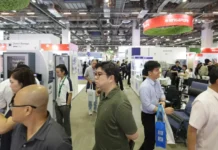



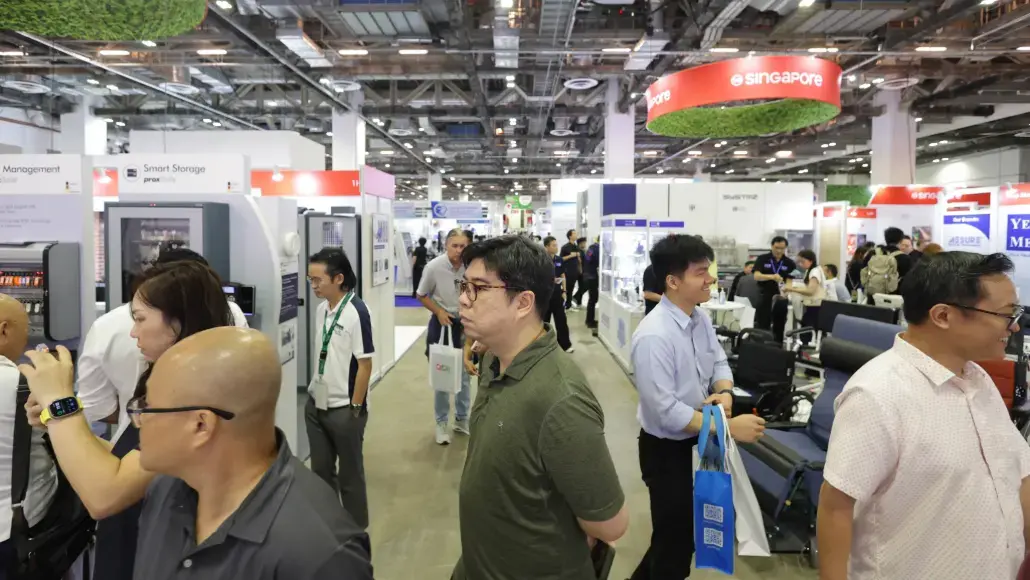
AI for pre-surgery assessment, wearable rehabilitation technologies and live robotic gait demonstrations put the practical application of healthcare innovation at the centre of Medical Fair Asia, Medical Manufacturing Asia and the inaugural RehaCare Asia, held at Marina Bay Sands from 9 to 11 September.
The three co-located events brought together 13,854 attendees from 73 countries and regions, with over 40% overseas visitors, alongside 1,000 exhibitors from 40 countries and regions. From Singapore General Hospital’s work on the PEACH chatbot for pre-surgery assessment to discussions on manufacturing, cybersecurity and market access, the three events connected clinical needs with the expertise required to bring new technologies into wider use.
The MotusAcademy × RehaCare Asia Leadership Forum drew a full house. During the session, St Luke’s Hospital and Robotimize signed a memorandum of understanding to test, refine and integrate rehabilitation robotics into clinical practice.
The inaugural ASEAN Care Readiness Index 2026, commissioned by Messe Düsseldorf Asia and launched during the events, highlighted the challenge of translating healthcare ambition into practice. Among 300 healthcare and MedTech leaders surveyed across six Southeast Asian markets, 94% considered their organisations prepared for the next three to five years, yet 54% identified technology implementation capability as a barrier to future readiness.
Lars Wismer, Managing Director of Messe Düsseldorf Asia, shared: “The technology is advancing quickly, but implementation must keep pace. Over the three days, we have seen what that means in practice: technology must fit clinical workflows, support healthcare professionals, work beyond the hospital and be viable to manufacture and scale. These are no longer separate conversations. They determine whether innovation ultimately reaches patients.”
Medical Fair Asia: AI moves closer to everyday clinical use
At Medical Fair Asia, practical applications of AI and connected healthcare showed how technology is beginning to move from experimentation into clinical workflows. At the Paradigm Shifts in Healthcare Seminar 2026, Singapore General Hospital shared its experience developing PEACH (PErioperative AI Chatbot) to support pre-operative assessments. The tool was developed around SGH’s institutional protocols for a clinic handling around 120 patients each day. Meanwhile, at the Future for Health (FTR4H) Conference Asia 2026, Quanta Computer explored continuous monitoring through wearable and ambient sensing across hospitals and homes.
Healthcare institutions and technology companies from Taiwan shared applications spanning AI-assisted cardiovascular and stroke detection, antimicrobial resistance prediction, generative AI to reduce administrative workloads, telehealth and remote monitoring. The sessions also examined how hospitals, homes and communities can be better connected, alongside pathways to clinically validate and commercialise locally developed MedTech.
The Innovation Partner Showcase zone brought emerging applications onto the exhibition floor, with Singapore-developed technologies from institutions including SUTD, the NUS Biorobotics Lab and Singapore Polytechnic, spanning wearable rehabilitation technologies, lightweight exoskeletons, AI enabled healthy ageing and AR/VR rehabilitation.
Sim Sovannara, CEO, Central Medical Services Co., Ltd, Cambodia shared that “To strengthen healthcare in Cambodia, we must look beyond our borders, learn from other healthcare systems and build meaningful international partnerships. Medical Fair Asia gives us access to new technologies, modern equipment and practical solutions that can improve patient care while supporting the continued development of our healthcare institutions.”
Medical Manufacturing Asia: A good technology still must become a viable product
At Medical Manufacturing Asia, implementation started further upstream: how to turn new technology into products that can be manufactured, commercialised and deployed safely at scale.
At the Medical Manufacturing Forum, A*STAR SIMTech / AIMfg examined barriers preventing manufacturers from scaling AI, including fragmented data and complex manufacturing environments. A*STAR Innovation Factory was introduced, focused on the decisions required to take technologies from prototype to manufacturable product, including whether companies should build capabilities internally, outsource, partner or acquire. Its central message was straightforward: a great technology does not automatically make a great product.
Market Entry Briefings added another consideration for companies looking to expand across the region. Regulatory strategy, intended use, product classification and the licences required to manufacture, import or distribute products can all affect how and when a technology reaches individual markets.
Medical Manufacturing Asia also named Nelipak Healthcare Packaging Pte Ltd the winner of its 2026 Marketing Excellence Award, with Toki Automation Pte Ltd receiving the Special Recognition Award.
Mr. Steven Toy, Chairman, Singapore Precision Engineering and Technology Association (SPETA) shared, “Medical Manufacturing Asia reflects the strength of the partnership between SPETA and Messe Düsseldorf Asia, combining our industry knowledge and local manufacturing network with the exhibition’s international reach. This edition has provided Singapore companies with an important platform to demonstrate their precision-engineering and advanced-manufacturing capabilities, connect with the global MedTech community and explore new business opportunities. We look forward to continuing to develop MMA in line with the evolving needs of the industry.”
RehaCare Asia: Recovery moves beyond hospital walls
At the inaugural RehaCare Asia, the question was not only what rehabilitation technology can do, but whether it can fit into the lives of patients and the work of healthcare professionals.
Speakers at the From Pilot to Practice: Closing Asia’s Rehabilitation Technology Adoption Gap forum stressed that clinical efficacy alone does not determine adoption. Patient goals, workflow fit, affordability, technical support, maintenance and whether technology can be used at home or in the community all matter.
Adjunct Associate Professor Dr Loh Yong Joo, Senior Consultant, Rehabilitation Medicine at Tan Tock Seng Hospital, highlighted the physical demands placed on therapists and the potential for robotics to reduce that burden while enabling patients to undertake more intensive rehabilitation. His message was clear: “Rehabilitation shouldn’t stop after discharge. It should continue in the community.”
The shift was reinforced at the Living Longer, Living Better Seminar, held in collaboration with Frost & Sullivan. Panellists described care moving from episodic treatment towards a connected journey spanning prevention, diagnosis, acute care, rehabilitation and community care, with technology helping to decentralise services and extend existing healthcare capacity. Another discussion challenged healthcare providers to design for the older adults of tomorrow, as today’s middle-aged population will enter later life with different expectations around independence, lifestyle, and how and where they receive care.
Practical application was also on display through Locomotor Therapy in Practice, which brought together robotic gait training, body weight-supported treadmill training and overground rehabilitation in a live patient demonstration.
Jenny Shih, an exhibitor with OPPO Medical’s Global Sales and Marketing team, said: “With so many medical exhibitions taking place around the world, the quality of the support team and the range of services available to exhibitors are crucial. Medical Fair Asia and RehaCare Asia gave us a strong platform to stay connected with our clients and business partners, while helping us stand out within a competitive international market.”
The co-located format brought clinical teams, researchers and technology suppliers together with manufacturing and market-access expertise, connecting participants across the development and adoption of healthcare technologies. The debut of RehaCare Asia extended that focus to rehabilitation, independence and care in homes and communities.
Looking ahead, Medical Fair Thailand and RehaCare Asia will take place in Bangkok from 8 to 10 September 2027. Medical Fair Asia, Medical Manufacturing Asia and RehaCare Asia will return to Singapore from 13 to 15 September 2028.
For updates on future editions, visit the official websites for Medical Fair Asia, Medical Manufacturing Asia and RehaCare Asia.