

















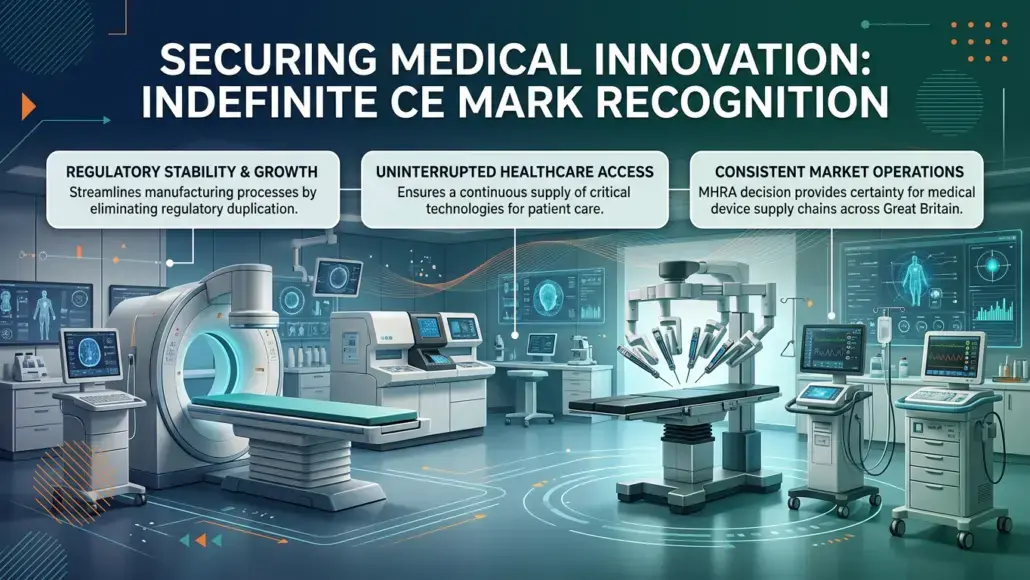

The United Kingdom government has officially confirmed the indefinite recognition of CE marked medical devices to ensure stable supply and uninterrupted patient access to critical healthcare technologies across Great Britain. Announced by the Medicines and Healthcare products Regulatory Agency (MHRA) on October 21, 2026, this decision follows an extensive public consultation period that concluded in April 2026. The move aims to eliminate regulatory duplication for manufacturers by allowing devices approved for the European Union market to remain accessible in the UK without requiring a separate domestic approval route. This policy applies to a vast range of products, including insulin pumps, replacement joints, surgical equipment, and in vitro diagnostic devices (IVDs) that patients and the National Health Service (NHS) depend on daily.
The government’s decision is rooted in a data-driven assessment of the current medical device market in Great Britain. Currently, more than 90% of medical devices registered for use in the country carry a CE mark, indicating they have undergone assessment and approval according to European standards. By maintaining recognition of these approvals, the UK avoids creating a bottleneck in the supply chain that could have occurred if a mandatory transition to the domestic UKCA marking had been enforced without a recognition pathway. This long-term certainty is designed to protect healthcare organizations from the administrative and financial burdens associated with redundant testing and certification, thereby preserving the resilience of the UK’s HealthTech sector.
This regulatory continuity is integrated with existing safety frameworks, ensuring that patient protection remains the primary focus. The indefinite acceptance of CE markings sits alongside the UKCA marking route, which will continue to operate as the domestic approval pathway for manufacturers seeking to place devices specifically on the Great British market. While the recognition of EU-approved devices provides a pragmatic solution for supply stability, the MHRA maintains full oversight of all products in circulation. This includes rigorous post-market surveillance and reporting requirements that allow the regulator to act swiftly if safety concerns arise. The MHRA continues to monitor device performance through the Yellow Card scheme and collaborates with international regulatory partners to share safety data.
The public consultation that informed this decision saw participation from over 1,000 respondents, representing a broad spectrum of stakeholders including patient advocacy groups, healthcare providers, and industrial bodies. The overwhelming feedback highlighted the necessity of a clear and predictable regulatory environment to support investment and innovation. By providing this long-term framework, the government aims to fulfill the ambitions set out in the Life Sciences Sector Plan and the 10 Year Health Plan. The approach ensures that Great Britain remains a competitive market for global manufacturers while prioritizing the immediate needs of patients who rely on both everyday treatments and life-saving diagnostic tools.
Domestic Framework and Future AI Integration
While the indefinite recognition of CE marked medical devices provides immediate market stability, the UK government is simultaneously advancing plans to modernize its domestic regulatory framework. The UKCA route remains the primary pathway for domestic approvals and is currently undergoing significant updates through a new pre-market statutory instrument. This legislative update is intended to refine the requirements that devices must meet to be granted the UKCA mark, ensuring that the domestic standard remains at the forefront of global safety and performance benchmarks. This dual-track approach allows the UK to maintain high safety standards while benefiting from the efficiencies of international regulatory alignment.
Beyond the current statutory updates, the government is seeking further enabling powers through primary legislation to establish a more adaptable licensing approach for the future. This forward-looking framework is specifically designed to address the challenges posed by rapidly advancing medical technologies, such as software as a medical device (SaMD) and artificial intelligence (AI). The proposed reforms reflect the findings and recommendations of the National Commission into the Regulation of AI in Healthcare. By creating a regulatory environment that is responsive to digital innovation, the UK intends to position itself as a global leader in the deployment of safe and effective AI-powered medical solutions.
The transition toward a modernized framework also involves a heightened focus on the entire lifecycle of medical devices. The MHRA’s 2030 Strategy emphasizes the expansion of reliance and recognition routes with other trusted global regulators. This strategy aims to reduce the overall regulatory burden on manufacturers by accepting evidence of safety and efficacy from jurisdictions with comparable standards. Such a move not only strengthens supply resilience but also ensures that UK patients are among the first to benefit from global innovations. The focus is on creating a “friction-free” access model that does not compromise on the rigorous scientific scrutiny required to protect public health.
The inclusion of software and AI in the future regulatory roadmap highlights the government’s recognition of how digital health technologies are transforming patient care. The goal is to move away from static regulatory models toward a dynamic system that can accommodate the iterative nature of software development. This adaptability is essential for maintaining the UK’s status as a hub for life sciences research and development. By providing a clear timeline and predictable rules for both traditional hardware and advanced digital tools, the MHRA aims to foster an environment where clinical safety and technological progress go hand in hand, ultimately improving outcomes for the NHS and its patients.
Industry Reaction and Strategic Vision
The decision to indefinitely recognize CE marked medical devices has been met with strong support from key industry bodies and healthcare leaders. Lawrence Tallon, Chief Executive of the MHRA, stated that the move provides the long-term certainty needed by the NHS and the broader industry to ensure uninterrupted access to essential technologies. Similarly, the Association of British HealthTech Industries (ABHI) has welcomed the decision, noting that regulatory predictability is fundamental to investment decisions that drive innovation. By avoiding unnecessary duplication, the UK strengthens its position as an attractive market for HealthTech, facilitating the rapid adoption of new treatments.
Looking ahead, the government plans to maintain active engagement with patient groups, clinicians, and industry partners as these arrangements are implemented. A series of engagement sessions will be launched to address questions regarding safety oversight and the practicalities of the recognition framework. This collaborative approach is intended to ensure that all stakeholders understand the updated requirements and the mechanisms in place to protect patient safety. As the UK continues to evolve its regulatory landscape, the focus remains on delivering a system that is robust, transparent, and fully aligned with the long-term goals of the national healthcare strategy.