















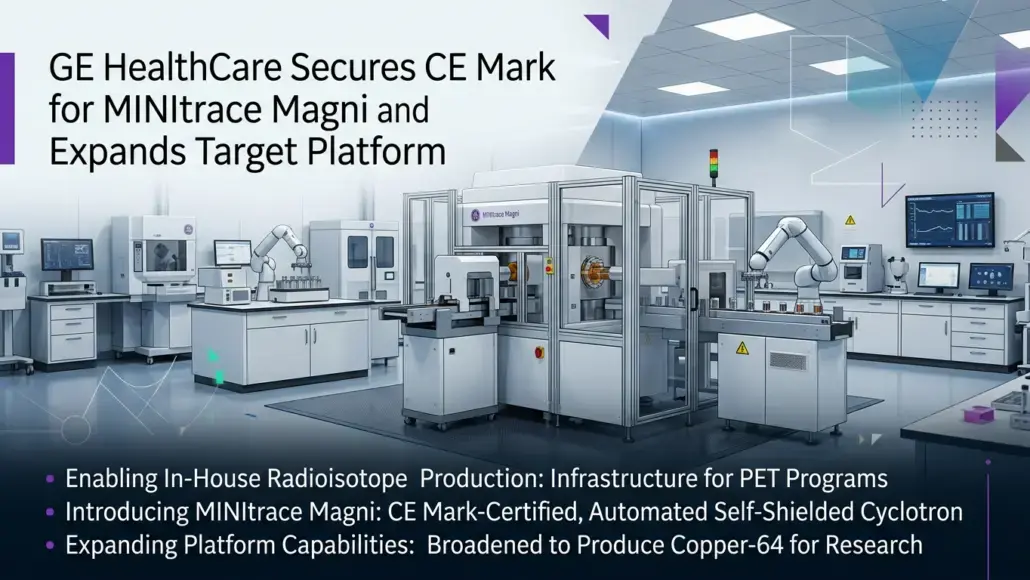

GE HealthCare has secured CE Mark certification for its MINItrace Magni cyclotron and broadened its PETtrace Solid Target Platform to manufacture Copper-64. Both developments target the production infrastructure needed by healthcare institutions to run positron emission tomography (PET) programmes and pursue radiopharmaceutical research.
Advancing Production With the MINItrace Magni
The newly certified MINItrace Magni is an automated, self-shielded cyclotron developed for in-house radioisotope manufacturing. Intended to produce Carbon-11, Fluorine-18, Nitrogen-13, and Oxygen-15, the compact unit automates beam tuning, target irradiation, and target preparation via a three-click operational interface.
When operated alongside the company’s TRACERcenter Solutions, the system fits into wider PET radiopharmacy setups to accommodate specific departmental and tracer manufacturing demands. Integrating this advanced equipment streamlines complex daily operations within modern PET radiopharmacy setups, ensuring consistent and efficient radioisotope manufacturing for medical facilities.
Broadening the PETtrace Solid Target Platform
At the same time, GE HealthCare has added Copper-64 capabilities to its PETtrace Solid Target Platform. The solid-target hardware was initially introduced for Gallium-68 in 2022 and subsequently adapted for Zirconium-89 in early 2026.
The latest addition broadens the isotope range that can be processed using PETtrace equipment, allowing facilities to expand their tracer output. The ongoing expansion of the PETtrace Solid Target Platform empowers clinical researchers and healthcare providers to scale their production capabilities without compromising precision.
Clinical Applications and Diagnostic Imaging
Copper-64 provides diagnostic imaging and is being investigated alongside Copper-67 agents as a potential diagnostic and therapeutic theranostic pairing. Clinical researchers are currently studying compounds labelled with Copper-64 in prostate cancer as well as human epidermal growth factor receptor 2 (HER2)-positive breast cancer.
Consistent diagnostic imaging is essential to support this critical work, and the company actively couples cyclotrons and targetry with synthesis chemistry and imaging tools.
Strategic Growth in Molecular Imaging
GE HealthCare molecular imaging vice-president Erez Levy said: “The molecular imaging landscape is being reshaped by the expansion of theranostics, the introduction of new PET tracers, and demand across oncology, neurology and cardiology.”
“As tracer portfolios broaden, healthcare providers need reliable access to radioisotopes and the flexibility to respond to changing clinical needs,” Levy explained. “That calls for a longer-term view of radiopharmaceutical production—one that supports established services while allowing institutions to prepare for new clinical and research applications.”
This forward-looking approach to molecular imaging aligns with recent strategic expansion moves by the healthcare technology provider.
Earlier this year, GE HealthCare partnered with Mass General Brigham to explore generative AI applications in radiotherapy.