
















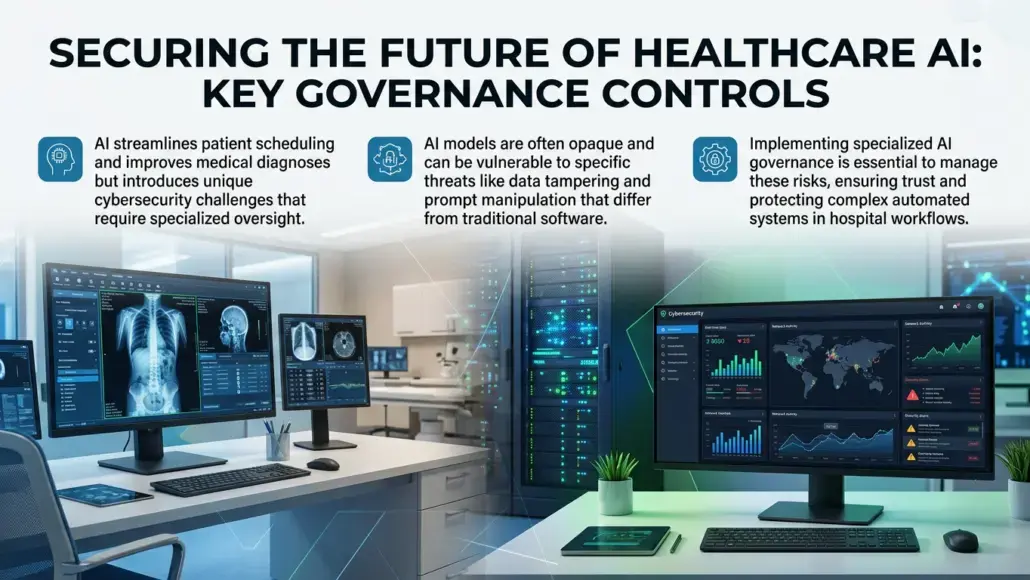

The integration of artificial intelligence into clinical and administrative workflows is transforming the way hospitals deliver care, from improving diagnostic accuracy to streamlining patient scheduling. However, as these automated systems become more prevalent, they also introduce a new set of cybersecurity risks that require specialized oversight. Unlike traditional software applications, AI models are often opaque and can be susceptible to unique threats such as data poisoning, prompt injection, and model inversion. To mitigate these risks, healthcare organizations must implement a comprehensive framework of AI governance controls. These controls ensure that AI systems are deployed safely, ethically, and securely, protecting both the patient and the institution from the potential pitfalls of automation.
Effective governance starts with the realization that AI is not a set-it-and-forget-it technology. It requires continuous monitoring and regular re-evaluation to ensure that the models remain accurate and secure over time. In a hospital setting, where AI might be used to recommend treatment plans or interpret medical images, the consequences of a compromised or malfunctioning model can be life-threatening. Therefore, the implementation of AI governance controls must be a top priority for hospital leadership, involving collaboration between clinical experts, data scientists, and cybersecurity professionals. By building a foundation of trust and accountability, hospitals can realize the full potential of AI while minimizing the associated digital risks. The focus remains on maintaining the integrity of the clinical decision-making process.
Securing the Data Pipeline and Model Integrity
The foundation of any AI system is the data used to train and validate its models. In a healthcare environment, this data often consists of highly sensitive protected health information. Securing the data pipeline is therefore a critical component of AI governance controls. This involves ensuring that data is encrypted both at rest and in transit and that access is limited to only those individuals and systems that strictly need it. Hospitals must implement protocols to detect and prevent data poisoning, where an attacker introduces malicious data into the training set to influence the model’s behavior. Regular audits of the data sources and the preprocessing steps are essential for maintaining the integrity of the AI system. This verification process must be documented to show a clear chain of custody for all clinical training data.
Protecting the model itself is equally important. Attackers may attempt to steal the model’s intellectual property or reverse-engineer its logic to discover vulnerabilities. To counter this, hospitals should use model obfuscation techniques and secure execution environments. Additionally, the implementation of model versioning and change management protocols ensures that only authorized updates are deployed to production. These measures prevent the accidental or malicious introduction of bias or security flaws into the clinical workflow. By maintaining a clear and documented history of every model update, the hospital can quickly roll back to a previous known-good version if a problem is detected. This ability to revert to a stable state is a fundamental requirement for clinical safety.

Managing Algorithmic Bias and Clinical Safety
One of the most significant ethical and security concerns in healthcare AI is the potential for algorithmic bias. If a model is trained on data that is not representative of the patient population, it may produce inaccurate or unfair results for certain groups. This can lead to disparities in care and potential legal liabilities for the hospital. Implementing AI governance controls involves regular testing of models for bias across various demographic factors. This testing should be an ongoing process, as the performance of a model can shift over time as the underlying patient data changes. By ensuring that AI systems are fair and equitable, hospitals can maintain the trust of their patients and the community. This vigilance is particularly important when deploying AI in diverse urban healthcare settings.
Clinical safety is another vital aspect of AI governance. Any AI system used in a clinical setting must undergo rigorous validation and clinical trials before being deployed. This process should include an assessment of how the AI output will be used by clinicians and what safeguards are in place to prevent human error. For example, an AI system that flags potential abnormalities in an X-ray should be used as a decision-support tool, rather than a replacement for a radiologist’s interpretation. The unique vulnerabilities introduced by automated systems must be formally integrated into cyber risk registers to maintain a comprehensive view of the hospital’s digital risk posture. This integration ensures that the risks of AI are treated with the same level of seriousness as any other enterprise risk.
Regulatory Compliance and Ethical Oversight
The regulatory environment for healthcare AI is still evolving, with new guidelines and requirements being introduced by agencies such as the FDA and the Office of the National Coordinator for Health Information Technology. Hospitals must stay abreast of these changes and ensure that their AI governance controls remain compliant. This includes maintaining detailed documentation of model development, testing, and deployment, as well as establishing clear procedures for reporting and investigating AI-related incidents. Compliance with existing data privacy laws, such as the Health Insurance Portability and Accountability Act, also remains a critical requirement for any AI system that processes patient information. These records serve as the primary evidence of the hospital’s commitment to patient safety and data protection.
Ethical oversight is a central pillar of an effective governance framework. Many hospitals are establishing AI ethics committees, composed of clinicians, ethicists, legal experts, and patient advocates, to review and approve new AI projects. These committees provide an independent perspective on the potential risks and benefits of AI, ensuring that the technology is used in a way that aligns with the hospital’s values and mission. By incorporating ethical considerations into the governance process, hospitals can avoid the pitfalls of black-box AI and ensure that automated systems are transparent and accountable. This commitment to ethics is essential for building public trust in the use of AI in medicine. The transparency provided by these committees also helps in managing the expectations of both staff and patients.
Monitoring for Model Drift and Performance Degradation
A unique challenge in AI governance is the phenomenon known as model drift, where the performance of an AI model degrades over time due to changes in the real-world environment. In a hospital, this could be caused by changes in clinical protocols, the introduction of new diagnostic equipment, or shifts in the patient population. AI governance controls must include automated monitoring for drift, with predefined thresholds for when a model must be taken offline for retraining. This proactive monitoring ensures that the AI continues to provide accurate and reliable support to clinicians. Without these checks, a model could slowly become less effective, potentially leading to incorrect diagnoses or treatment recommendations that could harm patients.
Additionally, the governance framework should address the issue of explainability. Clinicians must be able to understand why an AI system has reached a particular conclusion to use its output effectively. This “explainable AI” is a key component of trust and safety in the clinical workflow. By requiring that AI vendors provide models that offer clear rationales for their decisions, hospitals can ensure that their staff remains in control of the final medical judgment. This human-in-the-loop requirement is a fundamental safeguard against the unpredictable behavior of complex algorithms. The integration of explainability also helps in the forensic analysis of any AI-related incidents, allowing the hospital to identify the root cause of a failure and prevent its recurrence.
The following list identifies the key elements of an AI governance and security strategy:
- Establishment of a multidisciplinary AI governance committee to provide oversight and strategic direction for all automated initiatives.
- Implementation of rigorous data security and privacy controls throughout the entire AI data pipeline from ingestion to model training.
- Regular testing and validation of AI models for accuracy, security vulnerabilities, and algorithmic bias across all patient demographics.
- Development of clear protocols for model versioning, change management, and emergency rollback in the event of a performance failure.
- Integration of AI-related risks into the hospital’s broader enterprise and cyber risk registers to ensure executive-level visibility.
- Ongoing training for clinicians and staff on the safe and ethical use of AI decision-support tools in the clinical workflow.
- Continuous monitoring of AI model performance and security in the production environment to detect drift or unauthorized access.
- Selection of AI vendors that can provide transparent documentation, software bills of materials, and commit to long-term security support.
- Formalization of the human-in-the-loop principle to ensure that all final clinical decisions are made by qualified medical professionals.
By adhering to these principles, healthcare organizations can utilize the power of AI with confidence. The use of AI governance controls provides a necessary safeguard in a world where automation is becoming increasingly central to the delivery of care. When AI systems are secure and transparent, they can serve as powerful allies for healthcare professionals, helping them save lives and improve the quality of care for every patient. As the healthcare industry continues to embrace the potential of artificial intelligence, the ability to govern these systems effectively will be a key differentiator for leading institutions. This dedication to safety and security ensures that the benefits of AI are shared by all, while the risks are carefully managed through a structured and analytical approach.