

















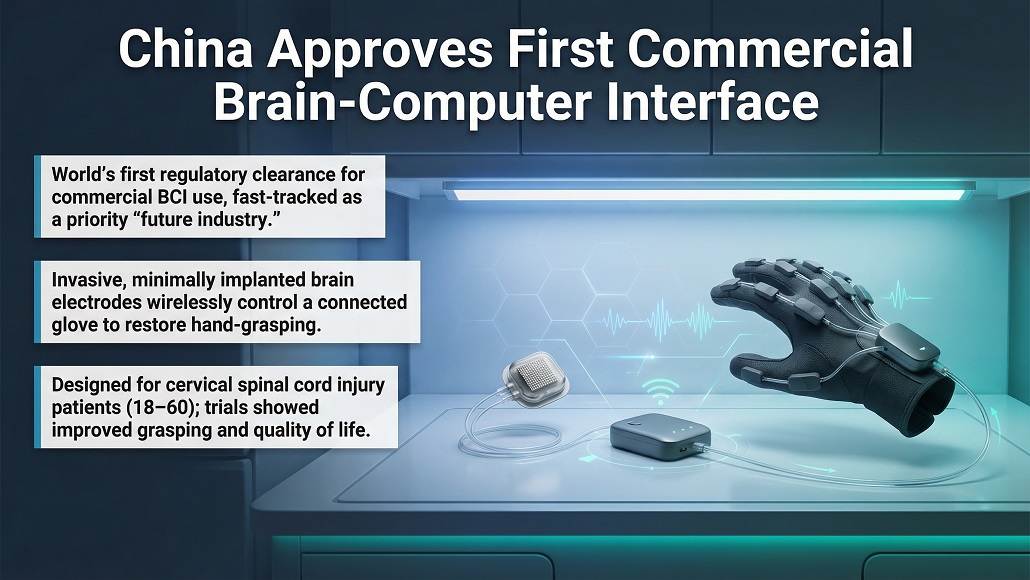

China has granted approval for the commercial sale of a brain-computer interface (BCI) system designed to help restore hand movement, marking the world’s first regulatory clearance of a BCI device for commercial use, the country’s drug regulator said on Friday. The device, developed by Borui Kang Medical Technology (Shanghai), is intended to restore movement and communication capabilities in individuals experiencing different forms of paralysis.
The system is specifically designed for patients with quadriplegia caused by cervical spinal cord injuries. By using a glove connected to the interface, the technology enables patients to regain hand-grasping ability. Classified as an invasive BCI system, the device functions by inserting electrodes directly into the brain rather than placing them on the brain’s surface. The system uses minimally invasive extradural implantation combined with wireless technology to facilitate communication between the brain and the external device.
China’s National Medical Products Administration said that Brain-Computer Interface products such as the newly approved system have been given priority regulatory attention. The regulator noted that the BCI sector has been identified as a “future industry” in Beijing’s latest five-year plan released last week. The move reflects the country’s efforts to accelerate development and deployment of emerging neurotechnology platforms.
Eligibility requirements for the device include patients aged 18 to 60 who suffer from a specific form of spinal cord injury. The diagnosis must have been established for at least one year, and patients must have remained in a stable condition for six months following standard treatment. Candidates must also be unable to grasp objects with their hands while still retaining some level of upper-arm function.
According to the regulator, clinical trial data showed significant improvement in hand-grasping ability among participants, with the improvement contributing to a better quality of life for patients involved in the trials.