













The industrial world is currently in the midst of its fourth major revolution, often referred to as Industry 4.0. While this movement has already reshaped sectors like automotive and aerospace, its most profound impact is perhaps being felt in the field of medical technology. The emergence of smart manufacturing transforming medtech production is not merely about adding more robots to a factory floor it is a fundamental reimagining of how we design, build, and distribute healthcare solutions. By integrating the physical and digital worlds through the Industrial Internet of Things (IIoT), artificial intelligence, and advanced robotics, the medtech industry is creating a new generation of smart factories. These facilities are capable of producing highly complex, life-saving devices with a level of precision, speed, and customization that was previously impossible.
At the heart of smart manufacturing transforming medtech production is the data-driven approach. In a traditional manufacturing environment, data was often siloed, and problems were often only identified after a batch of products had already been completed. In a smart factory, every machine, sensor, and tool is connected to a central digital nervous system. This allows for real-time monitoring of the entire production process, from the temperature of a cleanroom to the precise force applied by a robotic assembly arm. This level of visibility is the essence of industry 4.0 healthcare, as it enables a proactive, predictive model where issues are identified and resolved before they ever lead to a defective product. This not only reduces waste and lowers costs but also significantly enhances the safety and reliability of the medical devices that reach the patient.
The Power of Digital Twins in MedTech Production
A cornerstone of smart manufacturing transforming medtech production is the use of digital twins. A digital twin is a virtual replica of a physical asset, whether it is a single machine, a production line, or an entire manufacturing facility. By creating these virtual models, medtech companies can simulate and optimize their production processes in a risk-free digital environment. For example, before a new surgical instrument goes into production, engineers can use a digital twin to test how different materials or manufacturing methods will affect its final quality and performance. This capability is a game-changer for digital twins production, as it drastically reduces the time and cost associated with prototyping and scaling up new innovations.
Furthermore, digital twins allow for a level of flexibility that is essential in the modern medtech landscape. As the industry moves toward more personalized and patient-specific devices, the ability to rapidly reconfigure a production line is a critical advantage. In a smart factory, a digital twin can be used to plan a seamless transition from one product variant to another, ensuring that the physical machines are updated with minimal downtime. This is particularly vital for the production of custom orthopedic implants or patient-specific surgical guides, where every unit is unique. By leveraging the power of smart manufacturing transforming medtech production, companies can now produce batches of one with the same efficiency and quality as mass-produced goods.
AI-Driven Quality Control and Predictive Maintenance
One of the most transformative aspects of smart manufacturing transforming medtech production is the integration of artificial intelligence into the quality control process. In traditional manufacturing, quality control often relies on manual inspections or statistical sampling, which can miss subtle defects. In contrast, an AI-driven system can use high-speed cameras and advanced image recognition to inspect every single unit on a production line in real-time. These AI systems can detect microscopic cracks, surface imperfections, or dimensional deviations that would be invisible to the human eye. This level of AI manufacturing healthcare is setting a new standard for precision and safety in the industry, ensuring that every device that leaves the factory is perfect.
Beyond quality control, AI is also revolutionizing the maintenance of manufacturing equipment. Predictive maintenance uses machine learning algorithms to analyze data from sensors on a machine to predict when it is likely to fail. This allows the manufacturer to perform maintenance during a planned shutdown, rather than waiting for a catastrophic failure that could halt production for days. For a medtech company, this reliability is essential, as even a short disruption in the supply of critical devices like heart valves or insulin pumps can have serious consequences for patient health. By integrating smart manufacturing transforming medtech production into their operations, companies are building a more resilient and dependable production ecosystem.
Automated Medical Manufacturing and Collaborative Robotics
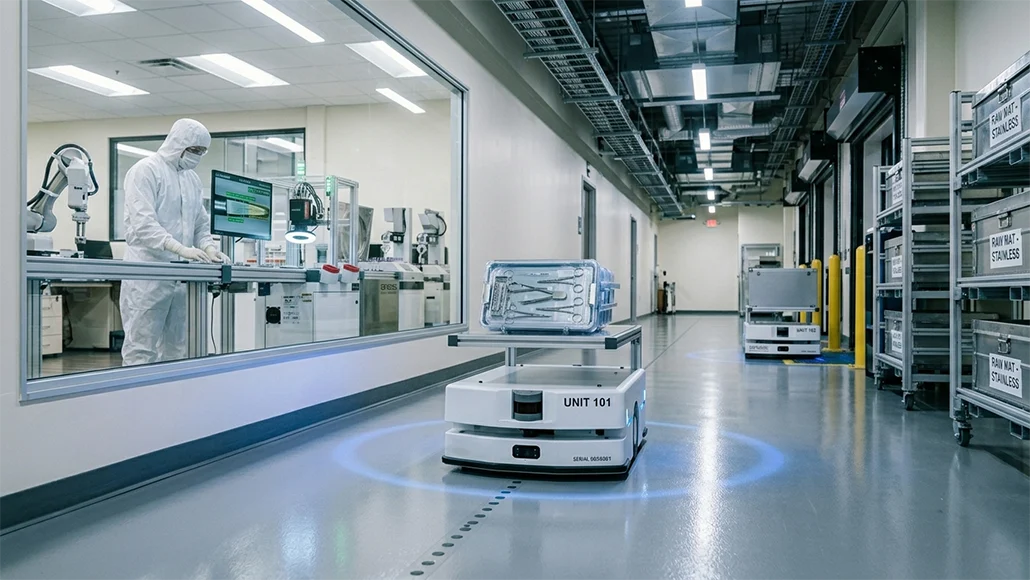
The physical manifestation of smart manufacturing transforming medtech production is the rise of automated medical manufacturing. We are seeing a new generation of cobots, or collaborative robots, that are designed to work safely alongside human operators. Unlike traditional industrial robots that are often caged for safety, cobots use advanced sensors to detect human presence and can be easily programmed to assist with delicate tasks like the assembly of micro-fluidic devices or the packaging of sterile instruments. This human-robot collaboration is a hallmark of industry 4.0 healthcare, as it combines the dexterity and problem-solving skills of a human with the precision and tireless endurance of a machine.
The automation of the manufacturing process also extends to the smart logistics within the factory. Autonomous mobile robots (AMRs) can navigate a facility to deliver raw materials to a production line or move finished goods to a warehouse. This reduces the need for manual material handling and ensures that the production process flows smoothly and efficiently. This holistic approach to smart manufacturing transforming medtech production creates a seamless environment where every movement is optimized for maximum value. This efficiency is particularly important in a global market where medtech companies are facing increasing pressure to lower costs while maintaining the highest standards of quality and innovation.
Sustainability and the Future of Smart MedTech
As we look toward the future, smart manufacturing transforming medtech production will also play a key role in making the industry more sustainable. By optimizing energy use, reducing material waste, and improving the efficiency of the supply chain, smart factories can significantly lower their environmental footprint. This is becoming a major priority for both manufacturers and healthcare providers, as the global community works toward a greener healthcare system. Furthermore, the ability to produce devices closer to the point of care through localized, smart manufacturing hubs will reduce the carbon emissions associated with long-distance shipping.
The ultimate goal of smart manufacturing transforming medtech production is to create a more responsive and patient-centric healthcare system. We are moving toward a world where a patient’s unique anatomical data can be sent directly from a hospital to a smart factory, where a custom device is designed, manufactured, and shipped within 24 hours. This level of speed and personalization will revolutionize the treatment of complex conditions, from rare genetic disorders to traumatic injuries. By continuing to invest in the technologies of Industry 4.0, the medtech industry is not just changing how it makes things it is changing what is possible for the human body. The transformation is already underway, and the result will be a healthier, more precise, and more resilient world for everyone.