










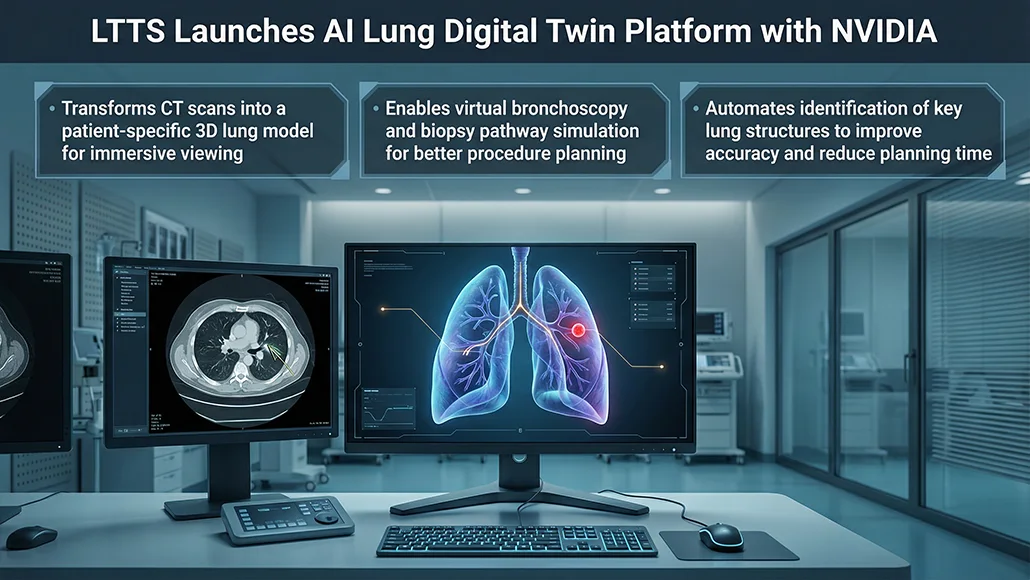

L&T Technology Services has introduced a next-generation AI Lung Digital Twin Platform, developed in collaboration with NVIDIA, aimed at advancing respiratory diagnostics, lung navigation, and surgical planning. The newly launched system integrates deep learning capabilities with immersive 3D visualization and CT imaging workflows, positioning it as a comprehensive solution for precision-driven clinical environments. As part of its broader push into AI-powered healthcare, LTTS is leveraging its MedTech expertise across medical imaging, AI-driven diagnostics, and connected healthcare systems to enhance diagnostic accuracy and patient outcomes.
At the core of the platform is its ability to generate a patient-specific, simulation-ready digital replica of the lungs. By embedding directly into CT imaging workflows, the system uses deep learning models to reconstruct a detailed 3D digital twin, offering clinicians an interactive view of anatomical structures such as airways, blood vessels, lung lobes, and lesions. This AI Lung Digital Twin Platform enables practitioners to simulate bronchoscopy and biopsy pathways, facilitating improved procedural planning within an immersive digital environment.
The platform is built on NVIDIA Physical AI infrastructure, incorporating NVIDIA Omniverse and OpenUSD for interactive visualization, NVIDIA TensorRT for optimized AI inference, and NVIDIA MONAI for advanced image segmentation. These components collectively support automated identification of critical lung structures, volumetric analysis, and navigation path planning. By transforming static CT scans into dynamic models, the system allows clinicians to better assess anatomical relationships, reduce pre-operative planning time, and improve procedural safety across complex interventions.
“By combining LTTS’ engineering expertise in medical imaging and digital health platforms with the power of NVIDIA’s Physical AI infrastructure, we are enabling a new generation of AI-powered biological digital twins for precision medicine,” observed Amit Chadha, CEO & Managing Director, L&T Technology Services. “These platforms can transform how clinicians visualize lung anatomy, plan interventions and deliver precision care. The impact will be visible across the global healthcare ecosystem in the years ahead.”
David Niewolny, Head of Business Development for Healthcare and Medical Technology, NVIDIA, said, “Digital twins are emerging as a powerful new tool for precision medicine. By leveraging NVIDIA Physical AI infrastructure, Omniverse, MONAI and TensorRT, LTTS is transforming CT data into interactive lung digital twins that allow clinicians to visualize anatomy in 3D, simulate procedures and plan clinical interventions with greater confidence.”
Rising global cases of respiratory diseases, including lung cancer and COPD, are accelerating the adoption of AI-driven digital twin technologies. These innovations are expected to shift clinical workflows away from conventional imaging interpretation toward predictive, simulation-led, and minimally invasive intervention planning, supporting more personalized and data-driven treatment strategies.