



Close
Digital Health & Ai Innovation summit 2026
Medical Taiwan 2026

Philips receives FDA premarket approval for its HeartStart FR3 and HeartStart FRx automated external defibrillators

Philips receives FDA premarket approval for its HeartStart FR3 and HeartStart FRx automated external defibrillators

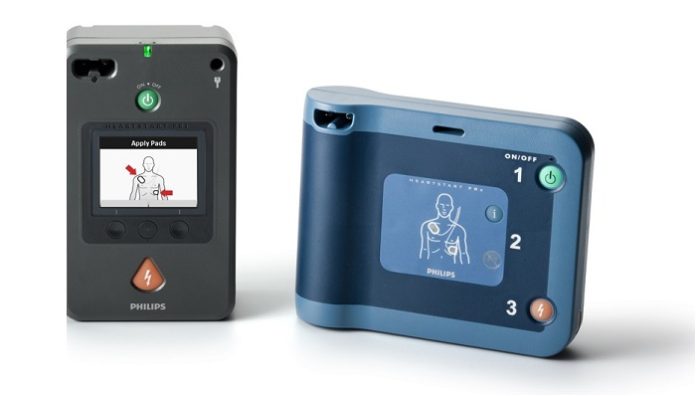
Royal Philips, a global leader in health technology, announced that the Center for Devices and Radiological Health (CDRH) of the U.S. Food and Drug Administration (FDA) has granted premarket approval (PMA) for the company’s HeartStart FR3 and HeartStart FRx automated external defibrillators (AEDs), and their supporting accessories, including batteries and pads.

The HeartStart FR3 is a professional grade AED with advanced features to help medical personnel and first-responders treat cardiac arrest. The HeartStart FRx is a public-access AED that features intuitive, step-by-step voice instructions, including cardiopulmonary resuscitation (CPR) guidance, for emergency use in workplaces, schools and other public spaces, as well as for medical professional use.

Our industry leading portfolio of AEDs is instrumental in helping save the lives of numerous sudden cardiac arrest victims in the U.S. and worldwide.

“We are pleased to receive premarket approval for our HeartStart FR3 and HeartStart FRx AEDs,” said Arman Voskerchyan, Business Leader Therapeutic Care at Philips. “This complements the premarket approval that we received last year for our HeartStart OnSite and HeartStart Home AEDs. Our industry leading portfolio of AEDs is instrumental in helping save the lives of numerous sudden cardiac arrest victims in the U.S. and worldwide. We look forward to continuing to meet our commitment to our medical professional and public-access customers, and especially to the victims of sudden cardiac arrest who rely on our AEDs.”

FDA PMA information for the HeartStart FR3 and HeartStart FRx defibrillators can be found here and here, respectively. These devices have been marketed to date under FDA premarket notifications (510(k)), but are now approved under PMA.

In 2019, Philips received PMA approval for its HeartStart OnSite and HeartStart Home defibrillators, which are the only over-the-counter AEDs available to consumers in the U.S.

About Royal Philips

Royal Philips is a leading health technology company focused on improving people’s health and enabling better outcomes across the health continuum from healthy living and prevention, to diagnosis, treatment and home care. Philips leverages advanced technology and deep clinical and consumer insights to deliver integrated solutions. Headquartered in the Netherlands, the company is a leader in diagnostic imaging, image-guided therapy, patient monitoring and health informatics, as well as in consumer health and home care. Philips generated 2019 sales of EUR 19.5 billion and employs approximately 81,000 employees with sales and services in more than 100 countries.

Circadia Health announces FDA clearance of AI-Powered Respiratory Monitor

Circadia Health announces FDA clearance of AI-Powered Respiratory Monitor

CResp addresses the known limitations of pulse oximetry and other wearables, offering long-term respiration data effortlessly to enable effective triage and ongoing care management.

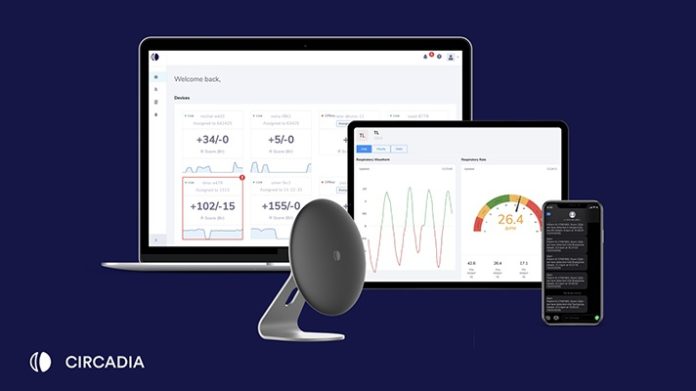
Circadia Health announced today that it has received expedited FDA clearance for Contactless Respiration Rate (CResp®) monitoring due to COVID-19. The C100 System™ uses radar to sense wirelessly, from up to 4 feet away in adult patients.

Continuous CResp will support clinicians and save patient lives, by predicting and preventing respiratory complications through early warning scores, enabling timely interventions. The C100 features a radar sensor, proprietary radar Signal Analysis Technology (rSAT®), and cloud-based software for early detection of patient deterioration to augment clinical decision making.

Respiratory rate is routinely measured manually, through visual counting of breaths per minute by nursing staff, and is one of the earliest signs of patient deterioration. However, staff shortages result in this parameter being frequently measured incorrectly or not at all. Contactless respiration rate, CResp, has been shown to be accurate, reliable, easy-to-use, and scalable for both continuous and spot-check monitoring across the continuum of care (general care floors, skilled nursing, and home health). CResp addresses the known limitations of pulse oximetry and other wearables, offering long-term respiration data effortlessly to enable effective triage and ongoing care management.

Circadia will be launching the C100 immediately to play a critical role in helping hospitals and skilled nursing facilities combat respiratory-related illnesses including COVID-19, pneumonia, COPD exacerbations, and other forms of respiratory failure, in a wide range of patients, both in-hospital and at home. Designed for convenience and scalability, Circadia’s aim is for the C100 to become the gold standard for respiratory monitoring. The C100 eliminates patient compliance issues and helps clinicians monitor proactively and remotely to improve patient outcomes, reduce readmissions, and reduce the risk of infection transmission from patient-to-patient and patient-to-clinician.

Alongside CResp, Circadia rSAT® and AI-powered algorithms offer monitoring of motion, presence, and sleep quality. This facilitates early detection of adverse events such as falls, and recovery analysis. In addition to physiological monitoring, the C100 also offers ambient sound and light monitoring for detecting disturbances and coughing.

Dr Guy Leschziner, Chief Medical Officer of Circadia, said, “We are building a ubiquitous data-driven platform, utilizing long-term continuous physiological parameters that we capture using our technology to develop proprietary early warning risk scores for various medical conditions.”

Circadia’s Data as a Service (DaaS) model allows the C100 to be available under a subscription model with zero upfront cost to healthcare providers. The C100 generates reimbursement revenue of $123 per patient per month under CPT codes 99454, 99457, and 99458.

Fares Siddiqui, Co-founder and CEO of Circadia, said, “Our goal is to provide a frictionless solution to clinicians in order to help improve patient outcomes and reduce the cost of care. During this COVID-19 crisis, the FDA has recognized the life-saving potential of our technology. We are now able to deliver the most convenient and powerful method to monitor fragile patients both in-facility and remotely at home.”

Headquartered in London and founded in 2016 by Imperial College London alumni Fares Siddiqui and Michal Maslik, Circadia’s mission is to enable early detection of respiratory failure, the third leading cause of death. Circadia employs engineers, scientists, and physicians to fuse wireless sensors, medical software, and clinically validated algorithms to save patient lives.

American Hospital Dubai selects Oracle and Cerner to deliver healthcare

American Hospital Dubai selects Oracle and Cerner to deliver healthcare

American Hospital Dubai, part of Mohamed and Obaid Al Mulla Group, has selected Oracle Cloud Applications and Cerner, a Gold Level member of Oracle Partner Network (OPN), for major Digital Transformation.

The initiative is aimed at reducing cost, optimising physician performance, driving better inventory management, avoiding losses to over or understocking, and hiring and retaining the best talent.

As per the agreement, Cerner will deliver a new health IT platform – an electronic health record (EHR) to improve the safety, quality and healthcare experience for patients and caregivers. In addition, Oracle will provide the digital business platform and Oracle Enterprise Resource Planning (ERP) Cloud to enhance productivity, reduce costs and improve controls. Both solutions will integrate hospital business and clinical operations to improve efficiency and business decision-making based on real-time data.

The new EHR and ERP platforms will provide American Hospital Dubai with the ability to truly automate its end-to-end clinical and business processes. The implementation of these industry-leading solutions will enable the hospital to deliver a seamless patient journey, drive efficiency and provide high quality, affordable care. In addition, the wealth of data collected will be used to report and improve patient outcomes, which ultimately will help optimise clinical and business performance across the entire organisation.

Sherif Beshara, Chief Executive Officer of Mohamed and Obaid Al Mulla Group, said: “Medical well-being is integral for the progress of our nation and its people, and we are consistently seeking intelligent methods to improve quality of care and to enhance the patients’ experience. Our partnership with Cerner and Oracle significantly improves our clinical and non-clinical services and further positions American Hospital as a beacon of medical service excellence and expertise in the region and beyond.”

American Hospital Dubai will also implement Oracle Human Capital Management (HCM) Cloud to further equip its 1,200 employees with the tools they need for the digital healthcare era. This initiative will help American Hospital retain and hire the best talent, initiate training programmes and ensure enhanced employee satisfaction.

“The Oracle Cloud Applications implementation is aimed at automating American Hospital’s core processes to provide a single source of truth with better budgeting and planning tools for the hospital’s leadership – as well as increasing employee satisfaction and reducing turnover,” said Rahul Misra, Vice President – Business Applications, Lower Gulf, Oracle. “American Hospital is a true pioneer and with this transformation, the healthcare provider is preparing for its next growth phase and continued delivery of excellent patient care.”

Alaa Adel, Managing Director, Cerner Middle East and Africa, said: “We are excited to work collaboratively with American Hospital to roll out a network wide EHR that will create a patient-centric health care delivery system and engage individuals in a culture of proactive health management.

“During the time of the COVID-19 pandemic, the role of technology becomes even more prominent. With Cerner’s innovative solutions, American Hospital will not only further enhance its response to the global crisis, but more importantly be well-equipped with cutting-edge technologies to thrive in the new era of post-pandemic healthcare.”

Oracle Cloud Applications and Cerner chosen to enhance efficiency and prepare a digital-ready healthcare workforce.

Metabolic health focused telemedicine startup Calibrate launches

Metabolic health focused telemedicine startup Calibrate launches

This morning a new digital-weight-management startup out of New York City called Calibrate launched with a $5.1 million boost in seed funding led by Forerunner Ventures.

Calibrate is a one-year telemedicine program focused on weight loss that combines both prescription medications and health coaching. The end goal of the program is to help customers “reset their metabolic health.”

Users are assigned a weight coach, who can work with them to modify their eating and exercise habits, as well as things like sleep. These can then be added to the Calibrate app.

“The weight loss industry has been focusing on the number on the scale, but the science tells us it’s more complicated,” Isabelle Kenyon, founder & CEO of Calibrate, said in a statement “Sustainable results are driven not by diets, but by metabolic health. So, our program combines what’s proven to achieve it – metabolic medication and coaching on food, exercise, sleep, and emotional health habits. The result is sustainable weight loss and success beyond the scale – whole-body health, from reduced disease risk to improved day-to-day. Weight doesn’t reflect willpower. It reflects your metabolic system. It’s time we treat it that way.”

WHY IT MATTERS

The United States has struggled with the obesity epidemic for many years now. Today the CDC reports an obesity rate of 42.4% in the country. Obesity is linked to a number of health risks, including Type 2 diabetes, heart disease and stroke.

THE LARGER TREND

Weight-management tools have been around for nearly the entire history of digital health. Weight Watchers was an early player in the space, but the space has become more crowded over the years. Direct-to-consumer virtual-health company Ro launched a weight-management offering in December. That initiative is focused on a digestible product called Plenity, which was designed to help the user feel full.

Over the years we’ve also seen a number of approaches to weight management. For example, Zero is a fasting app that helps users keep track of their meals, and Keyto is a startup dedicated to helping users with the keto diet.

India: Hospitals, health-tech startups to start free telemedicine app Swasth

Hospitals, health-tech startups to start free telemedicine app Swasth

More than 100 leading private hospitals, health-tech startups, technology companies and investors have come together voluntarily to launch a free telemedicine consultation app ‘Swasth’ to help fight the spread of the Covid-19 pandemic in India.

The initiative is being led by Infosys co-founder Kris Gopalakrishnan, Manipal Group’s Ranjan Pai, iSPIRT’s Sharad Sharma, Apollo Hospital’s Shobhana Kamineni, former Bill and Melinda Gates Foundation executive Nachiket Mor and Accel’s Subrata Mitra, who form the governing council of the non-profit consortium.

Swasth’s partners include Manipal Hospitals and Apollo Hospitals, e-pharma and diagnostics startups Medlife and 1MG, new-age medical and diagnostics chain Care.Fit, and e-commerce firms Flipkart and Udaan, among others.

The grouping will make available free teleconsultations through a network of over 2,000 certified and trained doctors, which it said was in response to Prime Minister Narendra Modi’s call to use telemedicine to combat the outbreak.

The Swasth app, which will go live on June 24, will also make available resources for users to find available beds, diagnostic labs and home quarantine aids.

It being launched in three languages – English, Hindi and Gujarati, but will be scaled up to 25 languages soon.

Swasth may charge a nominal fee for its services, which could go into covering operational and salary costs as the initiative gets a more formal structure.

Swasth has raised Rs 10 crore from ACT Grants, an initiative formed to back startups fighting Covid-19 and related innovation. ACT is a collective of entrepreneurs, investors and others within the startup community.

“The governing council will also look at non-shareholder fundraising as a part of its (job),” said Yashish Dahiya, cofounder and CEO of PolicyBazaar, which is part of the network.

The company could also look at raising further capital from other foundations and CSR funds of large organisations.

The platform will add more doctors as it scales over the next few months.

“The network has a bunch of doctors who will offer their services for free and then there’s the specialist networks from Apollo and Manipal and other hospitals that are coming onboard,” Shobhana Kamineni, executive vice-chairperson of Apollo Hospitals told ET.

The short-term goal of the company is to provide a telemedicine solution for the masses, and in the mid to long-term Swasth will evolve into the Bharat Health Stack, which is an open source and interoperable technology framework for healthcare built by software products industry body iSPIRT.

Swasth is in the process of being registered under Section 8 of the Companies Act, making it a not-for-profit organisation.

“Swasth has been built in close partnership with iSPIRT and the technology teams work together. It’s an open network that’s built on top of a consent layer where the owner of the data, which is the patient, and the hospital which he/she goes to, has access to that data and nobody else,” added Dahiya.

“The framework for this (Swasth) creates an intent that we can do more. It would be a waste to drop this off after the crisis,” added Kamineni. “Neutrality, data privacy and the ability to adjudicate in a very fair manner are the basis of this framework.”

While Swasth will compete with several players in the teleconsultation and healthcare space, it also provides an avenue for companies to collaborate to bring about big changes in India’s healthcare and adjacent sectors, Dahiya added.

According to the Swasth website, it will work to “further public health goals and work in coordination with the government, the Medical Council, public health organizations and the private sector” to provide quality healthcare access to the masses.

DentaQuest Selects MouthWatch Platform to Expand Teledentistry Capabilities

DentaQuest Selects MouthWatch Platform to Expand Teledentistry Capabilities

DentaQuest, the nation’s leading oral health organization, is working with MouthWatch, a leader in innovative patient-friendly, clinician-focused teledentistry solutions, to provide the TeleDent teledentistry platform to more than 70 DentaQuest managed or affiliated dental practices in Alabama, Massachusetts, Oregon and Washington.

The TeleDent platform will enable DentaQuest-affiliated dentists to conduct both synchronous (live) and asynchronous (store and forward) teledentistry encounters with patients, including video and messaging interactions and sharing of files and photos.

“Teledentistry has been essential for dentists during the COVID-19 pandemic. It enables them to connect with patients for emergency triage and consulting encounters, greatly reducing strain on hospital emergency rooms and dental practices,” said Todd Cruse, President, DentaQuest Care Group. We also believe teledentistry will be an increasingly important part of oral health in the future, facilitating improved access for those in underserved communities and accelerating medical-dental integration.

According to MouthWatch founder and CEO Brant Herman, “Mouth Watch and DentaQuest are dedicated to providing dentists and patients with improved access to dental care by delivering user-friendly technology that will become an integral part of oral health both during and after the pandemic. Working together, we will deliver more effective and convenient dental care to a greater number of patients.”

About DentaQuest

DentaQuest manages dental and vision benefits for 27+ million Americans and provides direct patient care through a network of more than 70 oral health centers in 6 states. They provide outcomes-based dental solutions for Medicaid and CHIP, Medicare Advantage, small and large businesses, and individuals nationwide.

About MouthWatch

MouthWatch, LLC has been developing teledentistry solutions since 2012 and is a leader in clinician-focused teledentistry, digital case presentation tools and intraoral imaging devices. They are the founders of the Teledentistry Innovation Awards, known as “The Tellies”, which recognizes teledentistry innovators nationally.

Rapid Radiology and OpenText Accelerate Diagnostic Results to Help Improve Patient Care

Rapid Radiology and OpenText Accelerate Diagnostic Results to Help Improve Patient Care

OpenText announced Rapid Radiology, one of the largest teleradiology providers in the U.S, has selected OpenText EMR-Link as its comprehensive solution for electronic medical record (EMR) integration and computerized physician order entry (CPOE).

Rapid Radiology will use OpenText™ EMR-Link™ to streamline the delivery of radiology test results to EMR charts at healthcare facilities. This will include senior and long-term care facilities with more vulnerable patients, where rapidly sharing diagnostic results improves decision-making for timely treatment and reduces avoidable hospital readmissions. Electronic orders can now be added to results capabilities across Rapid Radiology’s users and customers, eliminating the need for the inefficient blend of paper, fax, electronic portals, and other systems facilities must use today.

“OpenText EMR-Link allows us to deliver better turnaround on patient care. An order can happen in real-time in our system now—the order comes in and it’s automatically dispatched to the correct technician, versus taking a phone call, getting a fax, getting an email, and then having to re-enter it into a system,” said Mike Spears, Executive Vice President at Rapid Radiology. “On the results side, OpenText EMR-Link allows us to automatically put the electronic radiologist report into the patient’s file, also in real-time. This closes the loop and ensures that the patient record includes all the information coming from the radiology side.”

“Diagnostic labs and imaging centers often face integration challenges in exchanging electronic information with healthcare facilities, leading to critical delays in treatment,” said OpenText Chief Product Officer Muhi Majzoub. “OpenText EMR-Link handles integration complexity and delivers the consistent connectivity that labs and imaging centers require. OpenText’s expertise in long-term care also helps Rapid Radiology to optimize the workflows between service providers and ordering physicians, leading to improved patient outcomes.”

EMR-Link eliminates the need to search for and manage paper results or faxes, helping patient care teams gain quick access to review results and develop treatment plans. The OpenText Business Network solution delivers the industry’s only cloud integration service to provide interoperability between all EMR systems in the long-term care market, ensuring seamless delivery of clinical results between providers and improving patient care. This is particularly important with the move to increased remote work, as physicians and nurses are able to review lab results online, and support personnel can review orders and ordering characteristics remotely through EMR-Link.

“We’re all about patient care,” said Rapid Radiology’s Spears. “Automatic, accurate, and accelerated data helps deliver faster clinical decisions that can improve patient outcomes and bring relief to the anxious families.”

Spears summarized the value of the OpenText solution in helping Rapid Radiology meet its goals and fulfill its commitment to advancing teleradiology with technology: “OpenText EMR-Link is key to our business. It’s what we’ve built our business on.”

About Rapid Radiology

Rapid Radiology, one of the largest teleradiology providers in the U.S., delivers diagnostic services to healthcare organizations through the support of its national radiology group and its network of expert sub-specialty radiologists. Established to expedite diagnosis and treatment, Rapid Radiology offers custom technology and intelligent workflows to enhance patient care.

About OpenText

OpenText, The Information Company™, enables organizations to gain insight through market leading information management solutions, on-premises or in the cloud.

Swedish Healthcare Region to Realize Integrated Diagnostics – Expands IT Solution From Sectra With Digital Pathology

 Swedish Healthcare Region to Realize Integrated Diagnostics - Expands IT Solution From Sectra With Digital Pathology

International medical imaging IT and cybersecurity company Sectra has signed a digital pathology contract with Region Västmanland in Sweden. The healthcare region already uses Sectra’s software for handling medical images, which will now be expanded to also include digital pathology as it digitizes its pathology department. Using the same system to store and view images and information from various diagnostic specialties enables integrated diagnostics, which is key for efficient cancer care.

“We are excited to take the next step in our digitization journey toward a truly integrated diagnostic workflow. It is important that we can scale our solution at our own pace and Sectra’s solution allows this. We are also looking forward to equipping our pathologists with the tools that support us in our efforts to provide the best possible cancer care,” says Jonas Cederberg, Chair of Department for Medical Diagnostics at Region Västmanland.

With digital images of tissue samples rather than physical glass slides, pathologists can instantly access and share current and historical images and information from anywhere and at any time. Digital pathology provides pathologists with tools that are not available when using a microscope, which reduces variation between examinations and enables pathologists to spend their time on more advanced tasks. The digital solution also provides pathologists with assistance at critical decision points, such as grading or performing more precise measurements. Furthermore, digital access facilitates second opinions, external reading resources, and specialist consultations.

Sectra’s digital pathology solution will be integrated with Region Västmanland’s laboratory information system (LIS). This will provide pathologists with a complete overview of the patient history in one application and enable workflow orchestration to drive the workflow according to sub-specialties, rules and priorities. The solution’s vendor-neutral approach also gave Region Västmanland the freedom to select the scanner vendor of its choice.

Region Västmanland is already using Sectra’s solution for handling medical images within radiology, mammography, and clinical physiology. The solution will now also include approximately 10,000 pathology examinations per year, with the opportunity to gradually increase usage. The agreement to expand the existing contract was signed in May 2020.

Sectra’s enterprise imaging solution provides a unified strategy for all imaging needs while lowering operational costs. The scalable and modular solution, with a VNA at its core, allows healthcare providers to grow from ology to ology and from enterprise to enterprise. Read more about Sectra’s enterprise imaging solution and why Sectra PACS is ranked “Best in KLAS” for seven consecutive years.

About Sectra
Sectra assists hospitals throughout the world to enhance the efficiency of care, and authorities and defense forces in Europe to protect society’s most sensitive information. Thereby, Sectra contributes to a healthier and safer society. The company was founded in 1978, has its head office in Linköping, Sweden, with direct sales in 19 countries, and operates through partners worldwide. Sales in the 2019/2020 fiscal year totaled SEK 1,661 million. The Sectra share is quoted on the Nasdaq Stockholm exchange.

Scarce Medical Oxygen Leaves Many Gasping For Life Worldwide

Scarce Medical Oxygen Leaves Many Gasping For Life Worldwide

Soaring demand for oxygen prompted by the coronavirus is bringing out a stark global truth: Even the right to breathe depends on money.

In wealthy Europe and North America, hospitals treat oxygen as a fundamental need, much like water or electricity. It is delivered in liquid form by tanker truck and piped directly to the beds of coronavirus patients. Running short is all but unthinkable for a resource that can literally be pulled from the air.

But in poor countries, from Peru to Bangladesh, it is in lethally short supply. Across sub-Saharan Africa, oxygen is a costly challenge for government-funded medical facilities such as Guinea’s Donka public hospital in the capital, Conakry.

The hospital’s planned oxygen plant has never started up. So instead of piping oxygen directly to beds, a secondhand pickup truck carries cylinders over potholed roads from Guinea’s sole source of medical-grade oxygen. Outside the capital, in hospitals and medical centers in remote villages and major towns,doctors say, there is ‘no’ oxygen at all.

“Oxygen is one of the most important interventions, (but) it’s in very short supply,” said Dr Tom Frieden, former director of the CDC and current president and CEO of ‘Resolve to Save Lives’.

In Bangladesh, the lack of a centralised system for the delivery of oxygen to hospitals has led to a flourishing market in the sale of cylinders to homes. In Peru, the president has ordered industrial plants to ramp up production for medical use or buy oxygen from abroad. He allocated about $28 million for oxygen tanks and new plants.

But a massive production increase or an impromptu private marketplace are both out of reach in Guinea, where GDP per capita is $850.

Dr Aboubacar Conté, head of Guinea’s health services, said four hospitals in outlying cities will eventually get their own on-site plants to ease what he acknowledged is a need for oxygen outside the capital. — AP

Nanavati Hospital performs TAVR to save senior citizen’s life amidst COVID pandemic

Nixon Peabody represents Swedish Covenant Health in transaction with NorthShore University HealthSystem

A 70-year-old physiotherapist from Mumbai successfully underwent an extremely rare Transcatheter Aortic Valve Replacement (TAVR) surgery at Nanavati Super Speciality Hospital on Tuesday 23rd June 2020. Dr. Lekha Pathak—India’s first woman intervention cardiologist performed the procedure along with renowned cardiologist, Dr. A. B. Gopalamurugan, who flew in from Chennai along with his team.

“We performed the procedure under local anaesthesia. The diseased aortic valve of the patient was replaced percutaneously, with the help of a large catheter which was entered through patient’s groin. Very next morning, patient was happily walking in our corridors and ready to go home,” said Dr Pathak.

Despite the complexity of the procedure, Dr Pathak and her team opted for TAVR to avoid the risks of open heart surgery and reduce hospitalisation period of the senior citizen amidst ongoing COVID 19 pandemic.

“She was immunocompromised, diabetic, hypertensive and detected with hypothyroid. Opting for an open heart surgery could’ve increased the risk and considering her weakening heart, we couldn’t wait for pandemic to end. I am happy we took the decision to perform the surgery immediately,” said the patients husband—a renowned physician from Andheri who has requested anonymity.

The patient’s heart condition had escalated quickly from February this year to June.“We had visited the magnificent Statue of Unity in Gujarat just four months ago. I was feeling extremely well then, but recently, I started feeling fatigued, breathless and uneasy even after minor home chores. Now after the procedure, I am feeling renewed and energetic. I thank all my wonderful doctors for this new lease of life,” said the patient.

“Performing such a complex, lifesaving cardiac procedure on a critically ill senior citizen amidst the pandemic is a dynamic learning experience for cardiologists across the world. Due to a state-of-the-art catheterization laboratory, stringent infection control protocols such as mandatory use of PPEs, thorough fumigation and sanitisation and clear demarcation between COVID and Non-COVID facilities within the hospital, we successfully discharged the patient very next day,” said Mr. Manpreet Sohal, Director and Chief Operating Officer, Nanavati Hospital, wishing a speedy recovery to the patient.

Translate »