














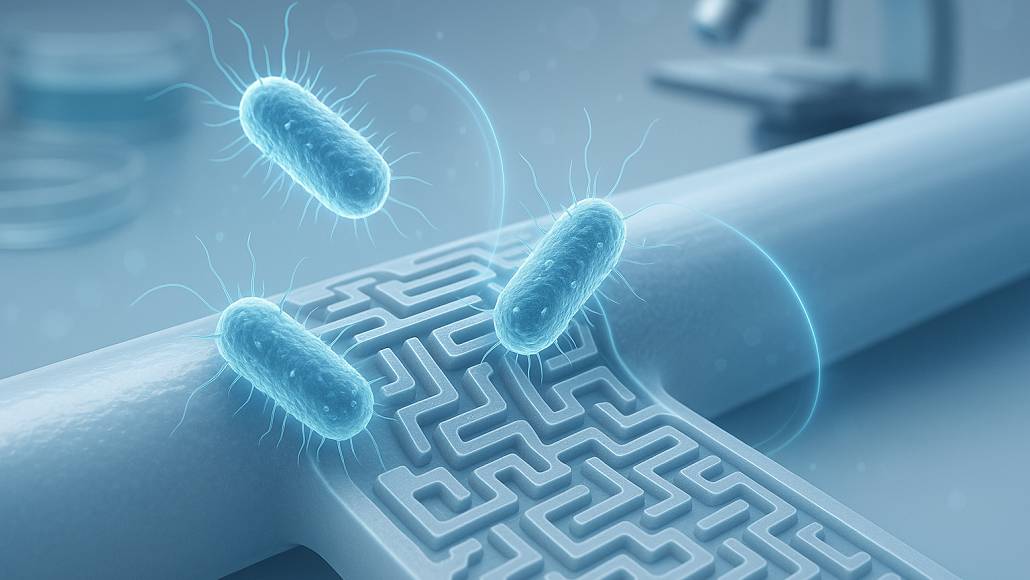
Researchers have found that bacterial cells can be tricked into producing a lubricant that prevents them from adhering to a plastic medical device by the presence of patterned grooves on the device’s surface.
Adding antimicrobials to the materials is a popular way to stop biofilm formation on devices, which shields bacteria from the body’s natural defences against infection of plastic medical devices. The emergence of bacterial resistance to antibiotics is one of its disadvantages, though. According to recent studies, adding surface patterns that resemble a maze can significantly lower bacteria’s capacity to grow on plastics, preventing infections from plastic-based medical devices like breathing tubes and catheters.
Bacterial cells lose their capacity to form biofilms when they come into contact with patterned grooves on a surface, according to a study published in Nature Communications. The body’s immune system is triggered to eliminate any existing bacteria, and the infection is successfully stopped before it has a chance to spread.
In order to find patterns that best inhibit the biofilm formation on devices, researchers at the University of Nottingham in the United Kingdom screened over 2000 designs in a variety of plastics, including polyurethane. They found that the bacterial cells were lured into creating a lubricant that prevents them from adhering to the plastic surface by tiny fissures in the raised patterns. This, in turn, prevents the formation of biofilms and facilitates the removal of the infecting bacteria by the host’s immune defence cells, thereby preventing infection.
Catheter landscaping
Professor Paul Williams from the School of Life Sciences at the University of Nottingham and an expert in molecular microbiology, who led the research, said, “Previous research has shown that introducing antibiotics to medical devices has flaws, such as driving the development of antibiotic resistance. Our study took this idea one step further as we wanted to find out if we could create a simple landscape on a catheter, made of the same material that bacteria didn’t like and couldn’t form biofilms on.
“We tested different species of bacteria on over 2000 different shapes. We had to use machine learning to figure out which of these shapes was best at preventing biofilms forming. We then looked at why certain bacteria didn’t like this surface.”
Reduced barrier to commercial application
Professor Morgan Alexander from the university’s School of Pharmacy, who participated in the study, noted the economic benefits of this technology. “Using physically patterned surfaces has the advantage over coating approaches that it can be applied to existing device materials, reducing the barrier to commercial application. Our discovery could save the [UK’s National Health Service] a lot of money,” said Alexander.