













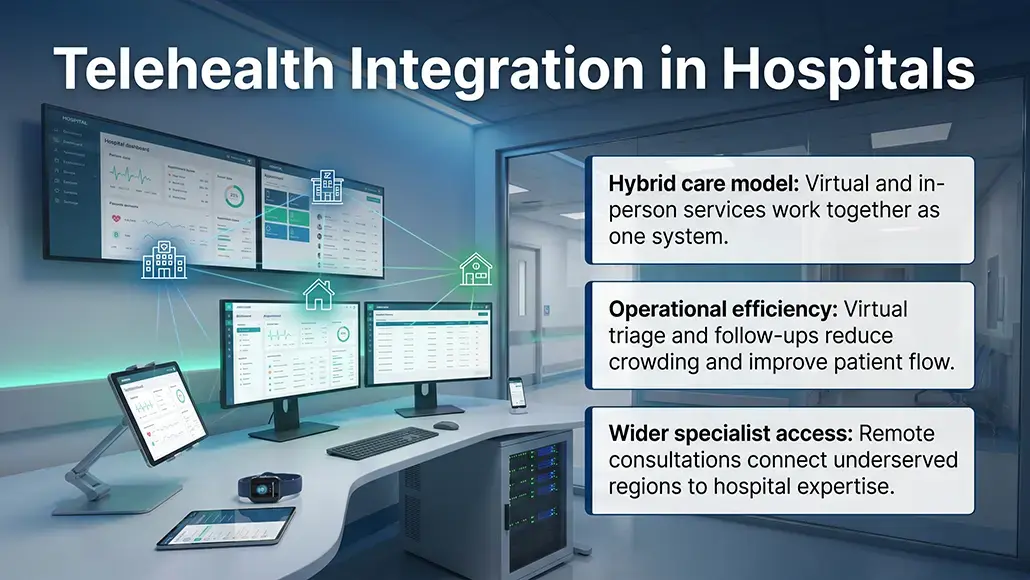

The healthcare sector is undergoing a structural transformation in how care is delivered, managed, and accessed. What was once considered a supplementary digital service has rapidly evolved into a core operational component of modern healthcare systems. Today, telehealth integration in hospitals is no longer limited to virtual consultations it is reshaping workflows, infrastructure planning, patient engagement, and long-term healthcare strategy.
Traditional hospitals, historically built around centralized physical care delivery, are increasingly adapting to a hybrid model where digital and in-person services operate simultaneously. This transition is not simply technological. It represents a broader shift in how healthcare systems think about accessibility, efficiency, and resource utilization.
From Emergency Solution to Strategic Infrastructure
Telehealth adoption accelerated significantly during periods of healthcare disruption, when hospitals were forced to reduce physical interactions while maintaining continuity of care. However, what began as an emergency response has evolved into a long-term operational strategy.
Hospitals are now integrating telehealth into routine services such as:
- Follow-up consultations
- Chronic disease management
- Mental health support
- Specialist referrals
- Remote monitoring programs
This expansion reflects a growing recognition that digital care delivery can improve operational flexibility while extending healthcare access beyond hospital walls.
Why Traditional Hospital Systems Are Embracing Telehealth
One of the primary drivers behind telehealth integration in hospitals is the increasing pressure on healthcare infrastructure. Rising patient volumes, workforce shortages, and growing demand for specialized care are pushing hospitals to optimize capacity without continuously expanding physical facilities.
Telehealth provides an alternative pathway by enabling hospitals to:
- Reduce unnecessary in-person visits
- Improve patient flow management
- Extend specialist access to remote regions
- Minimize overcrowding in outpatient departments
By shifting certain services into virtual environments, hospitals can allocate physical infrastructure more efficiently while improving overall operational performance.
Operational Efficiency Beyond Virtual Consultations
The impact of telehealth extends far beyond convenience. Its integration into traditional hospital systems is fundamentally changing operational workflows.
Virtual triaging, for example, allows hospitals to assess patient conditions before arrival, helping prioritize urgent cases and reduce unnecessary admissions. Remote consultations reduce pressure on outpatient departments, while digital follow-ups improve continuity of care without increasing physical occupancy.
Additionally, telehealth supports better coordination between departments, specialists, and external care providers. This creates a more connected healthcare ecosystem where information flows more efficiently across clinical operations.
In this sense, telehealth integration in hospitals is becoming an operational optimization tool, not just a patient-facing technology.
The Infrastructure Shift: Hospitals Without Walls
Traditional hospital systems were designed around centralized infrastructure beds, clinics, diagnostic facilities, and physical consultation spaces. Telehealth challenges this model by decentralizing parts of care delivery.
As virtual care expands, hospitals are increasingly investing in:
- Digital consultation platforms
- Remote patient monitoring systems
- Cloud-based clinical data integration
- Telemedicine command centers
This transformation is giving rise to the concept of the “hospital without walls,” where care delivery extends into homes, workplaces, and remote communities while remaining connected to centralized clinical systems.
Improving Access to Specialized Healthcare
One of the most significant advantages of telehealth integration is its ability to improve access to healthcare services, particularly in underserved regions.
Specialist shortages remain a major challenge across many healthcare systems. Telehealth enables hospitals to extend specialist expertise to rural and remote populations without requiring patients to travel long distances.
This is particularly valuable in areas such as:
- Cardiology
- Neurology
- Mental health
- Post-surgical follow-up care
By bridging geographic barriers, telehealth helps hospitals expand their reach while improving healthcare equity.
Financial Implications for Hospital Systems
The economics of telehealth integration in hospitals are becoming increasingly relevant for healthcare administrators. While digital infrastructure requires upfront investment, telehealth can generate long-term operational efficiencies.
Potential financial benefits include:
- Reduced infrastructure strain and occupancy costs
- Lower readmission rates through improved follow-up care
- More efficient clinician utilization
- Expanded patient reach without proportional facility expansion
At the same time, hospitals must balance these gains against challenges such as reimbursement models, technology investments, and regulatory compliance requirements.
The financial success of telehealth integration often depends on how effectively digital services are embedded into broader operational strategies rather than treated as standalone offerings.
Challenges Slowing Full Integration
Despite rapid adoption, telehealth integration still faces structural and operational barriers.
Many traditional hospital systems struggle with:
- Integration between telehealth platforms and existing clinical systems
- Data privacy and cybersecurity concerns
- Variability in digital literacy among patients and staff
- Regulatory and reimbursement inconsistencies
There are also concerns around maintaining quality of care in virtual settings, particularly for cases requiring physical examination or complex diagnostics.
These challenges highlight that successful integration is not purely about deploying technology it requires organizational adaptation, workflow redesign, and long-term strategic alignment.
The Human Factor in Digital Healthcare
As hospitals digitize care delivery, maintaining the human element of healthcare becomes increasingly important. Telehealth can improve convenience and accessibility, but concerns remain around patient engagement, communication quality, and continuity of care.
Healthcare providers must balance efficiency with personalization, ensuring that digital interactions do not weaken patient trust or clinical relationships.
This is particularly important in long-term care management, where patient experience and communication quality directly influence treatment adherence and outcomes.
The Role of Data and Analytics
The growth of telehealth is also increasing the importance of healthcare data management. Digital consultations, remote monitoring devices, and virtual care platforms generate large volumes of operational and clinical data.
Hospitals are increasingly using analytics to:
- Monitor patient engagement and outcomes
- Optimize appointment scheduling and resource allocation
- Identify high-risk patients through remote monitoring data
- Improve operational efficiency across virtual care networks
As frequently discussed across healthcare industry platforms, the convergence of telehealth and analytics is transforming hospitals into more connected, data-driven systems.
Conclusion: Building Hybrid Healthcare Systems
The future of healthcare is unlikely to be entirely physical or entirely digital. Instead, hospitals are moving toward hybrid care models where virtual and in-person services operate as integrated components of a unified system.
Telehealth integration in hospitals represents more than a technological upgrade it reflects a broader transformation in how healthcare infrastructure is designed and utilized. Hospitals that successfully integrate digital care delivery into traditional systems will be better positioned to manage capacity, improve accessibility, and respond to evolving patient expectations.
As healthcare systems continue to evolve, telehealth is becoming less of an alternative service and more of a foundational layer within modern hospital operations.