












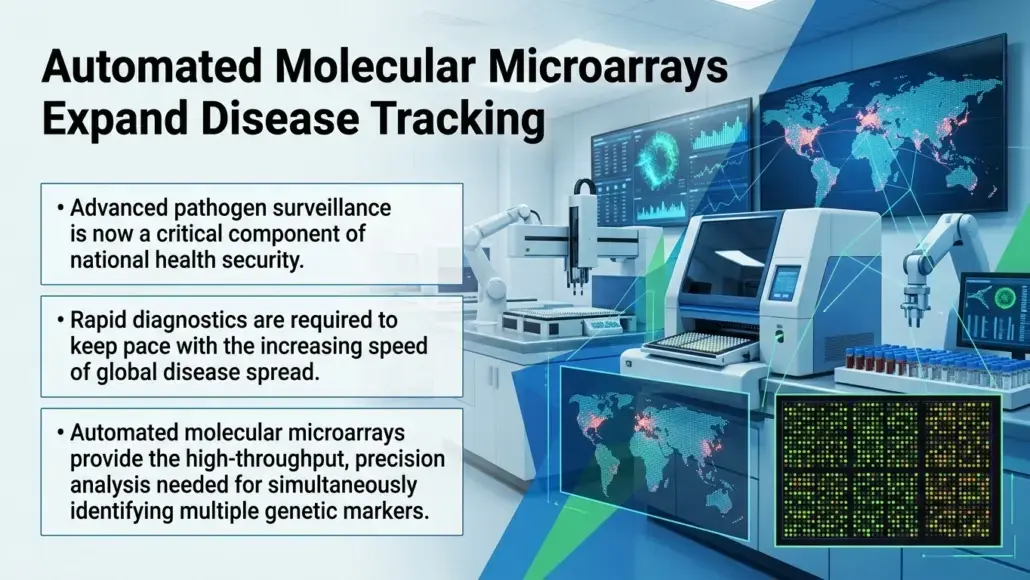

The capacity to monitor infectious agents with high precision has transitioned from a specialized research objective to a fundamental pillar of national health security. As global populations become more interconnected, the speed at which pathogens propagate requires a corresponding acceleration in diagnostic response. Automated Molecular Microarrays represent a significant shift in this capability, providing the high-throughput analysis necessary to identify multiple genetic markers simultaneously. This technology moves beyond the limitations of traditional culture-based methods or single-plex polymerase chain reaction assays, offering a comprehensive view of the microbial environment that is essential for modern disease tracking.
In the context of public health, the ability to detect a broad spectrum of pathogens in a single clinical sample changes the economics of surveillance. Clinical laboratories have historically faced a trade-off between the depth of information and the speed of delivery. High-density microarrays that are fully integrated into automated workflows allow for the rapid screening of respiratory, gastrointestinal, and blood-borne pathogens without the labor-intensive requirements of manual slide preparation or data interpretation. By reducing the potential for human error and increasing the volume of samples processed daily, Automated Molecular Microarrays ensure that epidemiological trends are identified in days rather than weeks.
Transforming Infectious Disease Surveillance
The integration of these systems into infectious disease surveillance programs provides a level of granular detail that was previously unattainable outside of academic settings. Molecular diagnostics have evolved to the point where they can differentiate between closely related viral strains or identify specific antibiotic resistance genes within a matter of hours. This level of detail is critical when managing outbreaks in hospital environments or community settings where the precise identification of a transmission chain can inform immediate containment strategies. Healthcare innovation in this space is not merely about faster results; it is about the quality and utility of the data generated for decision-makers.
Within clinical laboratories, the transition to diagnostic technology that supports automation is a response to the growing shortage of specialized laboratory personnel. Systems that utilize Automated Molecular Microarrays allow technical staff to focus on the interpretation of complex data rather than the repetitive physical tasks of diagnostic testing. This optimization of human capital is essential for maintaining the operational resilience of healthcare systems during periods of high demand. When a laboratory can scale its testing capacity rapidly through automation, the entire public health infrastructure becomes more responsive to emerging threats.
Automation Strengthening Clinical Laboratory Efficiency
The utility of these platforms extends into the realm of genomic characterization, where the identification of mutations can signal the emergence of more virulent or resistant strains. Disease tracking is no longer just about knowing where a virus is, but also understanding how it is changing. By employing Automated Molecular Microarrays, researchers and clinicians can track the evolution of pathogens in real-time, providing the necessary data for vaccine adjustments and the development of new therapeutic interventions. This proactive approach to molecular diagnostics is the foundation of contemporary infectious disease surveillance.
From a regulatory and investment perspective, the adoption of these advanced diagnostic tools reflects a broader trend toward data-driven healthcare. Investors are increasingly looking at diagnostic technology companies that can offer scalable, integrated solutions for large-scale public health challenges. The market for healthcare innovation is shifting toward platforms that provide high clinical value through comprehensive data sets. As Automated Molecular Microarrays become more common in the diagnostic arsenal, the cost per result continues to decrease, making widespread implementation more feasible for both developed and emerging healthcare systems.
Improving Patient Care Through Precision Diagnostics
The impact on patient management is equally profound. When a physician can receive a complete molecular profile of a patient’s infection within a single shift, the choice of treatment can be optimized immediately. This reduces the reliance on broad-spectrum antibiotics, which is a key component of global efforts to combat antimicrobial resistance. Public health benefits when clinical decisions are based on precise genetic data, as it leads to better outcomes for the individual and a more controlled environment for the population. The role of Automated Molecular Microarrays in this clinical workflow is irreplaceable.
The data infrastructure supporting these microarrays allows for the centralization of surveillance information. When clinical laboratories across a region or country utilize standardized automated platforms, the data can be aggregated to create a comprehensive map of disease prevalence. This information is vital for government health agencies as they allocate resources and plan for future health emergencies. The shift toward digital integration within the diagnostic technology sector ensures that the insights gained from molecular diagnostics are shared with the relevant authorities in a secure and timely manner.
Digital Integration Expanding Public Health Intelligence
Infectious disease surveillance is also being enhanced by the portability and modularity of new microarray designs. While the initial wave of automation was confined to large central laboratories, newer iterations of these systems are being designed for regional centers. This decentralization of high-level disease tracking capabilities ensures that rural and underserved populations are not left behind in the diagnostic revolution. Healthcare innovation must be inclusive to be truly effective, and the scalability of Automated Molecular Microarrays is a significant step toward that goal.
The technical sophistication of these systems is matched by their ease of use. Modern interfaces and automated interpretation algorithms mean that the results of complex molecular diagnostics are accessible to a wider range of healthcare professionals. This democratization of high-level data is essential for the rapid response teams that handle the front lines of disease tracking. When the technical barriers to entry are lowered through automation, the overall capacity of the health system to manage complex biological threats is increased.
Conclusion
As we look toward the future of healthcare innovation, the continued development of Automated Molecular Microarrays will likely focus on increasing sensitivity and expanding the range of detectable biomarkers. The goal is a system that can provide a total biological snapshot of a patient’s health status from a single draw. This vision of comprehensive molecular diagnostics is becoming a reality as clinical laboratories adopt more sophisticated automation. The resulting improvements in disease tracking will define the next generation of public health protection.
Finally, the long-term sustainability of disease tracking depends on the ability to maintain these high-tech diagnostic networks. This requires ongoing investment in both the hardware and the software that powers Automated Molecular Microarrays. It also necessitates a commitment to training the next generation of laboratory scientists who will manage these systems. By prioritizing the integration of advanced diagnostic technology, healthcare systems can ensure they remain prepared for whatever biological challenges the future may hold. The transition to automated molecular diagnostics is not a temporary trend but a fundamental reorganization of how we monitor and protect human health.