















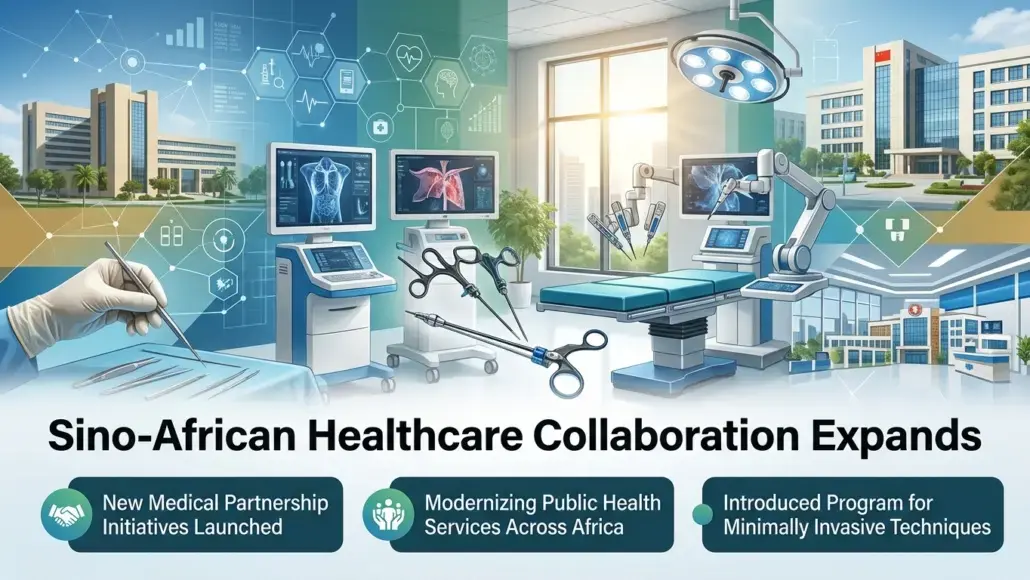

China and Africa launched collaborative medical partnership initiatives in Addis Ababa on Monday, geared toward modernizing continental public health services within the framework of deepening Sino-African practical cooperation. Jointly organized by China’s Central South University’s Xiangya Hospital, Addis Ababa Silk Road General Hospital, and the China-Africa Hospital Alliance, the July 28 event introduced the China-Africa Partnership Program for Minimally Invasive Medicine. Additionally, the gathering marked the official inauguration of the China-Africa Robotic Surgery Training Center and the China-Africa Endoscopic Technology Training Center.
Strategic Advancements in Public Healthcare
Held at the Silk Road General Hospital in the Ethiopian capital, the launch brought together senior Ethiopian government officials, members of the Chinese diplomatic community, alongside African and Chinese medical professionals. Addressing the attendees, Ethiopian President Taye Atske Selassie underscored the necessity of integrating modern technology and a proficient health workforce into public health services. He stated that adopting advanced medical techniques enables efficient service delivery to Ethiopian communities and across the African continent.
The president commended Chinese trainers and doctors for their commitment to skill and knowledge transfer, stating they are “important in upgrading our health services, appointing ourselves with new technology, and to be pioneers in many ways.”
Cultivating Specialized Medical Expertise
These collaborative initiatives aim to foster long-term cooperation between Chinese and African institutions by developing a localized workforce of African specialists. This structural enhancement will be achieved through systematic mentoring, simulator-based training, and practical clinical instruction focusing on advanced endoscopic technology and robotic surgical techniques.
Chinese Ambassador to Ethiopia Chen Hai characterized the initiative as a concrete step in executing the Health Partnership Action under the Forum on China-Africa Cooperation.
“At a time when practical cooperation between China and Africa continues to deepen and deliver tangible results across many sectors, I am especially pleased to see more of China’s high-quality medical expertise and resources reaching Africa, and Ethiopia in particular,” he said.
Promoting Sustainable Healthcare Equity
Ethiopian Health Minister Mekdes Daba praised the mutually beneficial outcomes of the collaborative frameworks in the health sector. Emphasizing the need for medical excellence, she noted that the joint initiatives “will become a model of success that we will try to translate to other services.”
According to Liu Longfei, vice president of Xiangya Hospital of Central South University, minimally invasive surgery plays a crucial role in advancing healthcare equity by providing precise treatment, reducing trauma, accelerating recovery times, and enhancing safety for surgical patients. He noted that institutions under the China-Africa Hospital Alliance are establishing long-term collaborative mechanisms to facilitate knowledge sharing and talent exchange. Promoting healthcare equity remains a central objective as these institutions expand access to minimally invasive surgery across the region.
During the inaugural session, approximately 40 trainees from Sudan, Tanzania, Uganda, Ghana, Libya, and Ethiopia participated in the primary training program centered on endoscopic technology, which was conducted by Chinese experts. This specialized instruction also introduced foundational principles for mastering robotic surgical techniques, reinforcing the overall goals of the medical partnership.