










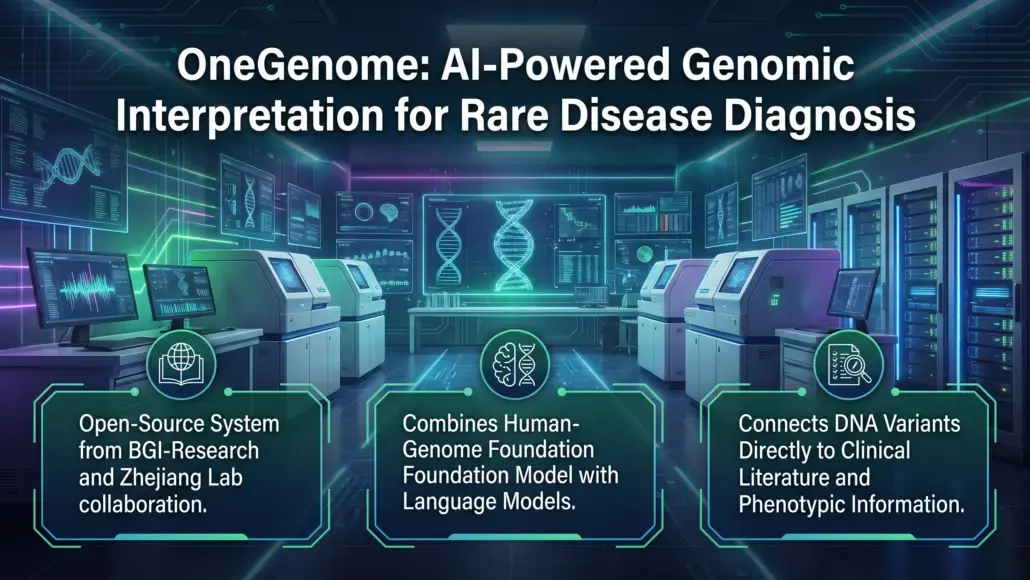

Chinese researchers have introduced an open-source genomic AI system called OneGenome, aimed at assisting clinicians with complex genomic sequencing interpretation and rare disease diagnosis. Developed through a collaboration involving BGI-Research and Zhejiang Lab, the technology combines a human-genome foundation model named Genos with large language model capabilities to connect DNA variants directly with clinical literature and phenotypic information.
The platform is structured to address critical bottlenecks in rare disease diagnosis where standard analytical methods struggle to categorize novel DNA variants. By integrating genomic sequencing data alongside patient phenotypes, OneGenome functions as an advanced decision-support tool designed to aid specialists in precision medicine applications without replacing clinical judgment. In July 2026, the innovation received an Innovate for Impact Use Case Award from the International Telecommunication Union at the UN AI for Good Global Summit.
Model Architecture and Comparative Benchmarks
The underlying Genos foundation model processes long DNA sequences from diverse populations. By linking these biological findings with medical literature, the genomic AI system enables structured reasoning over complex variant data. Developers report that OneGenome has surpassed conventional gene models and general-purpose artificial intelligence tools across several diagnostic and medication-guidance benchmarks.
Similar analytical methodologies are being explored across the sector. For instance, researchers at Shanghai Jiao Tong University and Xinhua Hospital introduced DeepRare, a platform that pairs clinical phenotypes with genetic context. In research testing published in Nature, DeepRare achieved a 57.18% top-ranked diagnostic rate using phenotype data alone, which rose above 70% when whole-genome or exome information was incorporated.
Diagnostic Impact and Scientific Considerations
Evaluating massive genomic datasets remains a primary challenge for clinical teams. Broader studies highlight the potential of comprehensive genetic analysis; a 2024 Nature Genetics study reported that genome sequencing provided plausible diagnostic answers for 29.3% of participants with suspected rare conditions. Furthermore, a 2025 study of 1,452 Korean families demonstrated a 46.2% molecular diagnostic yield, which altered clinical management in 18.5% of diagnosed cases.
Despite these computational advancements, developers emphasize that OneGenome is not an autonomous diagnostic entity. Variant interpretation requires thorough contextualization against clinical symptoms, population frequencies, and patient family histories. Precision medicine initiatives, including the NIH Undiagnosed Diseases Program, continue to demonstrate that computational outputs must be validated through clinical evaluation, rigorous privacy safeguards, and expert specialist oversight before broad integration into routine healthcare.