












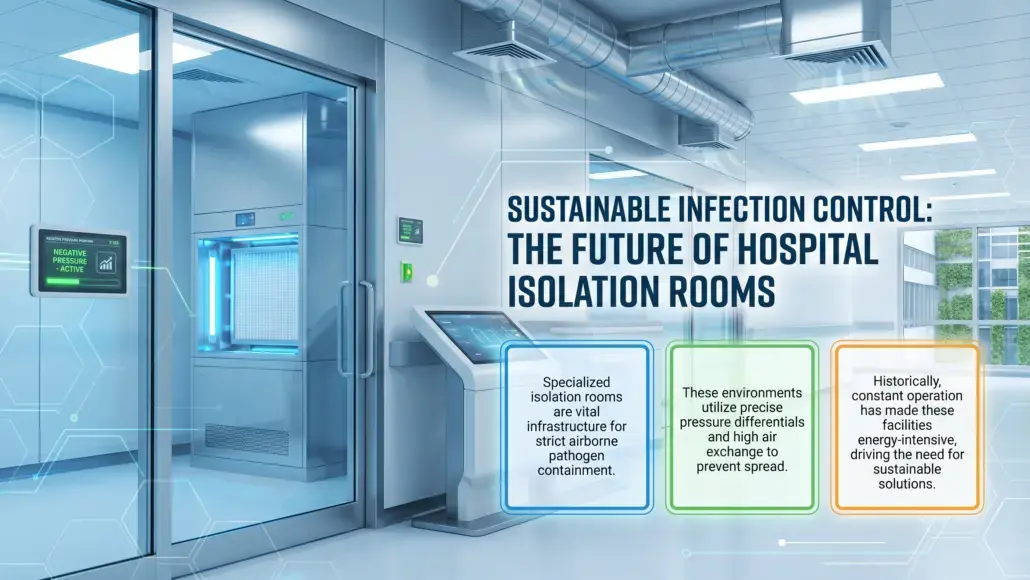
Maintaining strict infection control standards within modern healthcare facilities requires a significant commitment to specialized infrastructure, specifically regarding airborne containment. Isolation rooms are essential components of hospital architecture, designed to prevent the spread of infectious pathogens by utilizing pressure differentials and high air exchange rates. Historically, these environments have been notorious for their high energy consumption due to the constant operation of powerful supply and exhaust fans required to maintain negative or positive pressure environments. As hospitals worldwide face mounting pressure to reduce carbon footprints and operational costs, the implementation of low-energy isolation rooms has emerged as a vital strategy for balancing clinical safety with environmental responsibility. This shift represents a transition from brute-force ventilation methods to more intelligent, responsive systems that prioritize energy conservation without compromising the integrity of the clinical environment. The integration of these systems is no longer a luxury but a necessity for facilities aiming to provide high-quality care in an era of fiscal constraint and environmental awareness. By re-evaluating the fundamental mechanics of air handling, hospital engineers can deliver spaces that are both safer for patients and more sustainable for the institution’s long-term operations.
The Technical Evolution of Airborne Infection Isolation
The design of isolation suites has traditionally followed a prescriptive model that prioritizes safety at any cost. For decades, the standard approach involved static, high-volume airflow that remained constant regardless of occupancy or actual risk levels. This resulted in significant energy waste, as fans operated at maximum capacity even when the rooms were empty or when the patients housed within did not present a high risk of aerosolized transmission. The emergence of low-energy isolation rooms signals a move toward more dynamic engineering solutions. These modern designs incorporate advanced sensors and automation that allow the building management system to modulate airflow based on real-time environmental data. By moving away from fixed air changes per hour toward a demand-controlled model, hospitals can achieve substantial reductions in electrical load while ensuring that the physical barriers to infection remain intact. The sophistication of these sensors allows for a level of granularity that was previously impossible, tracking variables such as particulate counts and carbon dioxide levels to ensure the air remains clean and fresh.
Safety remains the paramount concern in these high-stakes environments. The technical evolution involves not just the fans and ductwork but also the sophistication of the monitoring equipment. Differential pressure sensors have become more accurate, allowing for tighter control over the negative pressure required to keep pathogens contained within the room. When these sensors detect a drop in pressure due to a door opening or a change in external atmospheric conditions, the system can rapidly compensate. The ability of low-energy isolation rooms to maintain this level of precision while using less power is a testament to the advancements in digital control algorithms and high-efficiency motor technology. These systems are now capable of fine-tuning the balance between supply and exhaust air to within a fraction of a percent, ensuring that the necessary protective environment is maintained with surgical precision. This precision also reduces the wear and tear on mechanical components, extending the lifecycle of the equipment and further reducing the total cost of ownership for the hospital.
Balancing Ventilation Requirements with Power Efficiency
One of the primary challenges in designing efficient isolation environments is the requirement for high-efficiency particulate air (HEPA) filtration. These filters create significant static pressure within the ventilation system, requiring fans to work harder to push air through the dense media. In traditional designs, this often led to an oversized mechanical plant that consumed excessive amounts of electricity. In the context of low-energy isolation rooms, engineers are now selecting specialized filters with lower initial resistance and larger surface areas. This modification reduces the energy required to achieve the necessary filtration standards. Additionally, the use of electronically commutated (EC) motors in fan units allows for more efficient operation at partial loads, which is where isolation rooms spend a significant portion of their operational life. These motors can adjust their speed based on the specific pressure needs of the moment, avoiding the inefficiencies of constant-speed motors that must be throttled by dampers.
The integration of heat recovery systems is another critical factor in reducing the thermal load associated with these specialized spaces. Because isolation rooms typically require a high percentage of outdoor air to prevent the recirculation of contaminants, the energy required to heat or cool this air can be immense. Modern low-energy isolation rooms often utilize run-around coil systems or other specialized heat exchangers that can recover thermal energy from the exhaust air stream without any risk of cross-contamination. This allows the facility to pre-condition the incoming supply air using energy that would otherwise be wasted. By addressing both the electrical load of the fans and the thermal load of the air conditioning, hospital managers can achieve a holistic reduction in the energy intensity of their critical care infrastructure. This approach not only saves money but also enhances the comfort of the patients, as the systems can more accurately maintain the desired temperature and humidity levels within the suite.
Innovations in Variable Air Volume Technology
The implementation of variable air volume (VAV) systems specifically tailored for healthcare applications is a cornerstone of modern efficiency efforts. In the past, VAV was often avoided in isolation rooms due to concerns about maintaining pressure stability during airflow transitions. However, contemporary control systems have overcome these hurdles. By using fast-acting actuators and precise airflow measuring stations, low-energy isolation rooms can now adjust their ventilation rates in response to specific triggers. For example, when a room is in a standby state, the ventilation can be reduced to a minimum safe level, providing significant energy savings during periods of low census. When a patient is admitted, the system can quickly ramp up to the required clinical standards, providing the necessary protection instantly. This responsiveness ensures that the hospital is never paying for more ventilation than is strictly required by the current clinical situation.
These innovations also extend to the way air is distributed within the patient room itself. Displacement ventilation and laminar flow systems are being refined to provide more effective contaminant removal with lower total air volumes. By carefully controlling the path of the air from the supply point to the exhaust grille, engineers can ensure that pathogens are swept away from the patient and clinical staff more efficiently. This focused approach to air movement means that the total number of air changes can sometimes be optimized, leading to further energy reductions. The success of low-energy isolation rooms depends on this synergy between mechanical hardware and intelligent software, creating a responsive environment that protects both the patient and the hospital’s operational budget. The use of computational fluid dynamics (CFD) during the design phase allows engineers to visualize these air patterns and optimize the placement of grilles and furniture to minimize dead zones where contaminants could accumulate.
Integrating Isolation Suites into Green Hospital Certification
The drive toward sustainable healthcare is often quantified through certification programs such as LEED or BREEAM. These frameworks place a heavy emphasis on energy performance and indoor environmental quality. Isolation rooms, due to their inherent energy intensity, were historically seen as a hindrance to achieving top-tier certification. The development of low-energy isolation rooms has changed this perception. By demonstrating that even the most critical clinical spaces can be operated efficiently, hospital administrators can earn significant points toward their sustainability goals. This integration is not merely about prestige; it reflects a deeper commitment to the concept of “do no harm,” extending that philosophy from individual patient care to the broader environment and public health. A sustainable hospital is a healthier hospital, providing a cleaner environment for the community it serves.
The data generated by these advanced isolation systems provides valuable insights for facility managers. By monitoring the energy consumption and performance of isolation suites through a centralized building management system, hospitals can identify opportunities for further optimization across the entire campus. The lessons learned from implementing low-energy isolation rooms can be applied to other energy-intensive areas, such as operating theaters and intensive care units. This cascading effect of efficiency improvements helps to build a more resilient and sustainable healthcare infrastructure. As energy costs continue to rise and environmental regulations become more stringent, the adoption of these advanced technologies will transition from being an optional upgrade to a fundamental requirement for modern hospital management. The focus on sustainability ensures that the hospital remains a leader in community health, both through clinical excellence and environmental stewardship. By embracing these changes, healthcare leaders can ensure their facilities are prepared for the challenges of the future while maintaining the highest standards of patient safety today.
The continued refinement of isolation room technology is essential for the future of healthcare. As new infectious threats emerge, the need for reliable containment will only grow. At the same time, the global imperative to reduce energy consumption and mitigate climate change requires that we rethink how these spaces are built and operated. The development of low-energy isolation rooms represents a successful convergence of these two critical needs. By utilizing sophisticated controls, high-efficiency mechanical components, and innovative design strategies, the healthcare industry is proving that it can protect its most vulnerable patients while also protecting the planet. This balanced approach is the hallmark of a truly modern and responsible healthcare facility, ensuring long-term viability and operational excellence in an increasingly complex global environment. The investment in these advanced systems pays dividends not only in reduced utility bills but also in the enhanced reliability and safety of the hospital’s most critical infection control infrastructure.