
















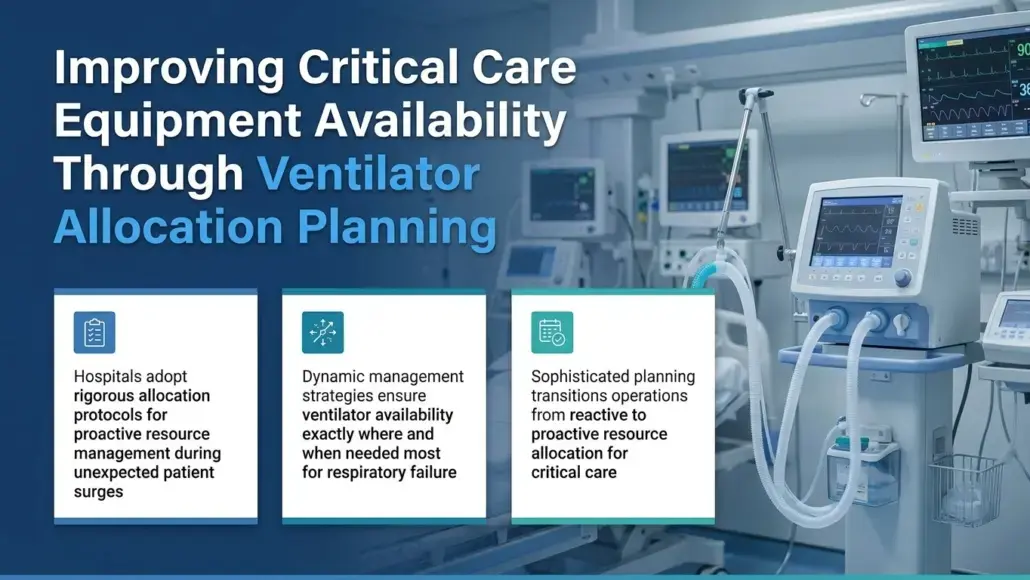

The management of critical care resources is a fundamental pillar of hospital operations, particularly during periods of unexpected patient surges or large-scale public health emergencies. Ventilators, being the primary life-support tool for patients with respiratory failure, require a sophisticated and dynamic management strategy to ensure that they are available where and when they are needed most. The implementation of rigorous allocation planning protocols allows hospitals to transition from a reactive model of equipment retrieval to a proactive system of resource distribution. By identifying potential shortages before they occur and establishing clear pathways for equipment movement, healthcare facilities can significantly enhance the availability of these critical assets.
Effective critical care management relies on the ability to mobilize equipment across different units, such as the Intensive Care Unit (ICU), the Emergency Department, and step-down units. When allocation planning is integrated into the hospital’s daily operational cadence, it provides clinical leaders with the visibility required to make life-saving decisions under pressure. This planning process involves the continuous assessment of patient acuity levels, projected admissions, and the operational status of every ventilator in the building. Consequently, the hospital can maintain a high level of preparedness, ensuring that no patient is left without the necessary respiratory support due to logistical failures.
Strategic Distribution of Life-Support Technology
The strategic distribution of ventilators requires a deep understanding of the hospital’s clinical layout and the specific needs of different patient populations. Unlike mobile devices that can be easily moved between units, ventilators often require specialized connections and monitoring systems, making their relocation a complex logistical task. Effective allocation planning addresses these complexities by establishing pre-determined staging areas and rapid-response teams dedicated to the movement and setup of critical care technology. This structured approach minimizes the time required to expand ICU capacity and ensures that newly created beds are fully equipped and ready for patient occupancy.
Logistical coordination is further enhanced by the use of real-time asset tracking systems that provide an instantaneous view of ventilator locations and status. By combining location data with clinical demand projections, hospital administrators can identify “pockets” of underutilized equipment that can be redirected to high-pressure zones. This ability to redistribute assets in real-time is a critical component of a resilient healthcare system. Additionally, the data generated by these tracking systems allows for the identification of trends in equipment demand, enabling the hospital to refine its allocation strategies based on actual clinical usage patterns rather than anecdotal evidence.
Sustaining this level of readiness requires constant monitoring, where equipment idle-time analysis helps identify which units can be safely moved without compromising safety. By analyzing how long a ventilator sits unused in a particular unit, planners can determine whether it represents a necessary safety buffer or a redundant asset that could be better utilized elsewhere. This level of granular oversight ensures that the hospital’s critical care infrastructure is operating at peak efficiency, maximizing the utility of every life-support device in the inventory. By aligning resource availability with clinical demand, the institution can achieve superior patient outcomes while maintaining operational discipline.
Clinical Governance in High-Acuity Resource Management
The allocation of life-saving equipment involves significant ethical and clinical considerations, making a strong governance framework essential. A multidisciplinary committee, including intensivists, respiratory therapists, and hospital administrators, should oversee the allocation planning process to ensure that it aligns with the highest standards of patient care. This committee is responsible for establishing the criteria for equipment prioritization and ensuring that the distribution process is transparent, fair, and based on objective clinical data. Clear governance prevents the fragmentation of resources and ensures that the entire hospital operates as a unified system during a crisis.
Governance also extends to the maintenance and readiness of the ventilator fleet. A ventilator is only available for use if it is fully functional and meeting all safety specifications. The allocation plan must therefore include a rigorous schedule for preventative maintenance and rapid decontamination. By centralizing the oversight of these processes, the hospital can ensure that every device in the pool is ready for immediate deployment. This commitment to quality assurance reduces the risk of equipment failure at the bedside and builds confidence among clinical staff, who know that the technology they are using is safe and reliable.
Additionally, the integration of clinical decision support tools into the allocation process can provide clinicians with real-time guidance during periods of extreme demand. These tools can analyze patient data from the electronic health record to help prioritize equipment for those patients who are most likely to benefit from mechanical ventilation. While the final decision always rests with the clinical team, these data-driven insights provide a valuable layer of support during high-stress situations. By combining human expertise with sophisticated analytical tools, hospitals can ensure that their most critical resources are used in a way that maximizes the number of lives saved.
Operational Resilience and Surge Capacity Development
The ability to rapidly expand critical care capacity is a hallmark of an operationally resilient hospital. Allocation planning provides the blueprint for this expansion, identifying how non-traditional clinical areas can be repurposed and equipped to handle overflow patients. This might involve converting surgical recovery suites or specialized procedure rooms into temporary ICU beds. By having a pre-defined plan for the movement of ventilators and the necessary support staff, the hospital can scale its critical care services in a matter of hours rather than days. This agility is essential for maintaining continuity of care during mass casualty events or infectious disease outbreaks.
Surge capacity is not just about having enough machines; it is also about having the staff and consumables required to operate them. A comprehensive allocation plan accounts for the entire ecosystem of critical care, including the availability of respiratory therapists, specialized tubing, and oxygen supplies. By coordinating the movement of these resources alongside the ventilators, the hospital ensures that every new bed is a fully functional clinical environment. This holistic view of resource management prevents the formation of secondary bottlenecks that could undermine the effectiveness of the expanded capacity.
Likewise, the lessons learned from previous surges should be continuously integrated into the hospital’s allocation planning protocols. By conducting after-action reviews and analyzing data from periods of high demand, hospital leaders can identify weaknesses in their distribution systems and implement corrective measures. This iterative process of improvement ensures that the hospital’s resilience grows over time, making it better prepared for future challenges. The commitment to continuous learning and adaptation is a key characteristic of a high-performance healthcare organization, where the goal is to provide the highest level of care regardless of the external circumstances.
Financial and Technical Stewardship of Critical Assets
Ventilators represent a significant financial investment, and their long-term stewardship is a key concern for hospital leadership. Effective allocation planning contributes to this stewardship by ensuring that the equipment is used efficiently and maintained to the highest standards. By avoiding the need for emergency rentals or rushed purchases of additional units, the hospital can achieve substantial cost savings. Likewise, a well-managed fleet of ventilators has a longer operational life, providing a better return on investment and reducing the frequency of expensive capital replacement cycles.
Technical standardization is another important aspect of asset stewardship. By focusing the ventilator fleet on a few key models from reliable manufacturers, the hospital can simplify the training of clinical staff and the procurement of spare parts. This uniformity reduces the potential for clinical errors and streamlines the maintenance process for the biomedical engineering team. When equipment is moved between units as part of an allocation plan, clinicians can be confident that they are using a familiar device with a known operational profile. This consistency improves safety and reduces the cognitive burden on staff working in unfamiliar or temporary clinical settings.
Finally, the transparency provided by a centralized allocation system simplifies compliance with regulatory and accreditation standards. Agencies such as The Joint Commission require hospitals to have clear plans for the management of critical resources during emergencies. By maintaining detailed records of ventilator locations, maintenance history, and utilization rates, hospitals can easily demonstrate that they are meeting these requirements. This documentation also provides a valuable resource for internal audits and quality improvement initiatives, helping the hospital to continuously refine its operations and provide a safer environment for its most vulnerable patients. The transition to a data-driven, planned approach to resource allocation is a vital step in the evolution of modern critical care.
Future Directions in Automated Resource Allocation
The next phase of innovation in critical care resource management will likely involve the use of artificial intelligence and machine learning to automate the allocation process. By analyzing real-time data from the electronic health record, wearable sensors, and environmental monitors, AI systems could predict the need for mechanical ventilation before a patient’s condition deteriorates. This “early warning” capability would allow the allocation planning team to move a ventilator to the patient’s bedside in anticipation of their needs, further reducing delays and improving outcomes.
The development of “smart” ventilators that can communicate their status and location directly to a central management platform will also enhance the efficiency of allocation systems. These devices could automatically signal when they require maintenance or when a specific consumable is running low, allowing the logistics team to be proactive in their support. This level of connectivity creates a truly integrated clinical environment where technology and human expertise are closely aligned. By embracing these advancements, hospitals can ensure that their critical care services remain at the leading edge of medical technology and operational excellence.
Ultimately, the goal of allocation planning is to ensure that the hospital’s mission of providing high-quality care is never compromised by a lack of resources. By treating ventilators as a precious and dynamic asset that must be managed with the utmost precision, healthcare facilities can provide a higher level of safety and support to their patients. The commitment to operational discipline, data-driven decision-making, and continuous improvement is what sets the most successful hospitals apart. In the high-stakes world of critical care, having the right equipment in the right place at the right time is not just a logistical goal,it is a clinical imperative.