














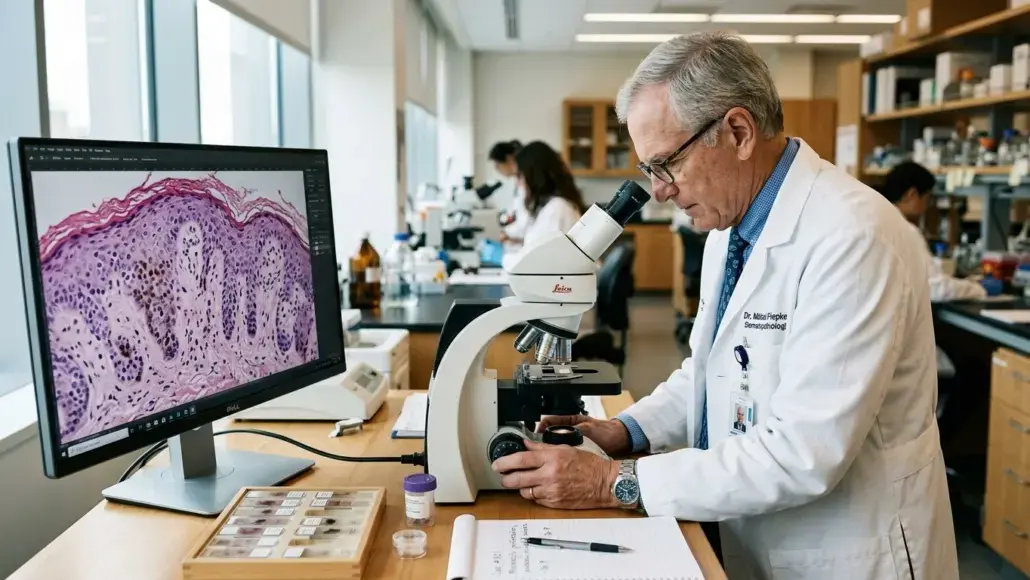

Modern dermatologic care often requires careful coordination between clinical observation and microscopic analysis. Dermatopathologist and melanoma researcher Dr. Michael Piepkorn has spent decades working within both domains, where the alignment between what is seen on the skin and what is identified under the microscope directly influences patient outcomes. His approach reflects a broader principle in medicine: neither clinical impression nor pathology interpretation should be considered in isolation when evaluating complex skin disease.
Clinical View and Microscopic Interpretation
In dermatology, visual examination is often the first diagnostic step. Patterns of pigmentation, lesion borders, and distribution across the body all contribute to clinical judgment. Even so, pathology offers a deeper level of analysis, revealing cellular architecture and molecular changes that are invisible to the naked eye.
Dr. Piepkorn has long emphasized that these two perspectives must be interpreted together. In his learned opinion, biopsy results gain meaning when placed alongside the clinical presentation that prompted them, rather than being treated as isolated findings.
The Limits of Isolated Pathology
Reliance on pathology alone carries inherent risk. A microscopic interpretation, no matter how precise, may not fully capture the broader clinical context. Lesions can evolve, sampling may be partial, and histologic features can overlap across conditions.
When pathology results are interpreted without reference to the patient’s presentation, the risk of misdiagnosis increases. This disconnect can lead to diagnostic and management complications, particularly in cases involving ambiguous or atypical lesions.
Communication as a Clinical Tool
To address these challenges, direct communication between the clinical provider and the pathologist becomes a critical component of care. This exchange allows for clarification, context, and, when needed, reconsideration of initial interpretations.
Dr. Piepkorn advocates for an active dialogue rather than a one-directional reporting process. When clinicians share detailed observations, including lesion history and visual characteristics, pathologists can improve the accuracy of their assessments.
Resolving Differences Between Clinical and Microscopic Findings
It is fairly common for a clinician to review a pathology report that doesn’t align with what is observed during examination. In these moments, passive acceptance of the report can lead to inappropriate management decisions.
To address these issues, Dr. Michael Piepkorn strongly advises immediate follow-up, preferably by direct call to the pathologist. This step creates an opportunity to revisit the case, compare findings, and identify potential discrepancies that may not have been evident in isolation.
Reevaluation and Advanced Testing
In Dr. Piepkorn’s experience, these conversations frequently lead to additional action. The original biopsy may be reexamined, sometimes with a fresh perspective or additional sections. In other cases, specialized testing may be introduced to clarify uncertain findings.
Techniques such as immunohistochemical staining or molecular analysis can also provide further detail, particularly in diagnostically challenging cases. This iterative process should be seen as a strength rather than a limitation, reflecting a commitment to accuracy through collaboration.
The integration of clinical dermatology and pathology isn’t merely a technical exercise but a practical necessity in patient care. As diagnostic tools continue to evolve, the need for thoughtful interpretation across disciplines remains constant. Dr. Michael Piepkorn continues to advocate for this integrated approach, reinforcing that meaningful diagnosis emerges from the alignment of observation, analysis, and communication.