











While the use of 3D printing technology in healthcare sector aims to make healthcare as affordable as possible for everyone, orthopedics and prosthetics have gained the spotlight among 3D printing device manufacturers. In addition to wide availability of technically advanced orthopedic prosthetics, escalating demand for custom-made orthopedic prosthetics is likely to push the growth of the global orthopedic prosthetics market in the next decade.
Although associated risks and technical complications are still creating a major roadblock in widespread adoption of orthopedic prosthetics, a new set of technological innovations holds the promise to positively influence the sales of orthopedic prosthetics in near future. One of the innovations includes 3D printed orthopedic prosthetics, which has been observed to impact the scenario for customized orthopedic prosthetic devices.
3D Printing Becomes Fast Track Technology for Tailor-made Orthopedic Prosthetics & Supports
Three-dimensional printing is identified to be a rapid way for manufacturing bespoke orthopedic supports and prosthetics, which efficiently compensate for a deformity, predominantly caused due to a lost limb or paralysis. 3D printed test sockets have already been registering a consistently positive feedback from patients, owing to the comfort, convenience, and well-fitting design. Handicap International (Humanity & Inclusion), a charity, has initiated the use of 3 dimensional printing technology in the making of customized orthopedic prosthetic devices. This technology aids in faster production of devices, and thus offers wider outreach.
Already having launched in developed economies, followed by significantly growing adoption, these bespoke device manufacturing technology is still in its nascent stage within developing economies, prominently due to supply-demand imbalance. A recent survey points out that a maximum of 5% of the total 15% patient population within emerging economies, who need a prosthetic support, brace, or limb, are currently able to get one. The charity is constantly emphasizing R&D along with clinical trials of 3D printed orthopedic prosthetics within developing countries with poor infrastructural settings. The NGO’s current program, which is gaining enormous funds, has also offered free made-to-measure 3D orthopedic prosthetic devices to hundreds of patients.
While 3D printing is being perceived as a revolutionary method for orthopedic doctors located in remote areas or conflict zones, as the scanner involved in this process is compact, portable, and convenient to use. However, high price point associated with the manufacturing of these orthopedic prosthetic devices will continue to limit adoption over the next few years.
Reimbursement Scenario Plays a Crucial Role in Pushing Adoption
Rising instances of accidental injuries and growing prevalence of arthritis, have been the key factors fueling the demand for orthopedic prosthetic devices, over the years. Increasing adoption of advanced technology and customized implantable products will also push the market for orthopedic prosthetics in next few years. Favorable reimbursement policies for orthopedic prosthetics will continue to keep the market up in developed economies. However, the market for orthopedic prosthetics within emerging economies is anticipated to thrive at a relatively moderate pace, owing to inadequate reimbursement scenario and lower awareness about the advances and availability of orthopedic prosthetic devices.
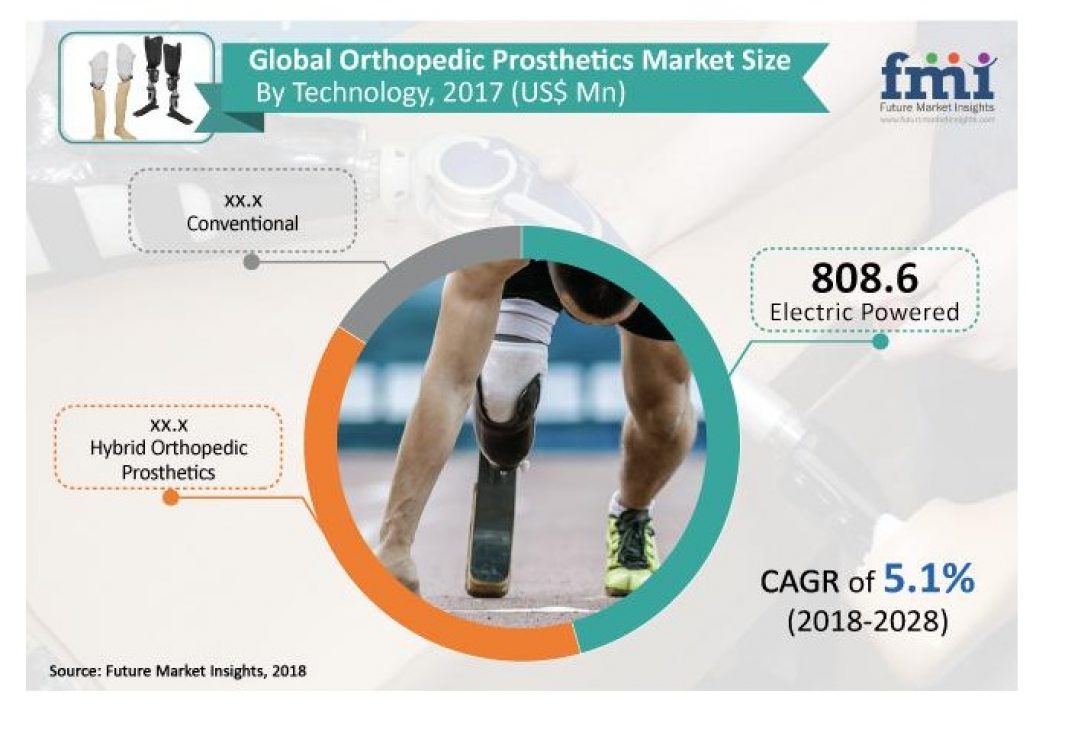
As indicated by a recently released market research intelligence report, the global market value for orthopedic prosthetics will possibly cross the mark of US$ 3 billion by the end of 2028. During the projection period 2018-2028, the global orthopedic prosthetics market is expected to witness progressive expansion at a CAGR of 5.1%.
The prices of 3D printed orthopedic prosthetics will possibly witness a dramatic fall in near future, provided that the trials go well and prove to be successful among a considerably large patient population, already using 3D orthopedic prosthetics. It remains to be seen yet, to what extent the innovation in 3D printing will impact the existing options available in orthopedic prosthetic devices. Will growing popularity and adoption of 3D printing technology among orthopedic prosthetic device manufacturers set the global orthopedic prosthetics market at a higher momentum?
These insights are based on an Orthopedic Prosthetics Market report by Future Market Insights