














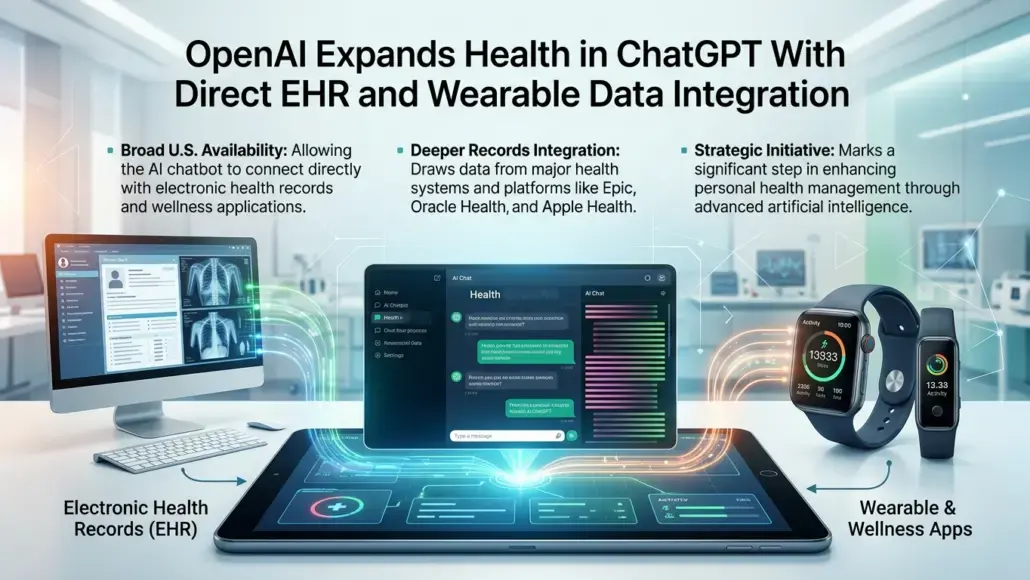

OpenAI has made its Health in ChatGPT feature broadly available to U.S. users, allowing the artificial intelligence chatbot to connect directly with electronic health records (EHRs) and wellness applications. Announced on Thursday, this rollout facilitates a deeper medical records integration by allowing ChatGPT to draw upon data from major health systems connected to Epic and Oracle Health, as well as platforms like One Medical, Function Health, and Apple Health. The initiative marks a strategic shift for OpenAI, moving the tool from a general-purpose question-and-answer interface toward a personalized health companion capable of synthesizing fragmented data from patient portals, wearables, and clinical notes.
According to OpenAI, more than 300 million people now use ChatGPT for health-related queries each week, up from 230 million in January. The expanded feature is designed to help users prepare for doctor appointments and navigate complex health information by providing context-aware summaries of changes in activity, sleep, or lab results. While OpenAI executives emphasized that ChatGPT is not intended for diagnosis or treatment and should not replace professional medical judgment, the tool’s ability to consolidate scattered data points is positioned as a solution for patients facing short appointment times and fragmented care delivery systems.
Enhanced Performance Through Specialized Medical Models
The broad release of Health in ChatGPT is supported by significant performance gains in OpenAI’s latest models. GPT-5.6 Sol, the version available to paid subscribers, is described as the company’s strongest model for health applications, demonstrating advanced reasoning across complex clinical details and lab results. For users on the free plan, GPT-5.5 Instant has also seen improvements in recognizing the need for urgent care and explaining medical uncertainty. These models have been evaluated against HealthBench Professional, a benchmark for AI performance on challenging medical tasks, where every GPT-5.6 model reportedly outperformed the previous GPT-5.5 iteration.
To ensure clinical accuracy and safety, OpenAI collaborates with a global network of hundreds of physician advisors across 60 countries. These professionals evaluate the models using realistic, “messy” health scenarios to test for accuracy, context awareness, and appropriate escalation to emergency care. Ashley Alexander, VP of Health Products at OpenAI, noted that the latest models correctly recommend immediate emergency care over 99 percent of the time when required, while also avoiding unnecessary escalations at a similar rate. This rigorous evaluation framework is central to the company’s “evidence generation ladder” as it moves deeper into the regulated healthcare space.
Privacy Frameworks and Industrial Scalability
As OpenAI deepens its medical records integration, the company has implemented layered privacy and security safeguards to manage sensitive information. All conversations within the Health feature are encrypted both at rest and in transit, with additional protections applied to connected clinical data. Crucially, OpenAI stated that medical records and Apple Health information connected through the feature are not used to train its foundation models or to target advertisements. Users maintain granular control over their data, with the platform requiring explicit permission before accessing connected records to personalize a response, and users can disconnect their information at any time.
The decision to integrate these features into the main ChatGPT interface, rather than a separate health-specific space, followed feedback from early testers. OpenAI’s health product team found that more than 70 percent of users preferred conducting health conversations within their existing chats, suggesting that users view their health as an inseparable part of their daily digital routines. By removing the friction of a separate experience, OpenAI is positioning ChatGPT as a centralized hub for personal data management. As the biopharmaceutical and clinical sectors increasingly explore the utility of generative AI, OpenAI’s move to secure direct EHR access could set a new standard for how consumers interact with their longitudinal health data.