











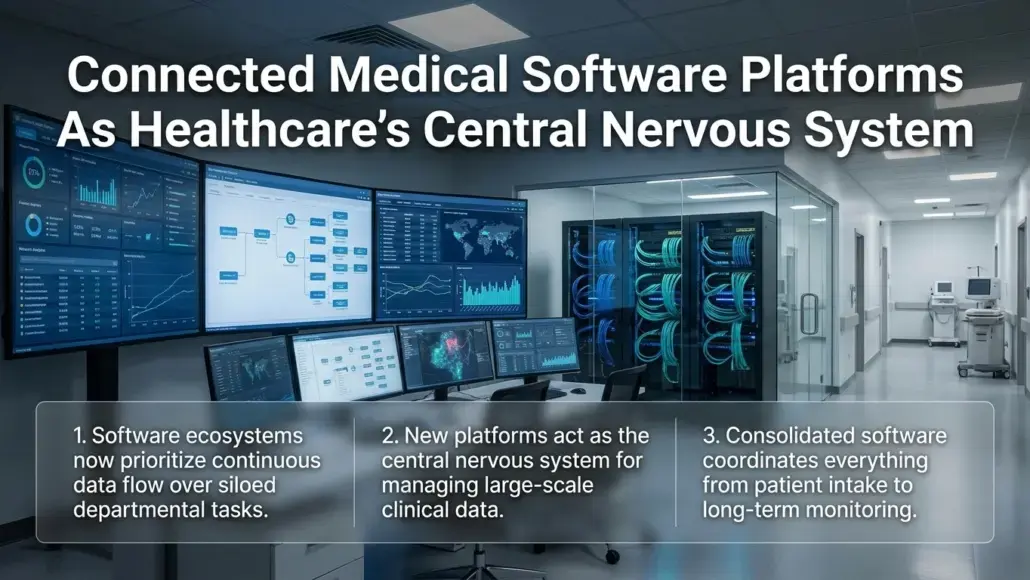

Modern healthcare facilities are increasingly moving toward software-defined ecosystems where data flow is prioritized over isolated departmental tasks. The adoption of sophisticated medical software platforms represents a fundamental shift in how clinical providers manage large-scale data sets and patient records. These platforms serve as the central nervous system for hospitals, coordinating everything from initial patient intake to long-term post-operative monitoring. By consolidating disparate data streams into a unified interface, health systems can reduce the administrative burden on clinicians while improving the precision of care delivery. The primary goal of these digital implementations is to foster connected healthcare operations that link pharmacy systems, laboratory results, and electronic health records into a single, accessible repository. As the volume of medical data continues to grow, the reliance on stable, scalable software architectures becomes a necessity rather than a luxury for high-performing medical centers. The transition to digital-first environments is driven by the need for real-time visibility into patient status and resource allocation. Traditional methods of data entry and retrieval often lead to bottlenecks that can delay critical treatments or result in medication errors. By implementing centralized software solutions, healthcare administrators can gain a comprehensive view of the entire facility, identifying areas where efficiency can be improved. These systems are designed to handle the complexities of multi-site operations, providing a consistent user experience for medical staff regardless of their physical location. This level of connectivity is essential for managing the growing demands of aging populations and the increasing prevalence of chronic diseases that require continuous coordination between primary care and specialized departments.
Interoperability Through Standardized Data Protocols
Achieving true connectivity within a medical facility requires a deep commitment to data standardization and interoperability. Medical software platforms must be able to communicate across different manufacturers and legacy systems to ensure that a patient’s medical history is always available to the treating physician. The use of Fast Healthcare Interoperability Resources (FHIR) and Health Level Seven International (HL7) protocols has become the industry standard for facilitating this exchange. These protocols provide the grammatical structure for data, allowing different software modules to interpret and process information without manual translation. When platforms adhere to these rigorous standards, they enable connected healthcare operations to function without the risk of data silos forming between specialized clinical units like radiology and oncology. Standardization also facilitates the integration of third-party applications that offer specialized analytical tools or patient engagement features. A platform that supports open application programming interfaces (APIs) allows a hospital to customize its digital toolkit based on specific clinical needs. For example, a cardiology department might integrate a specific rhythm analysis tool into the broader hospital platform, ensuring that the results are instantly visible in the patient’s main chart. This modular approach to healthcare software ensures that institutions are not locked into a single vendor’s ecosystem, fostering an environment of innovation and continuous improvement. The ability to swap or upgrade individual components without disrupting the entire clinical workflow is a significant advantage of modern, interoperable platform designs. Standardized data protocols are also essential for participating in regional or national health information exchanges. These exchanges allow for the secure sharing of patient data between different health systems, ensuring that emergency room doctors have access to vital information even if the patient is far from their home facility. The software platforms acting as the gateway for this information must maintain high levels of data accuracy and latency management to be effective. As healthcare becomes more decentralized, the role of these platforms in maintaining a coherent patient narrative across the continuum of care will only increase in importance.
Cloud Orchestration for Enterprise Scalability
Cloud-based orchestration has revolutionized the way medical software platforms are deployed and maintained, offering the elasticity required to handle sudden surges in clinical data traffic. By utilizing cloud-hosted services, healthcare organizations can reduce the physical footprint of their data centers while gaining access to advanced computing power. These cloud-based medical software platforms supporting connected healthcare operations provide a foundation for growth that is not limited by local hardware constraints. Centralized cloud management also simplifies the process of software updates and security patching, ensuring that every clinician is working with the most current clinical guidelines and that the system remains compliant with evolving privacy laws. The reduction in localized IT maintenance allows hospital staff to focus more on patient-facing activities, while the redundancy offered by cloud providers enhances disaster recovery capabilities. Instead of making large capital investments in physical hardware, healthcare providers can adopt a subscription-based model that aligns their expenses with their actual usage, providing greater financial flexibility for the institution.
Cybersecurity and Data Integrity in Digital Environments
As healthcare operations become more connected, the surface area for potential cyber threats increases exponentially. Protecting sensitive patient information is not only a legal requirement under frameworks like HIPAA and GDPR but also a fundamental component of patient trust. Medical software platforms must incorporate multi-layered security protocols, including end-to-end encryption, multi-factor authentication, and continuous monitoring for suspicious activity. A single data breach can have devastating consequences for a healthcare organization, ranging from financial penalties to a complete loss of institutional reputation. Therefore, cybersecurity must be treated as a core feature of the platform rather than an optional add-on. Maintaining data integrity is equally important as data security. Clinicians rely on the accuracy of the information provided by their software platforms to make life-altering decisions. If a laboratory result is mislabeled or a medication dosage is incorrectly recorded due to a software glitch, the patient’s safety is at immediate risk. Modern platforms utilize advanced validation techniques and audit trails to ensure that every piece of data is tracked from its point of origin to its final entry in the clinical record. This transparency allows for rapid identification and correction of errors, minimizing the risk of adverse clinical outcomes. The implementation of blockchain or other distributed ledger technologies is also being explored as a method for creating immutable records of medical transactions, further enhancing the reliability of digital health data. Regular security audits and penetration testing are essential practices for any organization managing connected healthcare operations. These assessments help identify vulnerabilities before they can be exploited by malicious actors. Additionally, the human element of cybersecurity cannot be ignored; medical staff must be trained to recognize phishing attempts and follow strict protocols for data access. A platform that includes built-in training modules and role-based access controls can significantly reduce the risk of internal data leaks or accidental exposures. By fostering a culture of security awareness, healthcare providers can ensure that their digital tools remain a safe and effective component of their clinical practice.
Enhancing Clinical Workflow Efficiency via Platform Integration
The primary value of any medical software platform lies in its ability to streamline clinical workflows and reduce the time spent on administrative tasks. When software modules for scheduling, billing, and clinical documentation are fully integrated, the duplication of data entry is eliminated. This not only saves time but also reduces the likelihood of clerical errors that can complicate the billing process or delay patient discharge. An integrated platform allows for a smoother transition of patients through the various stages of care, from the initial consultation to the final follow-up appointment. Clinicians often experience “alert fatigue” when bombarded with too many notifications from disconnected systems. A sophisticated software platform can aggregate these alerts and prioritize them based on clinical urgency, ensuring that the most critical information reaches the physician immediately. For instance, a platform might filter out non-essential system notifications while highlighting a critical change in a patient’s vitals or a potential drug-drug interaction. This intelligent filtering allows medical staff to maintain their focus on the patient, improving both the quality of care and the overall job satisfaction of the healthcare workforce. The reduction of cognitive load is a key benefit of medical software platforms supporting connected healthcare operations. Platform integration also extends to the patient experience through the use of patient portals and mobile health applications. These tools allow patients to view their test results, schedule appointments, and communicate with their care team directly from their personal devices. By empowering patients to take an active role in their own healthcare, these platforms can improve adherence to treatment plans and lead to better long-term health outcomes. The data generated by these patient-facing tools can also be fed back into the main hospital system, providing clinicians with a more complete picture of the patient’s health status outside of the clinical setting.
Future Directions for Data-Driven Decision Support
The next frontier for medical software platforms is the widespread adoption of artificial intelligence and machine learning to provide real-time clinical decision support. These technologies can analyze vast amounts of historical and real-time data to identify patterns that might be invisible to the human eye. For example, a machine learning algorithm could detect early signs of sepsis in a patient by monitoring subtle changes in their heart rate and blood pressure over several hours. By alerting the care team to these changes before they become critical, the platform can facilitate earlier interventions and significantly improve survival rates. Data-driven decision support also plays a role in population health management. By analyzing data across entire patient populations, healthcare providers can identify trends and allocate resources more effectively. For instance, a health system might use its software platform to identify geographic areas with high rates of uncontrolled diabetes and then deploy targeted community health initiatives to address the problem. This proactive approach to healthcare shifts the focus from treating illness to maintaining wellness, potentially reducing the overall burden on the healthcare system. The integration of social determinants of health data into these platforms will further enhance their ability to provide personalized care recommendations that take into account the patient’s environment and lifestyle. As we look toward a future where integrated medical hardware and software supporting smart care becomes the norm, the role of central software platforms will evolve to become even more sophisticated. These systems will not only manage data but also orchestrate the actions of automated systems and robotic assistants within the clinical environment. The synergy between high-level software management and physical medical devices will create a truly smart care environment where technology acts as a force multiplier for human expertise. Maintaining the stability and security of these platforms will remain the top priority for health IT leaders as they address the complexities of modern medical practice. The continued evolution of connected healthcare operations will be defined by the ability to turn massive data sets into actionable insights that improve the lives of patients and clinicians alike.